Custom racking is one of the highest-leverage decisions in warehouse equipment procurement. Standard racking configurations work well for approximately 60 percent of warehouse projects, but the remaining 40 percent — non-standard pallets, unusual loads, tight building constraints, or industry-specific handling requirements — need custom engineering to achieve the storage density, safety, and operational performance the project targets.
Custom racking is not simply standard racking in different dimensions. It involves structural engineering, material selection, load verification, coating specification, and often bespoke accessories designed for a specific product or handling method. Done well, custom racking delivers 20 to 40 percent more usable storage capacity than standard alternatives and eliminates operational compromises that would otherwise persist for the equipment lifecycle. This guide explains what can be customized, when custom is the right choice, the customization process from specification to installation, and how to select a manufacturer capable of delivering it.
What Is Custom Racking?
Custom warehouse racking is a storage system engineered to project-specific requirements — dimensions, load capacity, material, coating, configuration, or accessories — rather than assembled from standard catalog components. Custom racking may be a modified version of a standard system (adjusted beam length, unusual upright height) or a fundamentally different structure engineered from the ground up for a specific product, industry, or building constraint.
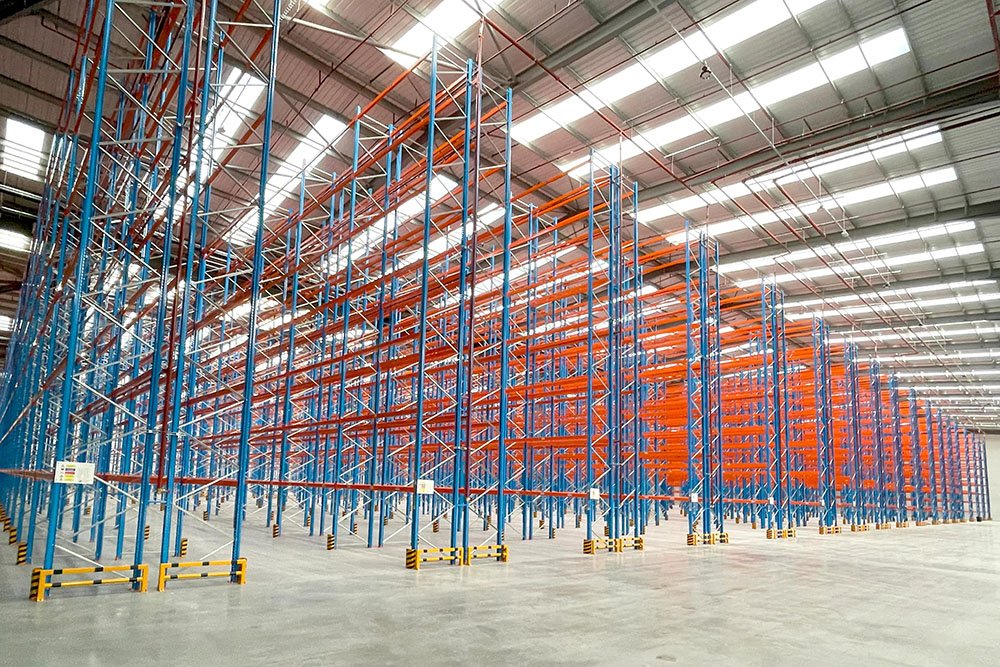
Custom racking projects typically involve four levels of customization:
- Dimensional customization — non-standard beam lengths, upright heights, frame depths, or bay sizes to match pallet, product, or building constraints
- Structural customization — reinforced sections, alternative bracing patterns, or higher-grade steel to handle unusual loads or seismic requirements
- Functional customization — accessories such as dividers, sloped beams, or specialty support surfaces for specific products
- Systematic customization — fundamentally different rack architecture for specialized applications such as mold racking, coil racking, or fabric racking
The level of customization required determines the engineering effort, lead time, and cost — but also the operational value delivered when the system matches the actual requirements of the warehouse.
When to Choose Custom Racking Over Standard Racking
Not every project needs custom racking. Standard racking is faster to procure, less expensive per pallet position, and easier to modify later. Custom racking is justified when one or more of the following conditions apply:
Non-standard pallet or product dimensions. Pallets larger than 1,200 × 1,000 mm, longer than 2,400 mm, or with unusual footprints (drums, coils, molds) require custom beam spans, frame depths, or support surfaces.
Unusual load characteristics. Point loads, live loads, unstable loads, or ultra-heavy loads (above 3,000 kg per pallet) often exceed standard racking capacity or require reinforced structural design.
Restrictive building constraints. Low clear height, tight column grids, unusual bay geometries, or seismic zones may require dimensionally adjusted or structurally reinforced racking.
Industry-specific handling requirements. Automotive coils, textile rolls, chemical drums, and molds all require accessories or configurations that standard pallet racking cannot provide.
Integration with automation. Semi-automated shuttle systems, ASRS integration, or WMS-guided picking often require dimensional precision beyond standard tolerances.
Regulatory or client compliance. Some end-customers or industries require racking built to specific standards, dimensions, or documentation packages that standard product lines cannot meet.
For projects that fit one or more of these conditions, custom racking typically produces net savings across the equipment lifecycle even at 15 to 30 percent higher initial cost.
What Can Be Customized
Understanding the customization options helps buyers specify what they actually need and identify what a supplier is capable of delivering.
Dimensional Customization
- Beam length — bay widths from 1,200 mm to 4,500 mm or more
- Upright height — frame heights from 2 meters to 30 meters and above
- Frame depth — matched to pallet depth (typically 600 mm to 1,500 mm)
- Beam profile — box, step, or C-profile matched to load and deck requirements
- Beam pitch — beam-level spacing adjusted to product height plus working clearance
Structural Customization
- Steel grade — standard Q235B upgraded to Q345B or higher for heavier loads
- Column thickness — 1.5 mm, 2.0 mm, 2.5 mm, or 3.0 mm cold-rolled sections
- Bracing pattern — Z-bracing, K-bracing, or D-bracing adjusted for load and seismic requirements
- Base plate size — enlarged base plates and additional anchoring for point-load or seismic conditions
- Connector design — multi-tab hook-in, bolted, or welded connectors matched to structural demand
Material and Coating Customization
- Standard powder coating — general-purpose ambient environments
- Hot-dip galvanized — outdoor, cold storage, or corrosive environments
- Electro-galvanized + powder coating — enhanced corrosion protection at moderate cost
- Stainless steel — food-grade, pharmaceutical, or clean-room applications
- Custom colors — brand alignment, safety visibility, or client specification
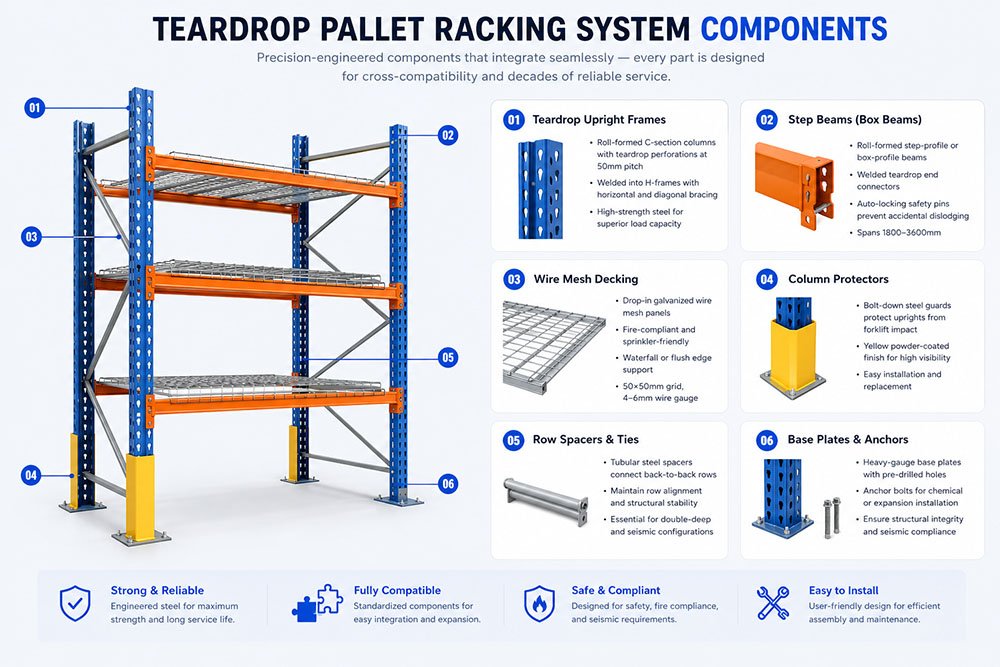
Accessory Customization
- Wire mesh decking — for non-palletized loads, sprinkler compliance, or fine goods
- Pallet support bars — for damaged pallets, non-standard footprints, or additional load distribution
- Column protectors and rack guards — impact protection sized to forklift type
- Product dividers — vertical or horizontal separators for specific SKUs
- Sloped beams or shelves — for rolling products (tires, drums, coils)
- Drawer or pull-out systems — for molds, tools, or heavy items requiring easy access
For a fuller inventory of what can be added to a system, see pallet rack accessories and components.
Configuration Customization
- Single-deep, double-deep, or triple-deep — density vs selectivity trade-off
- Drive-in vs drive-through — LIFO vs FIFO variants
- Narrow aisle vs VNA — density optimization by forklift type
- Cantilever configurations — single-sided, double-sided, adjustable-arm
- Mezzanine integration — rack-supported vs steel-structure mezzanines
- Shuttle-ready configurations — dimensional tolerances for automated shuttle carriers
Industry-Specific Customization
Specialized racking exists for products that standard pallet systems cannot handle:
| Product Type | Customization Focus | Reference Product |
|---|---|---|
| Tires | Sloped or arm-based supports, stacking bases | Tire storage racks |
| Pipes and tubes | Cantilever with divided compartments | Pipe storage racking |
| Steel coils | Reinforced cradles, high-load bases | Coil racking |
| Fabric rolls | Vertical or horizontal rack with soft supports | Fabric storage racks |
| Drums | Angled support surfaces, spill containment | Drum storage racks |
| Chemicals | Corrosion-resistant coatings, spill containment | Chemical storage racks |
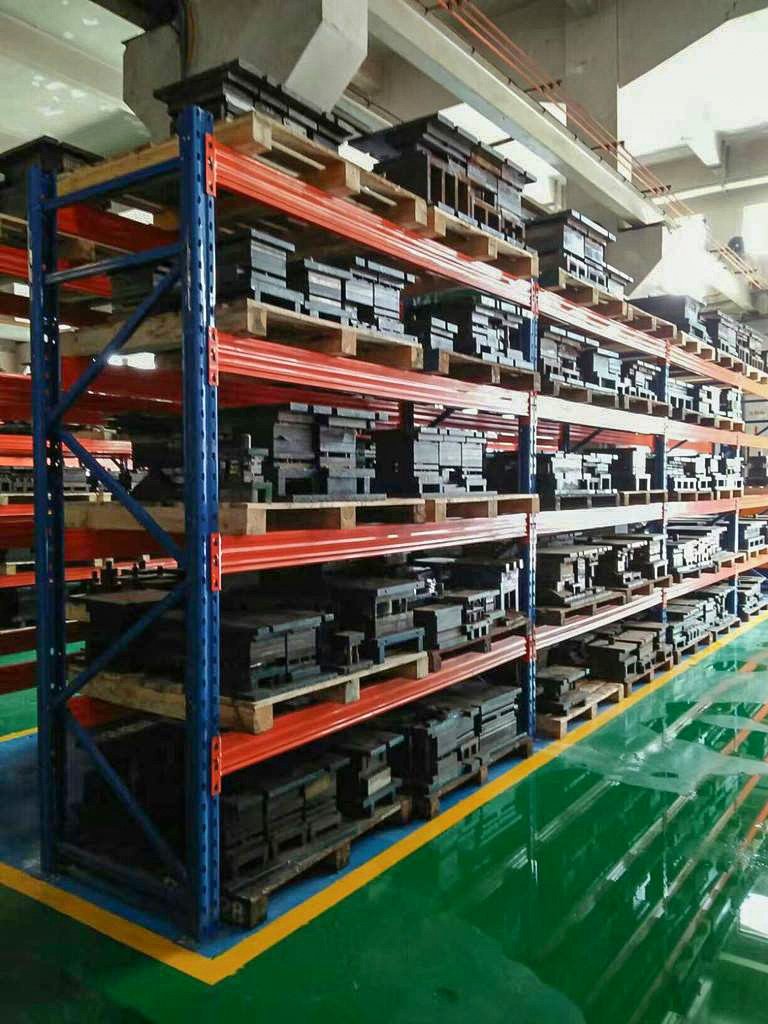
| Molds | Drawer systems, ultra-heavy-duty structures | Mold racking |
The Custom Racking Design Process
Custom racking projects follow a structured process from initial requirement gathering to installation. Skipping steps at the front end creates expensive rework downstream.
Step 1 — Requirement Gathering
The manufacturer collects the operational profile: pallet or product dimensions, weight, quantity, throughput, rotation method, forklift type, and destination market. Building drawings, floor plans, and clear-height measurements complete the picture.
Step 2 — Site Assessment
For complex projects, on-site or virtual assessment verifies column grid, floor loading, clear height, door positions, sprinkler layout, and any obstructions that constrain rack layout. Assumptions made without site verification frequently fail at installation.
Step 3 — Load and Structural Analysis
Engineers calculate load capacity requirements at beam, upright, and base plate levels. Live loads, seismic loads, and impact factors are modeled. The output is a structural specification confirming that the intended design will safely carry the intended loads with appropriate safety margin. For industrial rack design context, the Rack Manufacturers Institute (RMI) is a useful reference for steel storage rack systems.
Step 4 — CAD Drawing and 3D Layout
The manufacturer produces detailed CAD drawings and 3D layouts showing rack dimensions, bay configuration, aisle widths, and building integration. Load notices, safety clearances, and forklift envelopes are verified against building constraints.
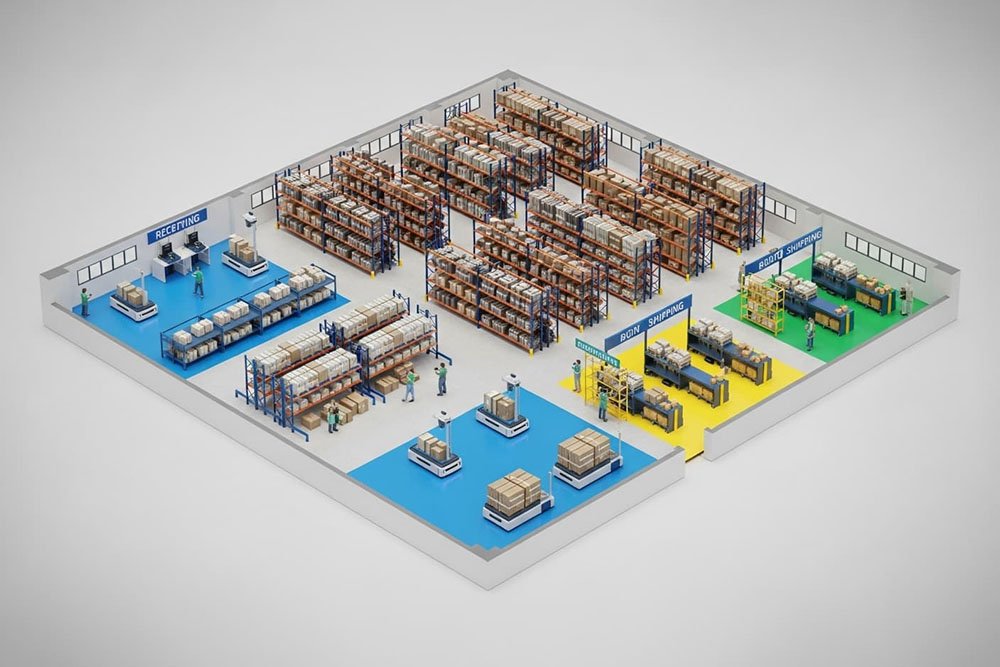
Step 5 — Buyer Review and Approval
The buyer reviews drawings, load calculations, material specifications, and installation plan. Revisions are made based on operational feedback. Final approval releases the project into production.
Step 6 — Prototype or Sample (for large or complex orders)
For high-volume or complex custom projects, a prototype bay or sample unit is fabricated first. This verifies dimensional accuracy, assembly quality, and load performance before releasing full production.
Step 7 — Manufacturing
Production runs through steel processing, cold roll forming, welding, coating, and quality inspection. Custom projects typically require dedicated production runs rather than mixing with standard product batches. See the overview of the rack manufacturing process for detail on each stage.
Step 8 — Packaging and Shipping
Custom racking is packaged for container-optimized shipping. Documentation includes assembly instructions, load notices, safety warnings, and material certifications.
Step 9 — Installation and Commissioning
Installation follows the approved layout, with load notices posted at each bay and safety clearances verified. Post-installation inspection confirms structural performance and readiness for use.
Standard vs Custom Racking Comparison
| Dimension | Standard Racking | Custom Racking |
|---|---|---|
| Design Time | 1–2 days | 1–4 weeks |
| Manufacturing Lead Time | 15–25 days | 30–60 days |
| Unit Cost | Baseline | +15–30% |
| Storage Fit | ~60% of projects | ~40% requiring optimization |
| Engineering Support | Load charts only | Full structural analysis |
| Modification Flexibility | High (standardized parts) | Moderate (matched to design) |
| Documentation | Standard load notices | Structural calc report + CAD |
| Suitable for Automation | Limited | Yes, dimensional tolerance controlled |
Selecting a Custom Racking Manufacturer
Not every racking manufacturer is equipped for custom projects. Key capabilities to verify:
Engineering capacity. In-house structural engineers, CAD teams, and 3D modeling capability — not just sales staff modifying catalog products.
Material sourcing flexibility. Ability to source Q235B, Q345B, structural steel, and stainless steel from certified mills with traceable material certificates.
Manufacturing capability. Cold roll forming lines capable of custom section profiles; welding and coating lines that can handle non-standard runs.
Certifications. ISO 9001 for quality systems; FEM 10.2.02, AS 4084, or MH16.1 for structural design compliance; CE for European markets.
Documentation package. Custom projects should be delivered with full structural calculations, CAD drawings, material certificates, load notices, and installation instructions.
Project management. Dedicated project coordinator, defined communication protocols, and milestone-based delivery.
Post-installation support. Inspection procedures, warranty terms, and replacement part availability for the equipment lifecycle.
Common Pitfalls in Custom Racking Projects
Under-specifying loads. Nominal load requirements should include safety margin for dynamic impact, live loads, and future growth. Under-specification creates deflection, damage, and safety risk.
Incomplete site information. Missing measurements — sprinkler positions, column locations, floor slope — result in rework at installation.
Ignoring forklift compatibility. Aisle widths, upright depths, and beam heights must match the intended forklift envelope. Retrofitting racking to accommodate a different forklift is disruptive.
Skipping structural review. Custom racking design should be independently reviewed against applicable standards (FEM, MH16.1, AS 4084) before manufacturing. OSHA warehousing safety guidance is also useful when checking rack protection, storage stability, and material-handling hazards.
Overlooking future flexibility. Custom racking optimized only for current requirements can become obsolete as SKU mix changes. Reserve adjustment capacity where practical.
Cost-driven material downgrades. Reducing steel gauge, using lower-grade coating, or eliminating impact protection to reduce upfront cost typically increases total cost of ownership through damage and premature replacement.
Warehouse Planning Recommendations for Custom Racking
1. Document all operational and building constraints before engaging a supplier. Complete specification data — SKU profile, pallet dimensions, load weights, throughput, building drawings — accelerates design and reduces revision cycles.
2. Prioritize engineering capability over quoted price. The lowest-cost custom quote often lacks the engineering depth to prevent structural or dimensional errors that surface post-installation.
3. Request a full documentation package. Custom racking should be delivered with structural calculations, CAD drawings, material certificates, load notices, and installation instructions. Missing documentation limits future modifications and compliance verification.
4. Verify installation capability separately from manufacturing capability. Some manufacturers deliver excellent product but rely on third-party installers. Confirm installation scope, timeline, and quality assurance procedures.
5. Plan for lifecycle inspection and maintenance. Custom racking’s non-standard components require documented replacement part sourcing and inspection procedures over the 15 to 25-year service life.
6. Consider total cost of ownership, not just capital cost. Custom pricing factors are documented in the pallet rack prices and cost factors guide. Lifecycle cost — including maintenance, damage, and productivity — typically exceeds initial capital by 2 to 3 times.
7. Align custom racking with layout design and material handling. Custom rack dimensions must be coordinated with warehouse layout design and forklift specifications. Sequential specification of these elements produces mismatch.
How to Custom Racking: Step-by-Step Framework
Step 1 — Define the operational profile. Document SKU count, pallet dimensions, load weights, throughput, and rotation method.
Step 2 — Measure the building envelope. Record clear height, column grid, floor loading, floor flatness, and door positions.
Step 3 — Identify customization requirements. Determine whether dimensional, structural, material, accessory, or systematic customization is needed.
Step 4 — Shortlist manufacturers. Evaluate 3 to 5 manufacturers based on engineering capability, certifications, and portfolio depth.
Step 5 — Request detailed proposals. Ask for structural calculations, CAD drawings, material specifications, and full pricing including installation.
Step 6 — Verify structural compliance. Confirm designs meet applicable standards (FEM, MH16.1, AS 4084) with independent review if needed.
Step 7 — Approve prototype or sample. For complex projects, verify prototype quality before releasing full production.
Step 8 — Coordinate installation. Align installation schedule with facility readiness, floor curing, and forklift commissioning.
Step 9 — Commission and document. Verify installed dimensions, post load notices, and file complete documentation for future reference.
Step 10 — Establish inspection schedule. Set up periodic inspection procedures per applicable standard (weekly visual, monthly documented, annual expert).
FAQ
1. What is the difference between standard and custom racking? Standard racking uses catalog components in fixed sizes and load ratings, assembled to standard configurations. Custom racking is engineered to specific project requirements — non-standard dimensions, higher loads, unusual materials, or specialized accessories. Standard is faster and less expensive; custom delivers optimized fit for projects that standard cannot serve efficiently.
2. How much more does custom racking cost than standard racking? Custom racking typically costs 15 to 30 percent more than equivalent standard configurations. Dimensional customization adds the least; structural and material customization adds more. Cost premium is often recovered through storage density gains, longer service life, or reduced operational compromises.
3. What is the lead time for custom racking? Design and approval typically takes 1 to 4 weeks. Manufacturing takes 30 to 60 days depending on complexity, quantity, and material availability. Peak season (Q3–Q4) may extend lead times by 2 to 4 weeks. Total project time from initial specification to installation is typically 8 to 16 weeks.
4. What information does a manufacturer need to design custom racking? The manufacturer needs pallet or product dimensions, load weights, quantity per SKU, throughput requirements, forklift type, rotation method, building drawings, clear height, column grid, floor loading capacity, and any seismic or regulatory requirements. Complete specification data at the start reduces revision cycles and lead time.
5. Can standard racking be modified into custom racking? Simple modifications — adjusting beam length, adding accessories, changing coating — can be applied to standard product lines. More significant changes — steel grade, structural sections, unusual configurations — typically require fully custom engineering rather than modified standard.
6. Do custom racking projects require structural engineering documentation? Yes. Any racking with non-standard dimensions, materials, or configurations should be delivered with structural calculation reports, CAD drawings, and material certifications. These documents support installation, load verification, safety compliance, and future modifications.
7. What certifications should a custom racking manufacturer hold? Minimum expected certifications include ISO 9001 for quality management, and one or more racking design standards such as FEM 10.2.02 (Europe), AS 4084 (Australia/Asia-Pacific), or MH16.1 / RMI (North America). CE marking is required for European markets. Certifications should be verifiable through the issuing body.
8. How should custom racking be inspected after installation? Custom racking should follow the same inspection protocols as standard racking: visual inspection by warehouse staff weekly, documented inspection by a nominated Person Responsible for Racking Safety monthly, and formal expert inspection annually. Custom components may require additional inspection points defined by the manufacturer.
Key Takeaways
- Custom racking is engineered to project-specific requirements — dimensions, load, material, coating, accessories, or configuration — rather than assembled from catalog components.
- Standard racking works for approximately 60 percent of projects; the remaining 40 percent benefit from custom engineering to achieve full storage density and operational performance.
- Customization levels range from simple dimensional adjustment to fundamentally different structural design for specialized products.
- The custom process involves requirement gathering, site assessment, structural analysis, CAD design, buyer approval, manufacturing, and installation — with structural documentation delivered at each stage.
- Manufacturer selection should prioritize engineering capability, certification depth, and documentation quality over quoted price alone.
Conclusion
Custom racking projects require more design effort, longer lead time, and higher initial cost than standard alternatives — but they eliminate operational compromises that would otherwise persist for the full 15 to 25-year equipment lifecycle. For warehouses with non-standard pallets, unusual loads, tight building constraints, or industry-specific handling requirements, custom racking is not an upgrade but the correct baseline specification.
For projects requiring custom racking, procurement teams frequently include suppliers such as Gieantech in supplier assessments to compare engineering capacity, CAD design support, structural documentation, and material customization options against project-specific requirements, ensuring that the chosen manufacturer can deliver both the physical product and the engineering rigor a custom project demands.