Stack racking has become one of the most rapidly growing warehouse storage categories globally, driven by demand for flexible, modular, and reusable storage systems in FMCG, cold chain, tire storage, textile, and returnable packaging applications. As global buyers increasingly source stack racking from China, understanding which manufacturers are best positioned to serve international projects has become a core sourcing question for procurement teams and warehouse planners.
This guide reviews the 2026 top 10 China stack racking manufacturers based on production capacity, product specialization, certification standards, and export experience. It also explains the stack racking product category, key selection criteria, manufacturing standards, and industry-specific applications — providing warehouse operators with the full context needed to evaluate suppliers and align stack racking specifications with operational requirements.
What Is Stack Racking?
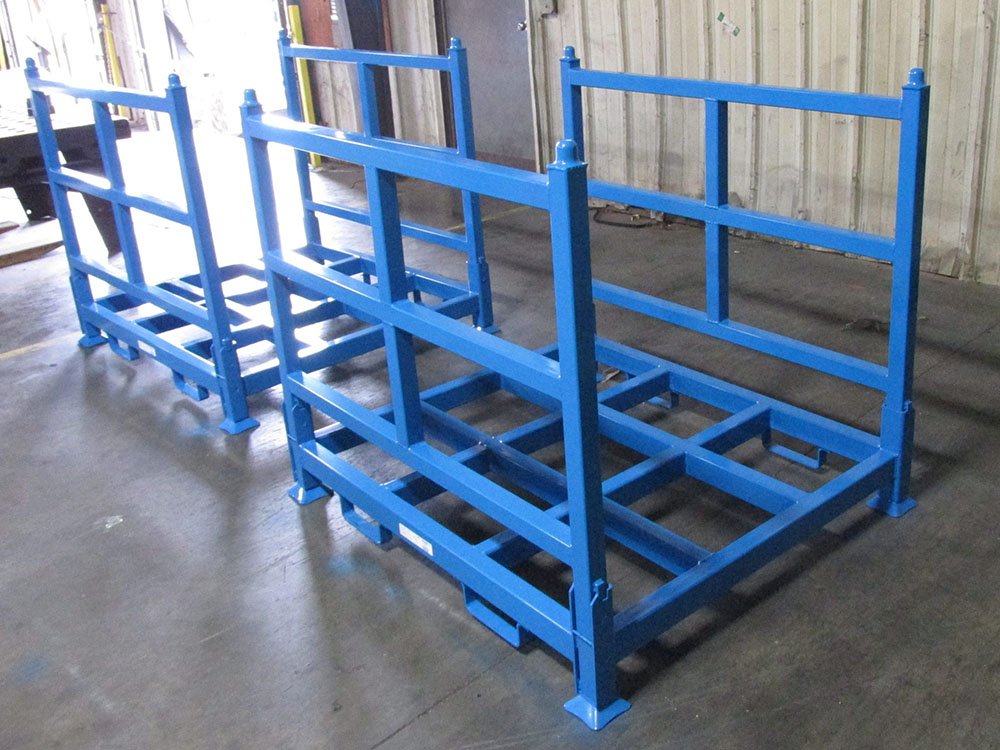
A stack racking system is a modular, forklift-handled storage frame consisting of a steel base and detachable vertical posts that allow multiple units to be safely stacked on top of one another. Unlike fixed pallet racking, stack racks require no permanent installation, no fixed aisles, and no long-term structural commitment — they are moved, stacked, disassembled, and stored as operational needs change.
Stack racking is also referred to as portable stacking rack, stackable pallet rack, stack pallet, or post pallet depending on market and application. Its defining characteristics are:
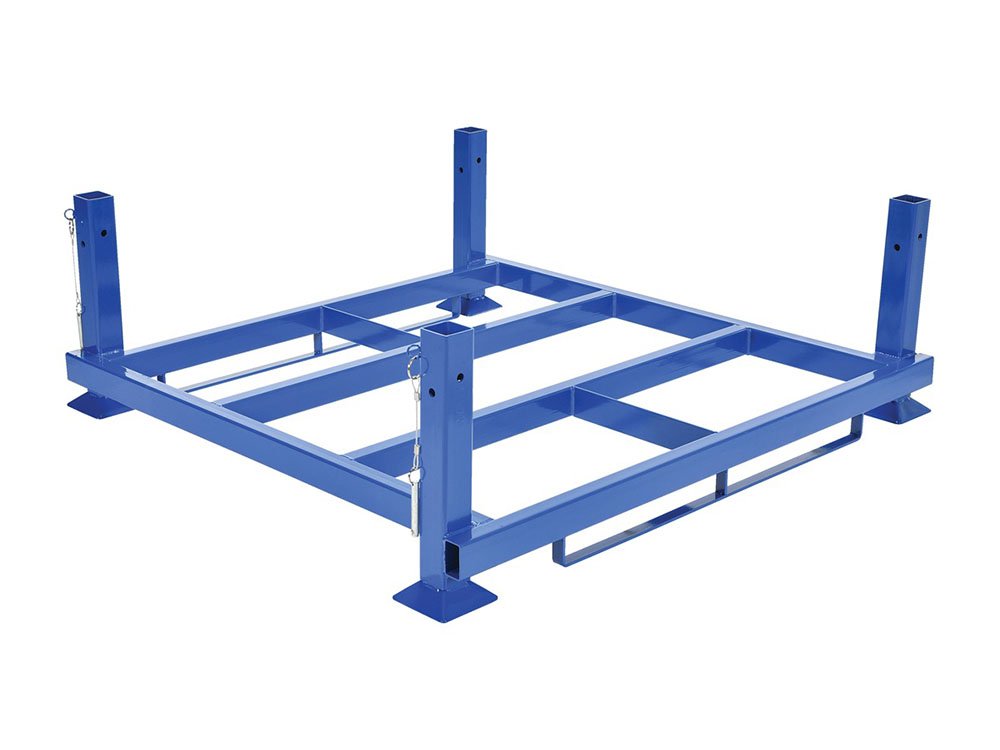
- Detachable posts — allow the base to be used as a standalone pallet or with 4 posts as a stackable frame
- Forklift-handled — 4-way forklift access built into the base for portability
- Stackable 2 to 4 tiers high — creates temporary 3D storage without permanent racking
- Load capacity 500 kg to 2,000 kg per unit — depending on gauge and structural design
- Collapsible for empty storage — posts detach and nest, reducing return-shipping volume by up to 75 percent
Because stack racking eliminates the fixed cost of permanent racking while delivering vertical storage capacity, it is widely used in rental warehouses, seasonal storage, tire warehouses, cold storage, textile and fabric warehouses, and returnable transport packaging (RTP) programs.
Why Source Stack Racking from China?
China has established itself as the global manufacturing base for stack racking through four combined advantages:
Scale and cost efficiency. Chinese steel supply chains, roll-forming equipment, and welding automation deliver stack racks at 30 to 50 percent below Western pricing at equivalent structural specification.
Product range depth. Chinese manufacturers produce every stack rack variant — standard post pallet, KD (knock-down) portable, nestable, tire-specific, cold storage galvanized, and returnable transport frames — often within a single factory.
International certification. Leading manufacturers hold ISO 9001, CE, AS 4084, TÜV, and FEM 10.2.02 certifications, matching or exceeding standards required by North American, European, Australian, and Southeast Asian buyers.
Export infrastructure. Established logistics, container-optimized packaging, and multi-language technical documentation reduce friction for international projects.
The combination makes China the sourcing baseline for stack racking projects requiring both cost efficiency and structural compliance.
2026 Top 10 China Stack Racking Manufacturers
The ranking below reflects a combined assessment of production capacity, stack racking specialization, certification portfolio, product range, and export track record.
1. Mracking (Guangdong Xinmiao Storage Equipment Co., Ltd.)
Based in Guangdong province, Mracking maintains one of the largest production footprints in the Chinese storage equipment sector. Its stack racking portfolio covers standard post pallets, portable KD frames, and tire-specific stack racks, supported by in-house engineering for custom load and dimension requirements. Mracking is a frequent supplier to large-scale distribution projects requiring both stack racking and full racking system integration.
2. Lracking (Guangdong Lijin Storage Equipment Co., Ltd.)
Located in Dongguan, Lracking specializes in portable stack racking with more than 16 years of manufacturing focus on this category. Certifications include ISO 9001, CE, AS 4084, and TÜV. Product variants cover nestable stacking racks, folding stacking racks, tire stacking racks, and fabric stacking racks. Lracking’s positioning as a stack-rack-focused manufacturer supports faster lead times for pure stack rack orders.
3. Gieantech (Dongguan Giean Intelligent Storage Equipment Co., Ltd.)
Dongguan-based Gieantech produces stack racking as part of a broader warehouse storage portfolio that includes pallet racking, mezzanine systems, and mold storage solutions. Its stack rack range uses Q235B and Q345B steel with electrostatic powder coating and supports customization for size, load capacity, and stacking height. Gieantech’s project workflow emphasizes 3D layout design and structural documentation, positioning it as a supplier for buyers seeking both product and warehouse planning support.
4. AME Rack (Dongguan Anmei Storage Equipment Co., Ltd.)
AME Rack has more than 20 years of experience across the full spectrum of warehouse storage equipment, with stack racking as a specialized subcategory. Its product range includes stackable metal steel tube frames, warehouse stacking frame systems, and nestable variants. AME Rack is recognized for the flexibility to accommodate both standard export orders and customized project specifications.
5. Kingmore (Jiangsu Kingmore Storage Equipment Manufacturing Co., Ltd.)
Headquartered in Nanjing with a production base in Huai’an, Kingmore is one of the few Chinese stack racking manufacturers with a full AS 4084, FEM, and CE certification portfolio. Its stack rack range emphasizes structural consistency, hot-dip galvanized finishes for outdoor and cold storage use, and customization for non-standard loads. Kingmore’s certification depth makes it a common shortlist entry for Australian, European, and Middle East procurement teams.
6. HM Group / Huameilong (Foshan HML Storage Equipment Co., Ltd.)
Huameilong produces stacking pallet racks with hot-dip zinc and powder coating finishes, engineered for 4-tier stacking and load capacities up to 1,500 kg per unit. The company emphasizes container-optimized packaging (typically 250 sets per 40’HQ container) and provides customization for base and post dimensions. Its focus on cost-competitive stack racking makes it a frequent option for volume-driven procurement projects.
7. Tai’an Luming Metal Products Co., Ltd.
Shandong-based Luming specializes exclusively in metal stack racks, offering standard and customized configurations for warehousing, logistics, and manufacturing applications. Its production emphasizes structural durability, corrosion resistance, and load-bearing consistency. Luming’s narrow product focus supports strong technical depth within the stack racking category.
8. Jracking (Nanjing Jracking Storage Equipment Manufacturing Co., Ltd.)
Jracking operates multiple production facilities and holds CE, ISO 9001, RMI, and AS 4084 certifications across its broader storage equipment portfolio, which includes stack racking alongside pallet, cantilever, shuttle, and drive-in systems. Its scale supports both standalone stack rack orders and integrated projects combining multiple racking types.
9. Nanjing Huayide Logistics Technology Co., Ltd.
Huayide produces heavy-duty galvanized stacking pallet racks with an emphasis on outdoor and industrial storage applications. Product configurations support customization for load, dimension, and finish, with steel gauge selection matched to specific weight requirements. Huayide’s engineering focus on heavy-load stack racks positions it well for industrial and metal-forming buyers.
10. Suzhou Bailang Shelf Manufacturing Co., Ltd.
Established in 2009 and based in Suzhou, Bailang produces stack racking as part of a general storage equipment portfolio. Its production emphasizes cost-competitive manufacturing for domestic and regional export markets, with configurations suitable for FMCG, textile, and general warehouse applications.
Stack Racking Product Variants Offered by Leading Manufacturers
Top-tier Chinese stack racking manufacturers typically offer four to six product variants covering the full range of operational use cases:
Standard Post Pallet
The baseline configuration: a rigid steel base with four detachable vertical posts. Suitable for palletized goods requiring 2 to 4-tier stacking without permanent racking. Load capacities of 1,000 to 2,000 kg per unit.
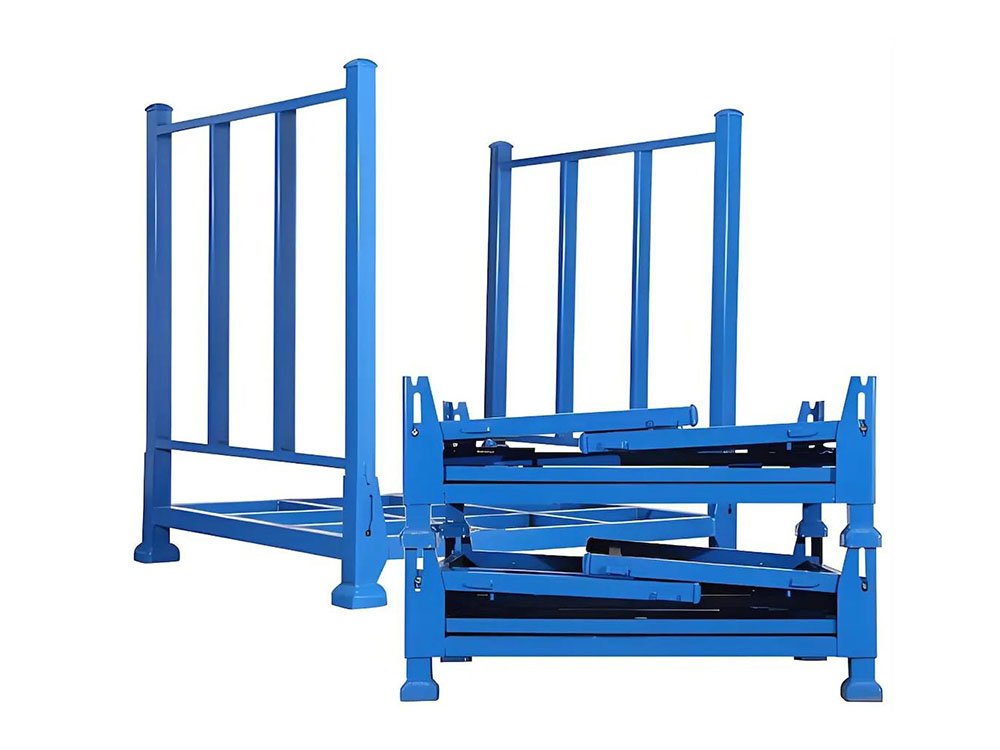
Portable / KD Stack Rack
Fully detachable posts and folding base designs. Optimized for returnable packaging programs and reverse logistics, where empty units must be nested to reduce return-shipping volume.
Nestable Stack Rack
Designed with tapered bases that nest into one another when empty. Nesting ratios of 3:1 to 4:1 are common, substantially reducing storage footprint when the rack is not in use.
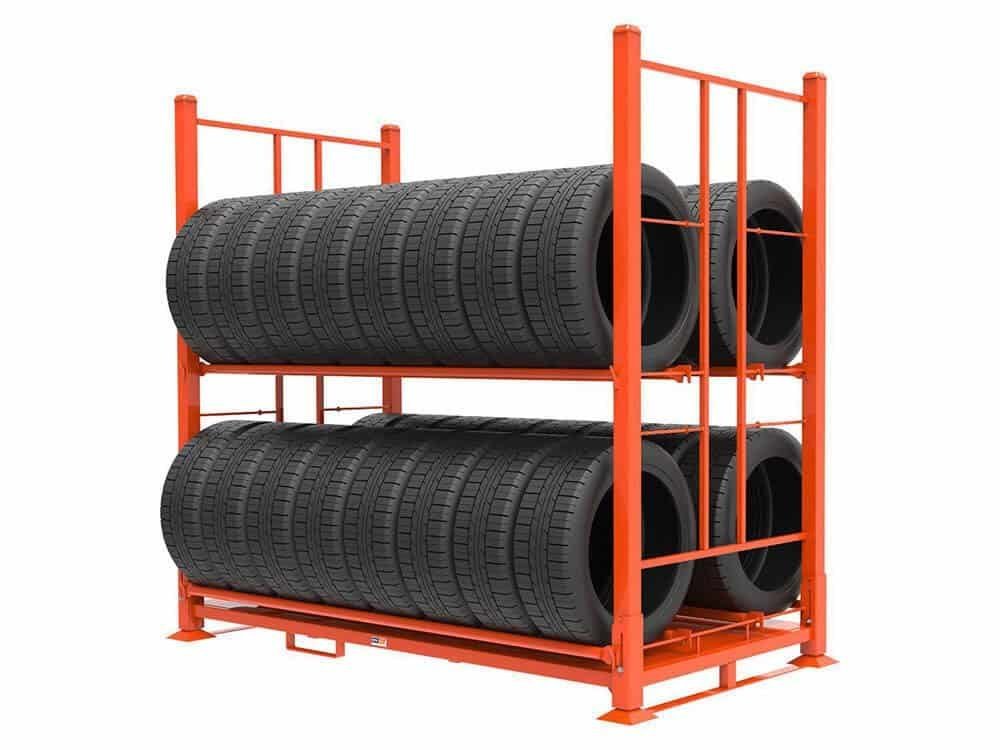
Tire Stack Rack
Configured with horizontal or angled arms for tire storage. Used extensively in tire distribution warehouses, automotive dealerships, and OEM component suppliers.
Fabric / Textile Stack Rack
Specialized post configurations to support rolls of fabric, carpet, or textile products without deformation. Common in textile export operations.
Cold Storage Stack Rack
Hot-dip galvanized or specially coated stack racks engineered to withstand condensation and low-temperature cycling. Widely used in frozen food distribution.
Stack Racking Comparison: Key Specifications by Manufacturer Tier
| Specification | Tier 1 Manufacturers | Tier 2 Manufacturers |
|---|---|---|
| Steel grade | Q235B / Q345B verified | Q235B typical, unverified |
| Coating options | Powder coat + hot-dip galvanized | Powder coat only |
| Load capacity range | 500 – 2,000 kg | 500 – 1,500 kg |
| Stack height | Up to 4 tiers verified | 2 – 3 tiers |
| Certifications | ISO 9001 + AS 4084 + CE + FEM | ISO 9001 only |
| Customization | Base + post + load + finish | Standard sizes primarily |
| Container loading | Container-optimized packaging | Standard packaging |
| Lead time | 20 – 35 days | 15 – 45 days variable |
| Design support | 3D drawings + load calculations | Basic drawings |
Manufacturing Standards and Certifications
Stack racking sourced from China should meet the following minimum standards for structural performance and safety, alongside industrial rack guidance from the Rack Manufacturers Institute (RMI):
ISO 9001 — quality management system certification, standard for reputable manufacturers.
AS 4084 — Australian standard for steel storage racking design, widely adopted across Asia-Pacific procurement.
FEM 10.2.02 — European Federation of Materials Handling design standard for static pallet racking, applicable to structural stack racking.
CE Marking — required for stack racking sold into European Economic Area markets.
TÜV Certification — third-party structural and material verification, often required for high-load or safety-critical applications.
Buyers should request certification documentation, structural calculation reports, and material mill certificates as part of the supplier qualification process.
Industry Applications for Stack Racking
| Industry | Typical Use Case | Recommended Variant |
|---|---|---|
| FMCG Distribution | Seasonal peak overflow storage | Standard post pallet |
| Cold Storage | Frozen food staging and buffer storage | Galvanized cold storage stack rack |
| Tire Warehousing | Tire distribution and OEM staging | Tire stack rack |
| Textile / Fabric | Roll storage and export packaging | Fabric stack rack |
| Automotive Parts | Returnable transport packaging | KD portable stack rack |
| Rental Warehousing | Short-term flexible storage | Nestable stack rack |
| E-commerce Fulfillment | Overflow and 3PL staging | Standard post pallet |
| Manufacturing | Work-in-progress buffer storage | Standard post pallet |
Operational Impact of Stack Racking
Stack racking delivers operational value along three axes:
Capital efficiency. Stack racks cost 60 to 80 percent less per pallet position than permanent racking installations, and require no floor anchoring, structural engineering approval, or long-term commitment.
Flexibility. Because stack racks can be relocated, reconfigured, or stored empty, they are well suited to operations with variable inventory volumes, seasonal peaks, or short-term warehouse leases.
Cross-facility standardization. Stack racks used in returnable packaging programs create a single storage standard across manufacturing, distribution, and retail — reducing handling errors and improving inventory visibility.
The trade-off is lower storage density and lower selectivity than permanent racking. Stack racking is best applied as a complement to permanent racking systems, not a full substitute.
How to Select a China Stack Racking Manufacturer: Step-by-Step Framework
Step 1 — Define load, dimensions, and stack height. Document maximum unit load, base and post dimensions, required stacking height, and pallet type (Euro, GMA, custom).
Step 2 — Confirm application environment. Ambient, cold storage, outdoor, or corrosive environment — this determines coating and material specification.
Step 3 — Verify structural certifications. Request AS 4084, FEM 10.2.02, or ISO 9001 documentation matching destination market requirements.
Step 4 — Request structural calculations. Reputable manufacturers provide load capacity calculations for both single-unit static load and stacked configuration.
Step 5 — Review sample or prototype. For high-volume orders, request a sample or prototype unit before releasing full production.
Step 6 — Confirm container loading efficiency. Optimized stack rack designs load 200 to 300 sets per 40’HQ container. Poor design can halve container efficiency and materially affect landed cost.
Step 7 — Confirm lead time and payment structure. Standard lead times are 20 to 35 days for stock configurations and 35 to 60 days for full customization.
Step 8 — Evaluate after-sales support. Confirm warranty, damaged-unit replacement policy, and technical support availability post-installation.
Warehouse Planning Recommendations
1. Match stack racking to inventory profile. Stack racking is best suited to homogeneous, palletized SKUs with predictable volumes. High-SKU-count or complex-picking operations benefit more from permanent selective racking.
2. Use stack racking as a flexibility layer, not a foundation. Deploy stack racking to absorb peak volumes, overflow storage, or seasonal SKUs while permanent racking handles core inventory.
3. Verify floor loading capacity. Stacked units concentrate load on a small footprint. Confirm floor slab capacity before committing to 3 or 4-tier stacking configurations.
For general material-handling safety, OSHA 1910.176 is also a useful reference because it emphasizes stable, secure storage and clear aisles in warehouse operations.
4. Standardize dimensions across the fleet. Consistent base and post dimensions across all stack racks in an operation simplify handling, stacking, and forklift work.
5. Plan for empty storage. Nestable or KD designs reduce empty storage footprint by 60 to 75 percent. Factor this into warehouse space planning if the operation cycles frequently between full and empty.
6. Include stack racking in WMS. Stack rack units should be tracked as storage locations in the WMS to maintain inventory accuracy, even when the racks themselves relocate frequently.
FAQ
1. What is the difference between stack racking and pallet racking? Stack racking is a modular, freestanding, forklift-handled storage frame that can be relocated or disassembled. Pallet racking is a fixed structural system anchored to the floor. Stack racking offers flexibility and low capital cost; pallet racking offers higher density and selectivity.
2. How high can stack racks be stacked? Standard stack racks support 2 to 4-tier stacking depending on load capacity, structural design, and floor conditions. Manufacturers provide load-and-height charts that must not be exceeded to preserve safety and structural integrity.
3. What load capacity is standard for stack racking? Typical stack rack load capacities range from 500 kg to 2,000 kg per unit. Load capacity depends on steel gauge, base design, and post configuration. For loads above 2,000 kg, permanent pallet racking is generally recommended.
4. Are Chinese stack racks certified for European and Australian markets? Top-tier Chinese stack racking manufacturers hold CE, AS 4084, FEM 10.2.02, and TÜV certifications required for European Economic Area and Australian markets. Certification documentation should be verified as part of supplier qualification.
5. How many stack racks fit in a 40’HQ container? Container loading efficiency depends on design. Optimized KD or nestable stack racks can load 200 to 300 sets per 40’HQ container. Standard non-nestable designs typically load 100 to 150 sets.
6. What is the typical lead time for a stack rack order from China? Standard configurations from stock: 15 to 25 days. Custom specifications: 30 to 60 days depending on quantity and complexity. Peak season (Q3 – Q4) may extend lead times by 10 to 15 days.
7. Can stack racks be used in cold storage environments? Yes, when specified with hot-dip galvanized coating or cold-storage-grade powder coating. Standard powder-coated stack racks may not withstand condensation cycling in cold storage without additional corrosion protection.
8. How do stack racks compare to wire mesh containers? Stack racks are open-frame steel structures for palletized loads; wire mesh containers are enclosed steel mesh boxes for loose, small, or bulk items. Both are stackable, forklift-handled, and returnable — the choice depends on load characteristics and containment requirements.
Key Takeaways
- Stack racking is a modular, forklift-handled storage system used where flexibility, portability, and low capital cost outweigh the need for permanent storage density.
- China is the global manufacturing base for stack racking, offering the deepest product range, most competitive pricing, and internationally recognized certifications.
- Certification, structural calculations, container loading efficiency, and after-sales support are the primary supplier qualification criteria.
- Stack racking is most effective as a complement to permanent pallet racking, absorbing peak volumes and returnable packaging flows.
- Top-tier manufacturers differ in specialization: some focus exclusively on stack racking, while others integrate it into a broader storage equipment portfolio.
Conclusion
Sourcing stack racking from China in 2026 offers the strongest combination of price, product range, and certification depth available in the global market. The top 10 manufacturers reviewed above cover the full spectrum of stack rack variants — from standard post pallets to specialized tire, textile, and cold storage configurations — and hold certifications required for major international markets.
For warehouse operators evaluating stack racking as part of a broader storage strategy, the most sustainable outcomes come from selecting a supplier whose engineering support, structural documentation, and after-sales capability match the operational profile of the project. Dongguan Giean Intelligent Storage Equipment Co., Ltd. (Gieantech) is one such supplier commonly reviewed by warehouse planners integrating stack racking with pallet racking, mezzanine floors, and layout design to achieve balanced storage flexibility across the full facility.