FMCG warehousing operates at the highest velocity of any warehouse category. Inventory turns 10 to 20 times per year, order profiles combine full pallets, cases, and pieces across the same facility, and SKU counts routinely exceed 3,000 to 5,000 active codes. In this environment, storage system decisions have direct and immediate impact on daily throughput, on-time delivery performance, and the cost of serving retail, wholesale, and e-commerce channels simultaneously.
The characteristics that make FMCG demanding — SKU diversity, high turnover, batch tracking requirements, promotional peaks, and multi-channel order profiles — also make it one of the most rewarding categories to optimize. A well-designed FMCG warehouse can support 40 to 60 percent higher throughput than an under-designed facility of the same size, at lower unit labor cost and with better order accuracy. This guide explains what makes FMCG warehousing distinctive, the racking systems best suited to fast-moving inventory, layout and flow principles, and a structured framework for designing an FMCG facility.
What Is FMCG Warehousing?
FMCG warehousing is the operation of distribution facilities that receive, store, pick, and dispatch fast-moving consumer goods — food, beverages, personal care, household products, and other categories characterized by high inventory turnover, broad SKU count, and short order-to-delivery cycles. FMCG warehousing differs from general distribution warehousing in throughput velocity, order profile complexity, and the operational discipline required to sustain both high accuracy and high speed. For food-safety-controlled categories, ISO 22000 is a useful management-system reference.
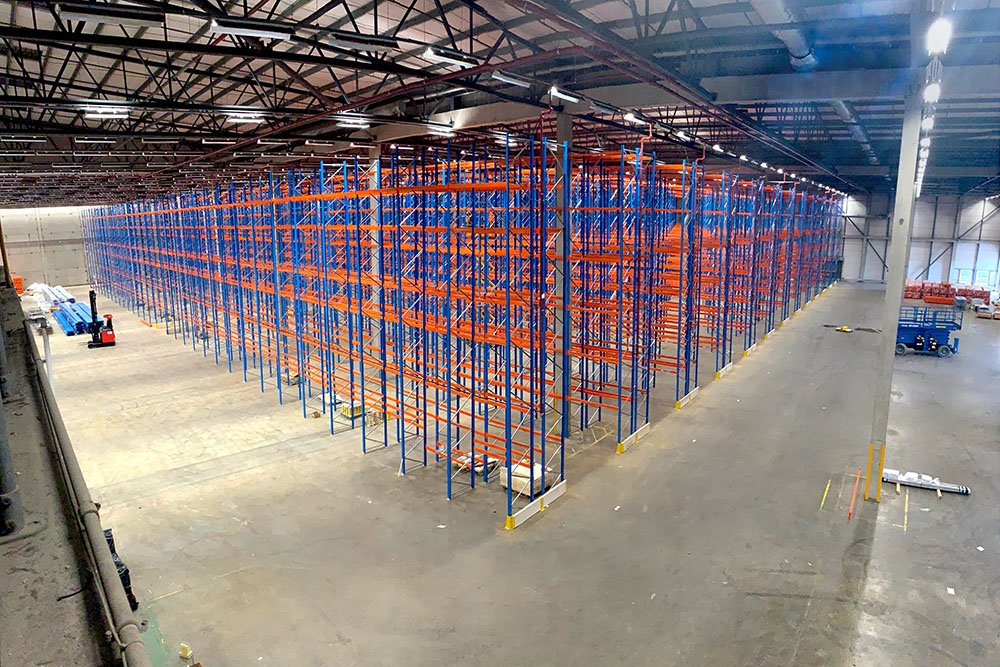
The four defining characteristics of FMCG warehousing are:
- High SKU count with variable velocity — thousands of active SKUs, with 20 percent generating 80 percent of movement
- High inventory turnover — 10 to 20 turns per year, with fast-moving SKUs turning 30 to 50 times
- Multi-channel order profile — full pallets, mixed cases, and piece picks for retail, wholesale, and direct-to-consumer channels
- FIFO/FEFO rotation requirement — shelf-life management, batch tracking, and expiration control for food and personal care categories
These characteristics shape every design decision: racking selection, layout, WMS integration, labor planning, and automation strategy.
What Makes FMCG Warehousing Different
Compared to general distribution, FMCG warehouses face four operational pressures that require specialized design.
Velocity Distribution Across SKUs
FMCG inventory follows a steep velocity curve. A small number of SKUs — typically the top 20 percent — generate 70 to 85 percent of picks. This concentration allows dedicated storage systems for the fast-moving segment while keeping the long tail on lower-cost storage. Failing to segment velocity forces the entire facility to run at the pace and cost of the fastest SKU, which is unaffordable at FMCG scale.
Multi-Channel Order Complexity
Traditional FMCG served full pallets to retailers. Modern FMCG serves full pallets to distribution centers, mixed cases to store-level DCs, and piece picks to e-commerce fulfillment — often from the same warehouse. This mixed profile requires simultaneous storage and picking systems: pallet storage for bulk, case storage for mixed shipments, and piece-pick zones for e-commerce orders.
Batch Tracking and Rotation
Most FMCG categories require FIFO or FEFO rotation. Batch numbers, receipt dates, and expiration dates must be tracked through storage, picking, and dispatch; many product identification workflows also rely on GS1 barcoding standards — creating a data burden that ambient distribution rarely faces. WMS integration and structural FIFO systems remove operational risk from rotation compliance.
Promotion and Seasonality
FMCG demand is not stable. Promotional peaks, seasonal cycles (Chinese New Year, Ramadan, back-to-school, Christmas), and new product launches create demand spikes of 200 to 500 percent above baseline. Warehouse design must accommodate these peaks without permanent overcapacity that erodes cost efficiency in off-peak periods.
FMCG Warehouse Design Considerations
Designing an FMCG warehouse requires alignment across seven interconnected decisions.
1. Layout and Flow Pattern
FMCG facilities typically adopt U-flow or through-flow layouts depending on throughput and building geometry. U-flow suits balanced inbound/outbound with dock sharing; through-flow suits high-velocity cross-docking. For a detailed comparison, see warehouse racking layout design.
2. Velocity-Based Zoning
The most impactful FMCG design decision is velocity-based zoning:
- A-Zone — top 20 percent of SKUs, positioned nearest to dispatch, in fastest-access storage
- B-Zone — middle 30 to 40 percent of SKUs, in medium-density storage with moderate access speed
- C-Zone — slow-moving long tail, in highest-density storage with lower access speed
Proper zoning can reduce forklift travel by 30 to 50 percent and pick times by 20 to 40 percent compared to unzoned layouts.
3. Racking System Mix
FMCG almost never runs a single racking type. The velocity distribution requires deep-lane systems for A-zone, selective systems for B and C zones, and often carton flow or mezzanine pick modules for piece picking. Detail on system-level suitability appears in the next section.
4. Building Height Utilization
FMCG facilities benefit from high-bay design because storage density directly affects the cost of serving distribution networks. Buildings above 12 meters clear height support VNA, shuttle, or ASRS systems that deliver 40 to 80 percent more capacity than conventional heights.
5. Dock Capacity and Yard Management
FMCG throughput drives dock activity. Dock door count, dock leveler capacity, and yard staging area should match peak inbound and outbound volumes. OSHA warehousing hazards and solutions guidance is also useful when planning safe traffic routes, staging, and material handling. Underdocked FMCG facilities lose 20 to 30 percent of theoretical throughput to loading delays.
6. Pick Module Design
For mixed-case and piece-pick channels, pick modules combine carton flow racking, shelving, and mezzanine floors into ergonomic picking zones with structured replenishment. Pick module design is often the difference between adequate and excellent FMCG performance.
7. WMS and Automation Integration
FMCG throughput cannot be sustained without WMS-directed picking, wave planning, and slotting optimization. Automation — from pick-to-light and voice picking to autonomous mobile robots (AMR) and ASRS — is increasingly standard for high-throughput FMCG operations.
Racking Systems for FMCG Warehousing
FMCG facilities typically deploy four to six racking systems within a single building, each matched to a specific velocity zone or product category.
Selective Pallet Racking
Selective pallet racking is the workhorse of the FMCG B and C zones, providing 100 percent selectivity for the long tail of SKUs. Low capital cost per pallet position and compatibility with FIFO/FEFO rotation make it the default choice wherever selectivity outweighs density.
Pallet Flow Racking (Gravity Flow)
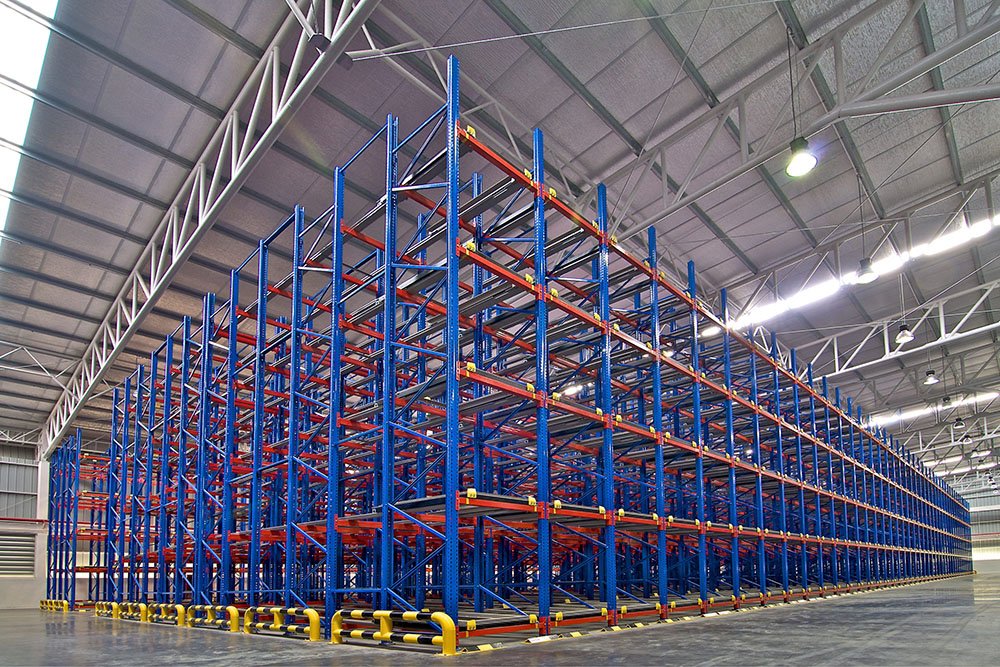
Pallet flow racking is the standard A-zone system for high-throughput SKUs requiring structural FIFO. Gravity flow separates load and pick aisles, reducing forklift travel and enabling 100 to 150 pallet moves per hour per aisle.
Push-Back Racking
Push-back pallet racking delivers moderate density for medium-velocity SKUs where 3 to 5 pallets per SKU justify deep-lane storage but strict FIFO is not required. Its LIFO rotation is acceptable for SKUs with long shelf life and rapid turnover.
Radio Shuttle Racking
Radio shuttle racking is increasingly adopted for FMCG A-zone SKUs with very high volume. Density gains of 60 to 90 percent over selective racking, combined with FIFO or LIFO configuration, make shuttle systems particularly valuable in high-cost-space markets.
Carton Flow Racking
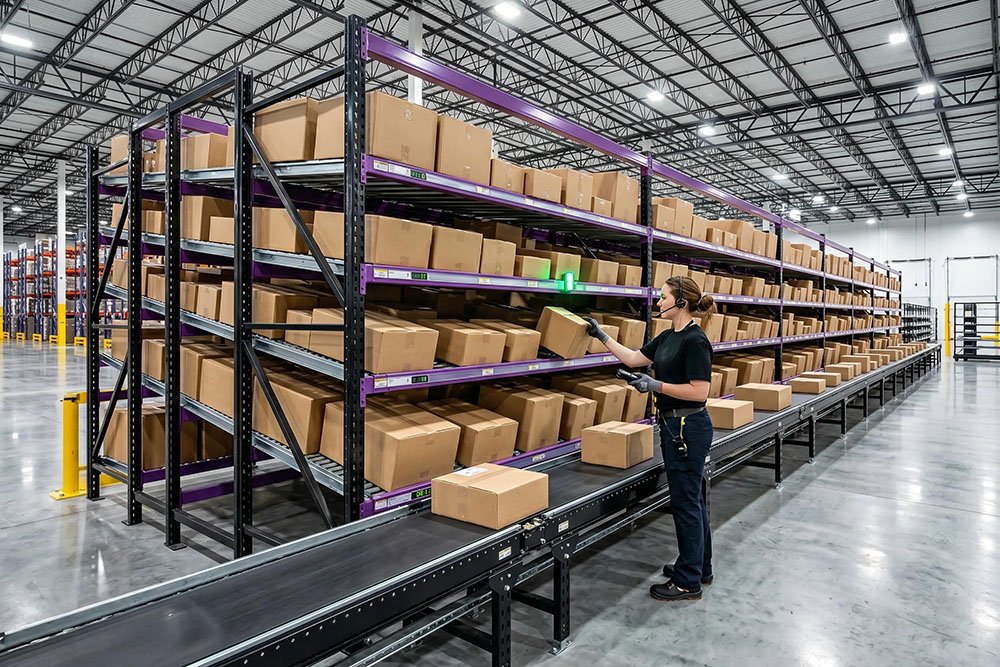
Carton flow racking supports high-velocity piece and case picking. Replenished from the back and picked from the front with automatic FIFO rotation, carton flow enables 300 to 500 picks per hour per operator when paired with pick-to-light systems.
Mezzanine Floors
Mezzanine floors multiply usable pick area for FMCG piece-picking operations. A 2- or 3-level mezzanine with carton flow, shelving, and pick modules can process 2 to 3 times more orders than a single-level equivalent within the same footprint.
FMCG Racking System Comparison
| System | Density | Selectivity | Throughput | FMCG Zone |
|---|---|---|---|---|
| Selective Racking | Low | 100% | High | B and C zones |
| Pallet Flow Racking | High | Medium | Very High | A-zone (FIFO) |
| Push-Back Racking | Medium-High | Medium | Medium | A/B-zone (LIFO acceptable) |
| Radio Shuttle Racking | Very High | Medium-High | Very High | A-zone (high volume) |
| Carton Flow Racking | Medium | High | Very High | Piece pick module |
| Mezzanine + Shelving | N/A | High | Very High | Piece pick module |
FMCG Layout and Flow Principles
FMCG layouts prioritize speed and travel reduction over any other consideration.
Minimize forklift travel distance. Forklift travel is the largest single driver of labor cost. Layouts should place A-zone SKUs closest to dispatch and B/C-zone SKUs progressively deeper. Well-slotted FMCG facilities cut travel by 30 to 50 percent versus unslotted equivalents.
Separate flow paths. Inbound receiving, storage replenishment, order picking, packing, and dispatch should flow along non-crossing paths. Cross-traffic in FMCG immediately becomes congestion because throughput volumes are high.
Position dispatch prep near A-zone. Staging, order consolidation, and dispatch preparation should be adjacent to the fastest-moving inventory. Locating dispatch prep away from A-zone forces long forklift and picker travel on every high-frequency order.
Design pick modules for one-touch picking. Pick modules should present product at ergonomic heights, in FIFO sequence, with pick-face density matched to velocity. Multi-touch picking (search, retrieve, verify) collapses productivity in FMCG.
Reserve capacity for promotions. Peak season storage requirements typically exceed baseline by 40 to 80 percent. Overpacked facilities lose productivity across every operational metric.
Automation and WMS in FMCG Warehousing
Automation adoption in FMCG accelerated during the pandemic and continues to expand. Common automation layers:
WMS with slotting optimization — the foundational automation layer. Every high-throughput FMCG facility runs WMS-directed picking with dynamic slotting rules.
Pick-to-light and voice picking — increase pick productivity by 20 to 40 percent versus paper picking. Common in carton flow pick modules.
Autonomous Mobile Robots (AMR) — replace manual pallet transport between zones. Especially valuable for goods-to-person picking configurations.
Automated Storage and Retrieval Systems (ASRS) — deployed in high-throughput case and piece picking operations. ROI depends on scale, labor cost, and building height utilization.
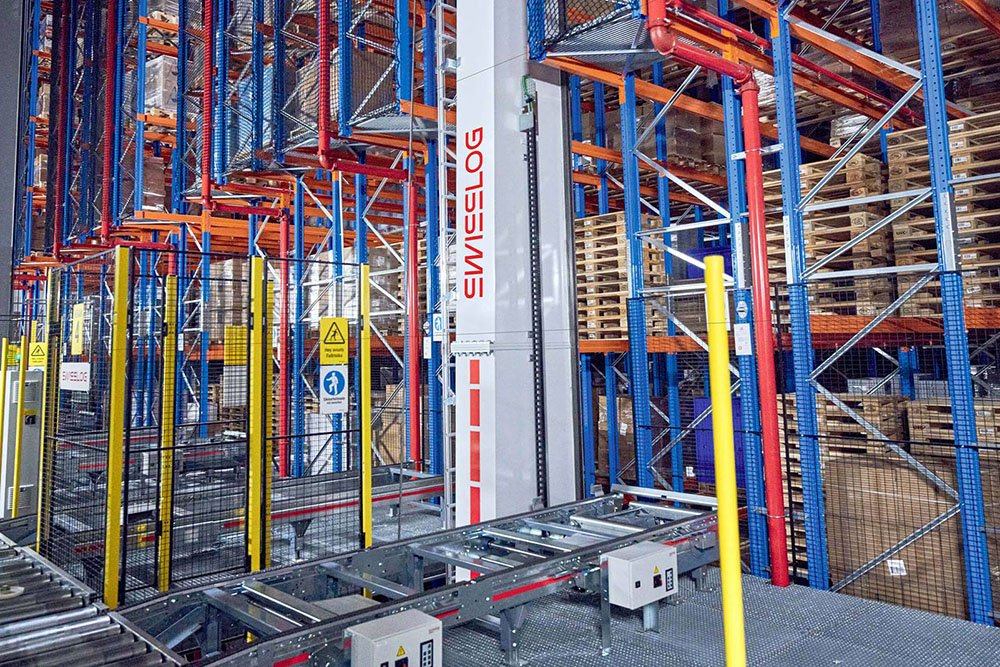
Conveyor and sortation systems — handle high-volume dispatch consolidation. Essential for multi-channel operations where orders diverge to different destinations.
WMS integration remains the highest-leverage automation. Physical automation without WMS discipline delivers a fraction of its potential value.
Operational Challenges in FMCG Warehousing
Rotation Discipline
Managing FIFO/FEFO across thousands of SKUs and hundreds of batches requires structural FIFO systems for high-volume SKUs and WMS-enforced FIFO for the long tail. Rotation errors in FMCG create write-offs, customer returns, and regulatory exposure. For method-level comparison, see FIFO vs LIFO vs FEFO and FIFO racking.
Labor Productivity
FMCG facilities operate at labor productivity levels that expose every layout, slotting, and racking inefficiency. A 5 percent productivity loss across a 100-picker operation translates to five full-time equivalents in unnecessary labor cost.
Peak Season Handling
Promotional peaks and seasonal cycles create demand spikes that permanent capacity cannot economically absorb. Solutions include temporary storage (stack racking, drop trailers), flexible labor (part-time and temporary staff), and pre-positioning of promotional inventory before peak.
Damage and Shrinkage
FMCG carries high forklift traffic, which accelerates rack damage. Column protectors, rack guards, and driver training substantially reduce annual damage cost.
Multi-Channel Complexity
Serving retail, wholesale, and e-commerce from the same facility requires disciplined wave planning, order profile management, and dedicated processing streams. Undisciplined multi-channel operations collapse into cross-channel interference.
Warehouse Planning Recommendations for FMCG
1. Segment velocity before selecting racking. ABC classification and pallets-per-SKU analysis drive every racking decision. Selecting racking before segmenting velocity produces uniform layouts that fit no SKU well.
2. Deploy hybrid racking, not uniform systems. FMCG facilities almost always require 4 to 6 racking types coordinated across a single layout. Uniform racking layouts waste density on A-zone or waste accessibility on C-zone.
3. Design pick modules as engineered systems. Pick module design combines carton flow, shelving, mezzanine, WMS, and material handling in a single engineered zone. Ad-hoc pick module design is one of the most common performance losses in FMCG.
4. Utilize building height fully. FMCG facilities in tight real estate markets should evaluate VNA, shuttle, or ASRS before considering expansion. Vertical capacity is often cheaper than horizontal.
5. Integrate WMS from day one. WMS-directed picking and slotting optimization are non-negotiable at FMCG throughput. Retrofitting WMS integration into a running operation is disruptive and costly.
6. Reserve 15 to 20 percent capacity for peaks and future growth. Overpacked FMCG facilities lose productivity across every metric. Reserved capacity preserves flow, rotation, and picking discipline.
7. Plan racking layout with dispatch and receiving together. Racking, dispatch, and receiving must be designed as one system. Sequential specification produces mismatch that undercuts total throughput.
How to Design an FMCG Warehouse: Step-by-Step Framework
Step 1 — Collect operational data. SKU list, ABC classification, pallets per SKU, order profile (full pallet vs case vs piece), throughput per hour, rotation method, and seasonal peak factor.
Step 2 — Analyze building constraints. Clear height, column grid, floor loading, dock positions, and sprinkler configuration.
Step 3 — Segment velocity zones. Determine A-zone (top 20 percent SKUs), B-zone (middle 30 to 40 percent), and C-zone (long tail).
Step 4 — Match racking systems to zones. Assign selective, flow, push-back, shuttle, carton flow, or mezzanine systems to zones based on velocity and pallets per SKU.
Step 5 — Design layout and flow. Select U-flow or through-flow, position A-zone nearest dispatch, and route inbound/outbound flow to avoid crossing paths.
Step 6 — Engineer pick modules. Design carton flow, mezzanine, and shelving into structured pick zones matched to piece-pick and case-pick volumes.
Step 7 — Plan WMS and automation. Select WMS platform, define slotting rules, and identify automation candidates (pick-to-light, voice, AMR, ASRS).
Step 8 — Model throughput and capacity. Confirm design meets peak throughput and reserves capacity for growth.
Step 9 — Validate safety and compliance. Verify aisle widths, sprinkler flue spaces, seismic requirements, and emergency egress.
Step 10 — Pilot and refine. Test slotting rules and layout logic in a pilot zone before full deployment.
FAQ
1. What is FMCG warehousing? FMCG warehousing is the storage and distribution of fast-moving consumer goods — food, beverages, personal care, and household products — that turn 10 to 20 times per year and require high-throughput picking, batch tracking, and multi-channel order fulfillment. It differs from general distribution in SKU velocity, order profile complexity, and required operational discipline.
2. What racking systems are best for FMCG warehousing? FMCG facilities typically deploy a mix of racking systems: selective for the long tail of SKUs, pallet flow or shuttle for high-velocity A-zone SKUs, push-back for medium-velocity SKUs, and carton flow with mezzanines for piece-pick operations. Uniform racking layouts rarely fit FMCG well.
3. Why does FMCG warehousing require ABC zoning? FMCG velocity distribution is highly skewed — the top 20 percent of SKUs generate 70 to 85 percent of picks. Placing high-velocity SKUs nearest dispatch and slow-moving SKUs deeper in the facility reduces forklift travel by 30 to 50 percent and cuts pick times by 20 to 40 percent versus unzoned layouts.
4. What is the difference between FIFO and FEFO in FMCG warehousing? FIFO (First In, First Out) ships the oldest receipt first, based on receipt date. FEFO (First Expired, First Out) ships the product with the earliest expiration first, regardless of receipt date. FMCG operations with variable batch shelf life require FEFO; operations with uniform shelf life can use FIFO.
5. How does e-commerce affect FMCG warehouse design? E-commerce adds piece-pick order profiles alongside traditional pallet and case shipments. This requires dedicated pick modules (carton flow, mezzanine, shelving), pick-to-light or voice picking, and often goods-to-person automation. E-commerce integration doubles the operational complexity of traditional FMCG facilities.
6. How much automation is typical in FMCG warehousing? WMS-directed picking is universal. Pick-to-light and voice picking are common in carton flow and shelving pick modules. AMR and goods-to-person automation are increasingly adopted for high-throughput operations. Full ASRS is deployed at the largest FMCG facilities. Automation intensity scales with volume, SKU count, and labor cost.
7. How should FMCG warehouses handle promotional peaks? Peak season capacity is best handled through temporary storage (stack racking, drop trailers), flexible labor, and pre-positioning of promotional inventory. Permanent capacity for peaks alone erodes off-peak cost efficiency. Design should target 15 to 20 percent reserved capacity to absorb normal peak variation.
8. What is a pick module in an FMCG warehouse? A pick module is an engineered zone within an FMCG warehouse where carton flow racking, shelving, and mezzanine floors combine into a high-throughput piece-pick or case-pick area. Pick modules are typically integrated with WMS-directed picking, pick-to-light, or voice systems and often serve e-commerce and mixed-case orders.
Key Takeaways
- FMCG warehousing operates at the highest velocity of any warehouse category, driven by high SKU count, fast turnover, and multi-channel order profiles.
- Velocity-based zoning (ABC) is the highest-leverage design decision; A-zone SKUs deserve dedicated high-throughput racking, and C-zone SKUs run on lower-cost storage.
- Hybrid racking layouts combining selective, pallet flow, shuttle, and carton flow systems consistently outperform uniform layouts in FMCG operations.
- Pick modules integrating carton flow, shelving, and mezzanine floors are essential for piece-pick and mixed-case order channels.
- WMS integration, slotting optimization, and appropriate automation deliver compounding returns across labor productivity, throughput, and accuracy.
Conclusion
FMCG warehousing rewards discipline in design and operational execution. Facilities that segment velocity correctly, match racking systems to velocity zones, integrate WMS and automation appropriately, and reserve capacity for peaks routinely achieve 40 to 60 percent higher throughput than facilities of equivalent size that skip these steps. The design decisions made at commissioning shape operational performance for the full 15 to 25-year lifecycle of the equipment.
FMCG warehouse teams comparing storage system providers frequently review suppliers such as Gieantech for their ability to integrate multiple racking types — selective, shuttle, pallet flow, carton flow, and mezzanine systems — into a single facility layout matched to SKU velocity and throughput demands, delivering the coordinated equipment package that high-turnover FMCG operations require.