FIFO racking is a category of warehouse storage systems specifically engineered to enforce first-in-first-out inventory rotation at the equipment level. Rather than relying on labor discipline and WMS slotting alone, FIFO racking uses the physical structure of the racking — inclined rails, separated load and pick sides, or shuttle-driven pallet movement — to automatically sequence pallets in the correct rotation order.
For warehouses handling perishable goods, date-controlled inventory, or high-throughput products where rotation errors are costly, FIFO racking removes a critical source of operational risk. This guide explains what FIFO means in warehouse operations, the main types of FIFO racking, how each type works, industry applications, and the framework for selecting the right system based on SKU profile, throughput, and building constraints.
What Is FIFO?
FIFO — First In, First Out — is an inventory rotation method in which the earliest-received stock is dispatched first. If Pallet A arrives on Monday and Pallet B arrives on Wednesday, Pallet A ships before Pallet B, preserving natural chronological order across the entire inventory lifecycle.
FIFO discipline matters for four operational reasons:
- Reduces obsolescence. Older stock leaves the warehouse before it ages beyond usability or salability.
- Aligns with shelf-life management. Products with defined shelf life reach the customer with maximum remaining life.
- Preserves working capital. Older inventory, which typically has lower forward value, is converted to revenue faster.
- Supports regulatory compliance. Pharmaceuticals, food, and cosmetics require documented rotation discipline under GMP and GDP frameworks.
FIFO can be enforced through operational discipline (WMS slotting and directed picking on selective racking) or through structural design (racking systems that physically sequence pallets in FIFO order). For a deeper comparison between rotation methods, see the guide to FIFO vs LIFO vs FEFO.
What Is FIFO Racking?
FIFO racking is a family of warehouse storage systems engineered to enforce first-in-first-out inventory rotation through physical design rather than operational discipline alone. In a FIFO racking system, pallets are loaded on one side and retrieved from the opposite side, so the earliest-loaded pallet is always the next one available for picking.
Common characteristics across FIFO racking systems include:
- Separate load and pick faces — inbound and outbound activities occur on different aisles, eliminating cross-traffic
- Structural sequencing — either gravity, shuttle carriers, or drive-through geometry moves pallets from load to pick side in FIFO order
- High storage density — deep-lane configurations achieve 60 to 90 percent more density than selective racking
- Reduced forklift travel — separation of load and pick reduces congestion and improves throughput
- Automatic rotation compliance — the physical structure prevents FIFO violations that can occur in selective racking
The result is a storage system that combines the density of deep-lane racking with the rotation discipline required for perishable, date-controlled, or high-turnover products.
Types of FIFO Racking
Five racking systems either enforce FIFO by design or can be configured to operate in FIFO mode.
1. Pallet Flow Racking (Gravity Flow)
Pallet flow racking is the archetypal FIFO racking system. Inclined roller or wheel beds slope downward from the load side to the pick side. Pallets loaded at the higher end travel by gravity to the picking end, controlled by flow-speed regulators and separators.
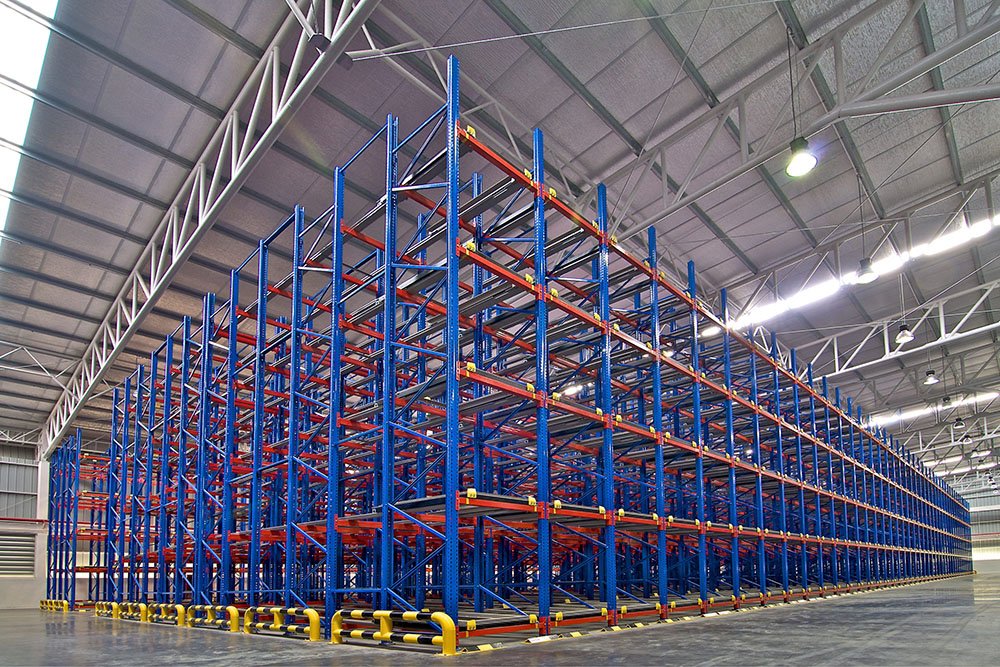
How it works:
- Load aisle at the elevated side; pick aisle at the lower side
- Lane depth typically 6 to 20 pallets
- Speed controllers (rollers with braking mechanisms) prevent runaway pallets
- Separators isolate the front pallet for safe retrieval
Best suited for: High-throughput SKUs, perishable goods, food and beverage distribution, and any operation with 5 or more pallets per SKU where strict FIFO is required.
2. Drive-Through Racking
Drive-through racking is a variant of drive-in racking with open access on both ends of the lane. Forklifts enter one side to load and the opposite side to retrieve, creating physical FIFO flow.
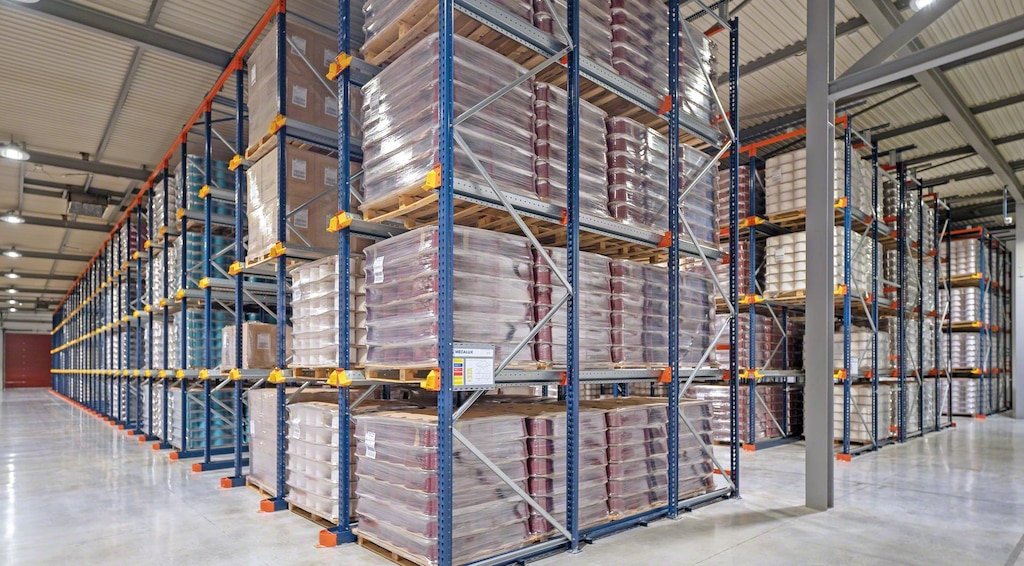
How it works:
- Two-sided access replaces the single-sided access of drive-in racking
- Lane depth typically 3 to 8 pallets
- Requires wider aisles on both sides for forklift access
- Storage rails support pallets by their outer edges
Best suited for: Cold storage, bulk beverage, and dry goods operations with moderate SKU counts, high pallets per SKU, and a strict FIFO requirement.
3. Shuttle Racking (FIFO Configuration)
Radio shuttle racking can be configured for FIFO operation by loading from one end of the lane and retrieving from the opposite end. The remote-controlled shuttle carrier moves pallets along the lane under WMS or operator control.
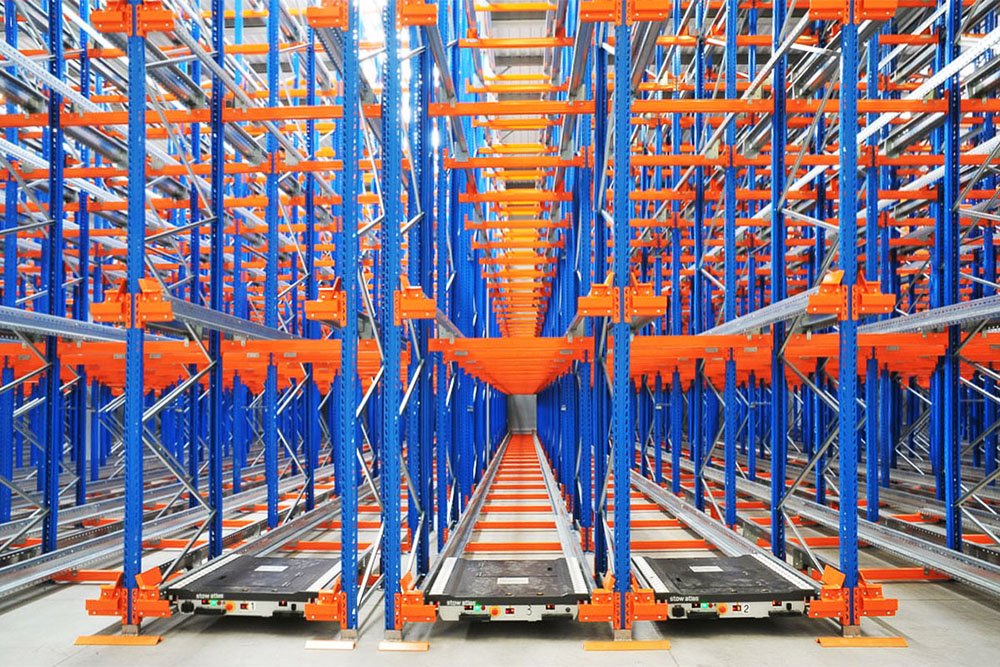
How it works:
- Two-end configuration: load face and pick face on opposite aisles
- Shuttle carrier moves pallets deep into the lane
- Lane depth typically 10 to 40 pallets
- Forklift remains in the aisle, improving safety and reducing damage
Best suited for: High-density cold storage, FMCG distribution, and beverage operations requiring both FIFO discipline and maximum storage density.
4. Selective Pallet Racking (with FIFO Discipline)
Selective pallet racking is not structurally FIFO — every pallet is directly accessible. However, when combined with WMS-directed picking, receipt-date slotting, and disciplined putaway, it can enforce FIFO rotation as reliably as deep-lane systems.
How it works:
- WMS assigns storage locations based on receipt date
- Pick lists prioritize the oldest available pallet for each SKU
- Barcode scanning verifies pallet identity at pick
- Rotation depends on operational discipline rather than structural sequencing
Best suited for: High-SKU operations where selective access is required, mixed rotation environments (FIFO for some SKUs, FEFO for others), and warehouses with reliable WMS integration.
5. Carton Flow Racking
Carton flow racking applies the gravity flow principle at the carton level. Cartons loaded at the back of the shelf gravity-feed to the pick face, delivering FIFO rotation for piece-picking operations.
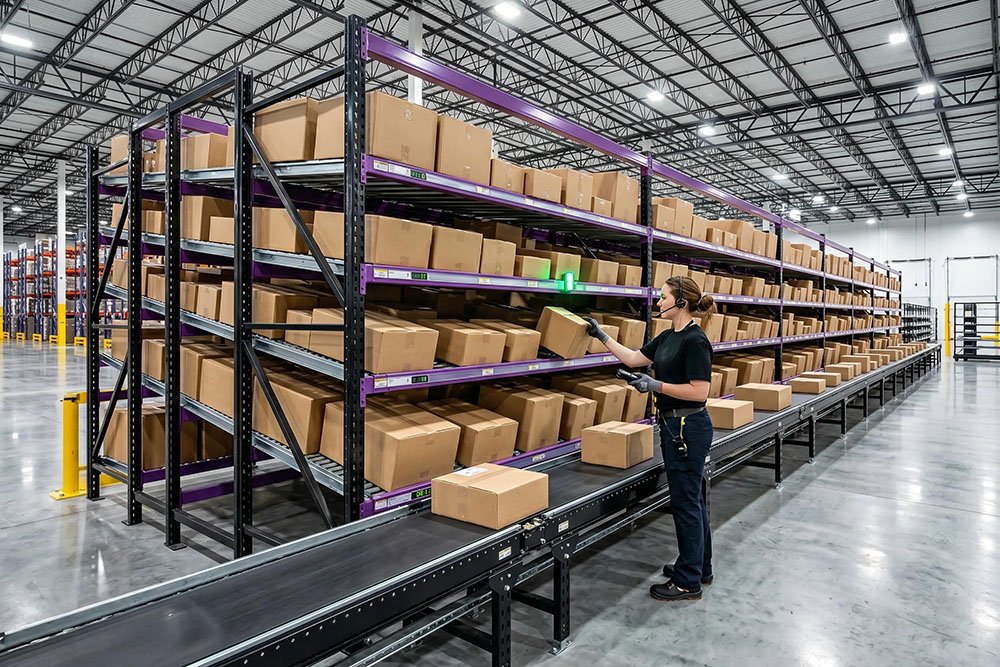
How it works:
- Inclined roller shelves within shelving or mezzanine structures
- Cartons flow from replenishment side to pick side
- Typical shelf depth: 3 to 10 cartons
- Often integrated with pick-to-light or voice picking systems
Best suited for: E-commerce fulfillment, spare parts distribution, and any operation requiring high-throughput piece picking with FIFO rotation.
FIFO Racking Comparison Table
| System | Storage Density | Lane Depth | Rotation Type | Throughput | Capital Cost |
|---|---|---|---|---|---|
| Pallet Flow Racking | High | 6 – 20 pallets | Structural FIFO | High | High |
| Drive-Through Racking | Medium-High | 3 – 8 pallets | Structural FIFO | Medium | Medium |
| Shuttle Racking (FIFO) | Very High | 10 – 40 pallets | Structural FIFO | High | High |
| Selective Racking (FIFO) | Low | 1 pallet | WMS-enforced FIFO | High | Low |
| Carton Flow Racking | Medium | 3 – 10 cartons | Structural FIFO | Very High | Medium |
How FIFO Racking Works: Structural Mechanics
The core principle across all structural FIFO racking systems is separation of load and pick sides. This eliminates the situation where a newly loaded pallet blocks access to an older pallet stored behind it — the geometric guarantee of FIFO discipline. For rack design and safety context, the Rack Manufacturers Institute (RMI) is a useful industry reference for industrial steel storage rack systems.
Gravity flow systems achieve this through inclined rail beds. The angle (typically 3 to 5 degrees) generates enough force to move loaded pallets toward the pick side while flow-speed rollers prevent uncontrolled acceleration. Separators at the pick face isolate one pallet at a time for safe retrieval by forklift.
Drive-through systems achieve FIFO through simple geometry: forklifts load at one end, retrieve at the other. The first pallet loaded is the deepest in the lane and, therefore, the closest to the retrieval end.
Shuttle systems achieve FIFO through carrier logic. The shuttle moves pallets in a controlled sequence, and WMS integration ensures the earliest-loaded pallet is always the next retrieved.
Each mechanism eliminates the human error component of FIFO enforcement, replacing operational discipline with structural certainty.
Operational Benefits of FIFO Racking
FIFO racking delivers value across four operational dimensions:
Rotation compliance. Structural FIFO eliminates rotation errors that generate waste, write-offs, and regulatory non-compliance. In perishable industries, this can reduce expired-stock write-offs by 50 to 80 percent.
Storage density. Deep-lane FIFO systems store 60 to 90 percent more pallets per square meter than selective racking, deferring the need for warehouse expansion.
Throughput. Separation of load and pick sides eliminates cross-traffic and doubles the effective aisle capacity for high-turnover SKUs. Pallet flow and shuttle systems can achieve 100 to 150 pallet moves per hour per aisle.
Labor productivity. Reduced forklift travel and elimination of manual rotation checks lift pallets-per-hour productivity by 20 to 40 percent compared to selective racking with equivalent SKU volume.
The trade-off is reduced selectivity: deep-lane FIFO systems typically hold one SKU per lane, so they work best for operations with sufficient pallets-per-SKU volume to fill lanes efficiently.
Industry Applications for FIFO Racking
| Industry | Recommended FIFO Racking | Reason |
|---|---|---|
| Food and Beverage | Pallet flow, drive-through | Shelf-life management, high throughput |
| Cold Storage | Shuttle racking, drive-through | Density + FIFO in high-cost space |
| FMCG Distribution | Pallet flow, shuttle | High turnover, consistent SKU volume |
| Pharmaceuticals | Selective with WMS FIFO | Selectivity + rotation compliance |
| Dairy and Frozen Foods | Pallet flow, drive-through | Strict FIFO for perishables |
| Beverage | Drive-through, shuttle | Bulk SKUs, high pallets-per-SKU |
| E-commerce Fulfillment | Carton flow racking | Piece-pick FIFO at high throughput |
| Spare Parts Distribution | Carton flow + selective | Piece-pick + pallet-level FIFO |
| Chemical Distribution | Selective with WMS FIFO | Batch control, lot traceability |
FIFO Racking vs LIFO Racking
Not every deep-lane racking system delivers FIFO. Some are structurally LIFO, and confusing the two leads to operational failure.
| System | Rotation Type |
|---|---|
| Pallet Flow Racking | FIFO (structural) |
| Drive-Through Racking | FIFO (structural) |
| Shuttle Racking | FIFO or LIFO (configurable) |
| Selective Racking | Neutral (WMS-controlled) |
| Drive-In Racking | LIFO (structural) |
| Push-Back Racking | LIFO (structural) |
Drive-in and push-back racking are commonly mistaken for FIFO because both are deep-lane systems. In reality, both are LIFO by design — the last pallet loaded is the first accessible for retrieval. For perishable or date-controlled inventory, drive-in and push-back systems create rotation risk unless SKUs turn over faster than their shelf life.
Warehouse Planning Recommendations
1. Confirm SKU velocity before specifying deep-lane FIFO. Deep-lane FIFO systems fill efficiently only when pallets per SKU exceed 5 to 6 units. Lower volumes leave lanes partially empty, wasting capital investment.
2. Match FIFO system to shelf-life margin. Products with tight shelf-life margins benefit most from structural FIFO. Products with generous shelf-life margins can often use WMS-enforced FIFO on selective racking at lower cost.
3. Design load and pick aisles as separate flow paths. FIFO racking requires physical separation of inbound and outbound flow. Layout must accommodate two aisles per bank of racking — this is often overlooked in retrofit projects. The OSHA materials handling and storage standard is also a helpful safety reference for clear aisles and secure storage.
4. Verify floor slope and flatness for gravity flow systems. Pallet flow and carton flow racking depend on controlled gravity. Warehouse floors with slope irregularities can accelerate or stall pallets, requiring floor correction before installation.
5. Integrate WMS to close the last-mile of FIFO compliance. Even structural FIFO systems require WMS to track batch numbers, receipt dates, and rotation exceptions. Structural design without WMS integration limits full FIFO benefit.
6. Plan for pallet quality control. Pallet flow and shuttle FIFO systems require dimensional and structural pallet consistency. Damaged or non-standard pallets can jam flow lanes or block shuttle carriers.
7. Reserve buffer capacity for FIFO exceptions. Not all inventory follows perfect FIFO cycles. Reserve 10 to 15 percent of storage capacity for returns, quality-hold, and priority replenishment that break normal rotation flow.
How to Select FIFO Racking: Step-by-Step Framework
Step 1 — Confirm the rotation requirement. Verify whether FIFO is a regulatory mandate, quality-driven preference, or capital-preservation strategy. This determines how much structural rigor is needed.
Step 2 — Analyze SKU profile. Document pallets per SKU, receipt frequency, and shelf-life margin. High pallets-per-SKU and short shelf life favor structural FIFO; low pallets-per-SKU favors WMS-enforced FIFO on selective racking.
Step 3 — Measure the building envelope. Record clear height, column grid, floor loading, floor slope, and available aisle configuration. Deep-lane FIFO requires two aisles per bank of racking.
Step 4 — Shortlist FIFO system types. Match SKU profile and building constraints to the five FIFO racking categories. Typically two options will fit; eliminate clearly unsuitable systems.
Step 5 — Model throughput and capacity. Calculate pallet positions, throughput per aisle, and forklift cycles for each shortlisted option. Confirm each meets peak demand.
Step 6 — Verify pallet compatibility. Confirm pallet dimensions, weight, and quality meet the tolerances required by the chosen FIFO system. Non-standard pallets may require adaptation or system change.
Step 7 — Compare total cost of ownership. Include capital, installation, forklift adjustment, WMS integration, and maintenance. Lowest capital rarely equals lowest total cost across a 15-year lifecycle.
Step 8 — Pilot before full deployment. Install one or two banks in a controlled zone, measure rotation compliance, throughput, and pallet quality issues, then scale.
FAQ
1. What is the difference between FIFO racking and selective racking? FIFO racking enforces first-in-first-out rotation through structural design — pallets are loaded on one side and retrieved from the opposite side. Selective racking allows any pallet to be picked directly from the aisle; FIFO rotation on selective racking depends on WMS logic and operator discipline rather than structure.
2. Is drive-in racking a FIFO system? No. Drive-in racking is a LIFO system because forklifts load and retrieve pallets from the same end of the lane, so the last pallet loaded is the first accessible for retrieval. Drive-through racking, with access on both ends, is the FIFO variant.
3. What is the storage density of pallet flow racking? Pallet flow racking typically achieves 60 to 90 percent higher pallet density than selective racking, depending on lane depth and building configuration. Lane depths of 8 to 12 pallets are common; up to 20 pallets is possible with strong pallet quality control.
4. Can shuttle racking operate in both FIFO and LIFO modes? Yes. Shuttle racking is configurable. In FIFO mode, load and retrieval occur at opposite ends of the lane. In LIFO mode, load and retrieval occur at the same end. WMS logic and physical layout determine which mode the system operates in.
5. Which industries benefit most from FIFO racking? Food and beverage, cold storage, pharmaceuticals, dairy, and any operation with shelf-life-sensitive inventory benefit most. FMCG distribution and beverage operations also benefit from the throughput gains of deep-lane FIFO even when shelf life is not the primary driver.
6. What is the typical lane depth for pallet flow racking? Standard lane depths range from 6 to 12 pallets, though depths up to 20 pallets are possible with advanced flow control. Depth is limited by pallet quality tolerances, flow-speed calibration, and safe retrieval considerations.
7. Does FIFO racking require special forklifts? Standard reach trucks or counterbalance forklifts operate pallet flow and drive-through racking. Shuttle racking uses standard forklifts for aisle-level operations, with the shuttle carrier handling deep-lane movement. Carton flow racking is served by pickers on foot or with order picker trucks.
8. What is the main risk of FIFO racking? Underutilized lane depth. If pallets per SKU do not fill the lane, capital is wasted on unused capacity. FIFO racking is most cost-effective when SKU volume matches lane depth — mismatches erode the density and throughput advantages the system is engineered to deliver.
Key Takeaways
- FIFO racking enforces first-in-first-out rotation through structural design, replacing operational discipline with physical guarantee.
- Five main systems deliver FIFO: pallet flow racking, drive-through racking, shuttle racking (in FIFO configuration), selective racking with WMS-enforced FIFO, and carton flow racking.
- Deep-lane FIFO systems achieve 60 to 90 percent higher density than selective racking but require sufficient pallets per SKU to fill lanes efficiently.
- Drive-in and push-back racking are LIFO systems, not FIFO — using them for perishable inventory creates rotation risk.
- Selection depends on shelf-life margin, pallets per SKU, building constraints, and total cost of ownership across the equipment lifecycle.
Conclusion
FIFO racking transforms rotation from an operational challenge into a structural guarantee. By separating load and pick faces and using gravity, shuttle, or drive-through geometry to sequence pallets, these systems eliminate the human-error component of FIFO enforcement while delivering the storage density and throughput gains of deep-lane racking. For perishable, date-controlled, and high-turnover inventory, this combination often produces the highest return per square meter of any warehouse storage investment.
Selecting the right FIFO system requires alignment between SKU profile, shelf-life margin, warehouse layout design, and long-term throughput requirements — not simply choosing the densest option available. Warehouse teams building FIFO-driven storage systems commonly evaluate providers such as Gieantech when matching pallet flow, shuttle, and drive-through configurations to specific rotation discipline and throughput targets.