Drive-in racking and shuttle pallet racking are the two most common high-density pallet storage systems in modern cold storage, beverage, food, and FMCG distribution. Both deliver 60 to 90 percent higher pallet density than selective racking, both store multiple pallets per SKU in deep lanes, and both are widely used in facilities where refrigerated or industrial floor space is expensive. At the same time, they differ in almost every operational dimension that matters — capital cost, throughput, damage rates, forklift fleet requirements, safety profile, and total cost of ownership across the equipment lifecycle.
Choosing between them is not a simple density decision. Drive-in racking costs 60 to 70 percent less per pallet position upfront, which is why many buyers initially assume it is the correct choice. Shuttle pallet racking, however, often repays its higher capital cost within 3 to 5 years through faster throughput, lower damage rates, reduced labor, and better utilization of refrigerated space. Whether the shorter-term capital saving or the longer-term operational return wins depends on SKU profile, operational horizon, cost of warehouse space, and labor economics. This guide compares the two systems across 15 dimensions, includes a full ROI and total cost of ownership analysis, and provides a selection framework for warehouse operators making this decision.
What Is Drive-In Racking?
Drive-in racking is a high-density pallet storage system in which forklifts enter the racking structure to place and retrieve pallets from deep lanes. Pallets are supported on rails along each side of the lane, and the forklift drives directly into the rack to reach positions deeper in the lane. Loading and retrieval occur from the same end of the lane, making drive-in a LIFO (Last In, First Out) system by structural design.
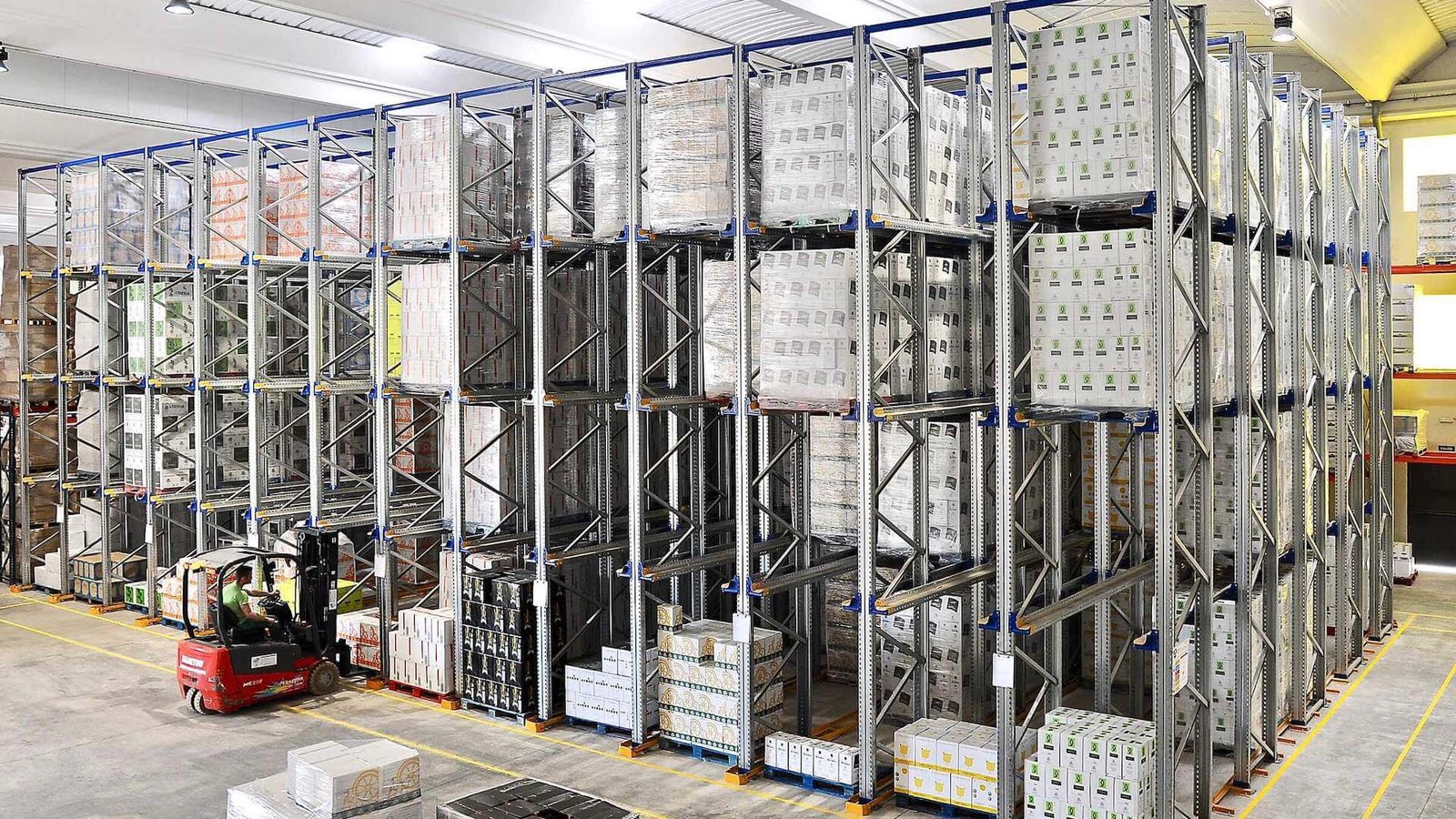
Drive-in racking is characterized by:
- Lane depth: 3 to 10 pallets deep
- Density gain: 60 to 80 percent higher than selective racking
- Rotation: LIFO (one access end); drive-through variants deliver FIFO with two access ends
- Forklift access: standard counterbalance or reach trucks enter the lane
- Selectivity: low — one SKU per lane
- Capital cost: medium — second lowest among high-density racking systems
Drive-in is a mature, well-understood system used extensively in cold storage, bulk frozen food, beverage distribution, and any operation storing large quantities of identical pallets per SKU.
What Is Shuttle Pallet Racking?
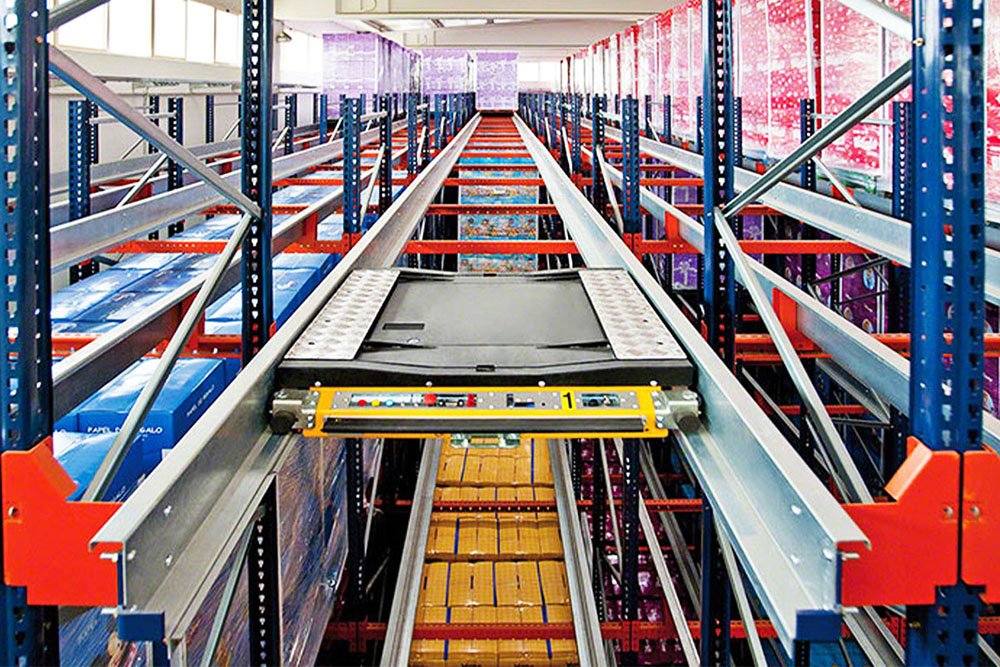
Shuttle pallet racking is a semi-automated high-density storage system in which a remote-controlled shuttle carrier moves pallets within deep lanes while the forklift remains at the aisle face. The forklift loads pallets onto the shuttle at the aisle entrance; the shuttle transports the pallet deep into the lane; retrieval reverses the process. Lanes can operate in FIFO mode (load and retrieve from opposite ends) or LIFO mode (load and retrieve from the same end), depending on configuration.
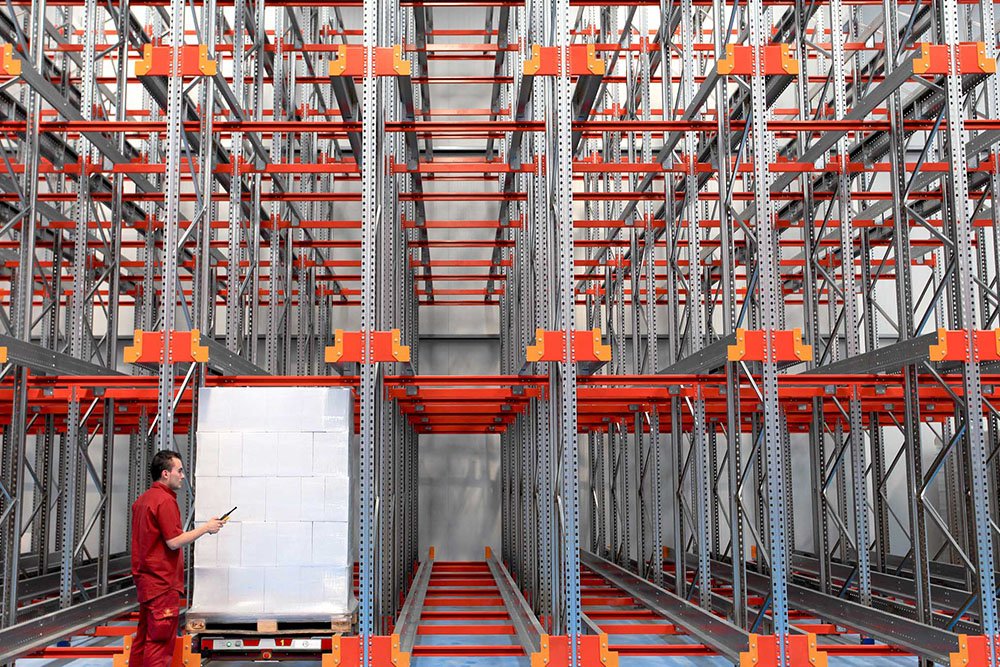
Radio shuttle racking uses shuttles that move along a single lane, while 4-way shuttle racking extends the concept with shuttles capable of lateral movement between lanes and levels.
Shuttle pallet racking is characterized by:
- Lane depth: 10 to 40 pallets deep (far greater than drive-in)
- Density gain: 60 to 90 percent higher than selective racking
- Rotation: FIFO or LIFO (configurable)
- Forklift access: forklift remains at the aisle face; shuttle handles internal movement
- Selectivity: medium-high (more accessible than drive-in)
- Capital cost: high — driven by the shuttle carriers and controls
Shuttle racking has become the fastest-growing high-density system globally, driven by cold storage economics, cold-chain throughput requirements, and the operational advantages of removing forklifts from the deep storage structure.
15-Dimension Comparison: Drive-In Racking vs Shuttle Pallet Racking
The two systems differ across 15 operational and economic dimensions. Understanding each dimension explains why the right choice varies by project.
1. Operating Principle
Drive-In: Forklift drives directly into the rack to place or retrieve pallets. Pallets rest on side rails inside the lane. Single-ended access creates LIFO flow.
Shuttle: Forklift loads pallet onto a shuttle carrier at the aisle face; the shuttle transports the pallet along the lane and places it on side rails. Forklift never enters the rack structure. Can be configured for either FIFO or LIFO.
2. Storage Density
Drive-In: 60 to 80 percent higher density than selective racking. Limited by lane depth and forklift reach.
Shuttle: 60 to 90 percent higher density, often at the upper end. Can achieve deeper lanes safely because forklift travel inside the structure is eliminated.
3. Lane Depth
Drive-In: Typically 3 to 10 pallets. Deeper lanes become unsafe for forklift operations due to cumulative travel distance and reduced visibility.
Shuttle: Typically 10 to 40 pallets, with some installations extending further. The shuttle handles deep-lane movement without safety or productivity constraints on forklift entry.
4. Pallet Rotation
Drive-In: LIFO by structural design (one access end). Drive-through variants with access on both ends can deliver FIFO.
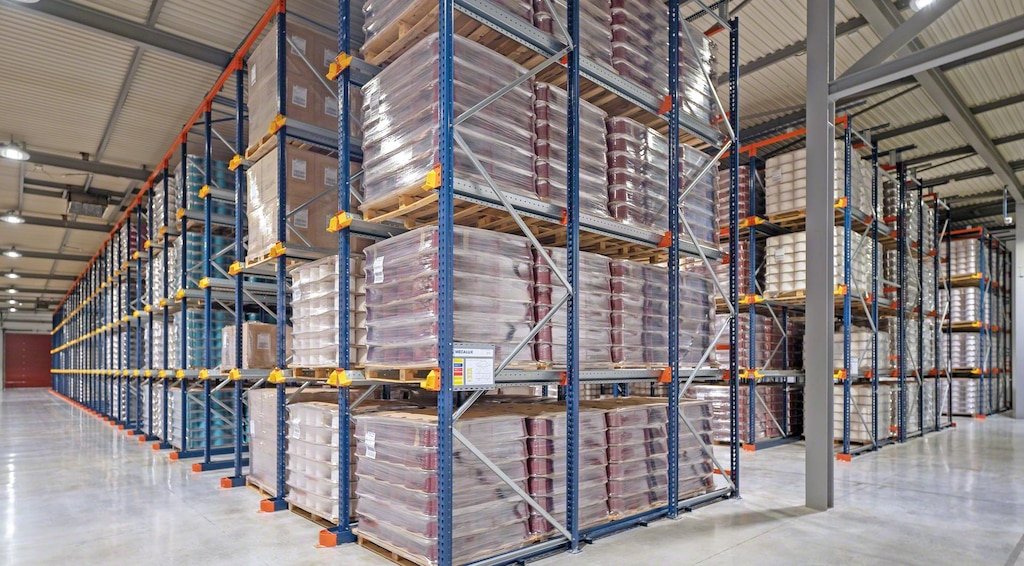
Shuttle: Fully configurable — FIFO when load and retrieval occur at opposite lane ends; LIFO when both at the same end. Rotation mode is set during system design and can be changed later with layout adjustments.
5. Throughput
Drive-In: Low throughput per aisle. Forklift travel inside the lane, pallet-by-pallet placement, and limited visibility reduce cycle times. Typical throughput: 20 to 40 pallet moves per hour per aisle.
Shuttle: High throughput. Forklift cycles are short (only to the aisle face); the shuttle handles deep-lane movement in parallel with forklift activity. Typical throughput: 60 to 120+ pallet moves per hour per aisle.
6. Selectivity
Drive-In: Low — one SKU per lane. Access to deeper pallets requires removing the front pallet first.
Shuttle: Medium-high — one SKU per lane, but all pallets in the lane are accessible without manual intervention. In 4-way shuttle configurations, selectivity extends across multiple lanes and levels served by the same shuttle.
7. Capital Cost per Pallet Position
Drive-In: $120 to $200 per pallet position for standard configurations. Lower end for basic installations, upper end for cold-storage-rated galvanized construction.
Shuttle: $400 to $800 per pallet position (including shuttle carriers and controls). The shuttle equipment is the dominant cost driver.
8. Operating Cost
Drive-In: Higher operating cost on a per-pallet basis — slower forklift cycles, higher damage repair, more labor per throughput unit.
Shuttle: Lower operating cost on a per-pallet basis — faster cycles, lower damage, less labor. Shuttle battery and maintenance cost is modest relative to the labor and damage savings.
9. Forklift Fleet Requirements
Drive-In: Standard reach trucks or counterbalance forklifts. Specialized drive-in masts help but are not strictly required. No shuttle equipment needed.
Shuttle: Standard forklifts at the aisle face plus a fleet of shuttle carriers. Shuttle quantity depends on throughput target and lane count. A typical installation may need 1 shuttle per 4 to 8 aisles.
10. Damage Rate
Drive-In: Typical annual damage rate 5 to 10 percent of racking components. Forklift entry into the rack structure creates frequent impact damage to uprights, rails, and base plates.
Shuttle: Typical annual damage rate 1 to 3 percent. Forklift never enters the structure, eliminating the main damage source. Shuttle-rack interactions are controlled and consistent.
11. Safety
Drive-In: Higher safety exposure. Forklift operators work in deep, narrow, poorly-lit lanes with limited visibility, repeated impacts, and the risk of rack collapse from accumulated damage. Operator training and discipline are critical. Use OSHA powered industrial truck requirements as a safety reference for the forklift element of the operation.
Shuttle: Lower safety exposure. Forklift stays in open aisles. Shuttle operation is remote-controlled with automatic sensors, reducing operator risk inside the storage structure.
12. Installation Time
Drive-In: 30 to 60 days for standard projects.
Shuttle: 45 to 90 days including shuttle commissioning, battery charging infrastructure, and operator training.
13. Scalability and Flexibility
Drive-In: Physical scalability is straightforward (add more bays). Operational flexibility is limited by LIFO rotation and single-SKU lanes.
Shuttle: Shuttle carriers can be added or reassigned across lanes as volumes change. FIFO/LIFO configuration can be adjusted. 4-way shuttle systems offer the most flexibility.

14. Maintenance Requirements
Drive-In: Standard rack inspection and damage repair. No electronic components.
Shuttle: Rack inspection plus shuttle maintenance (battery, motors, sensors, controls). Modern shuttles are designed for 99+ percent uptime with scheduled maintenance.
15. Environmental and Energy Impact
Drive-In: No energy consumption beyond forklift use.
Shuttle: Shuttle battery charging adds modest energy consumption. In cold storage, reduced forklift traffic reduces door openings and compressor load, often producing net energy savings.
Comparison Table: Drive-In vs Shuttle Pallet Racking
| Dimension | Drive-In Racking | Shuttle Pallet Racking |
|---|---|---|
| Density Gain | 60–80% | 60–90% |
| Lane Depth | 3–10 pallets | 10–40 pallets |
| Rotation | LIFO (drive-through = FIFO) | FIFO or LIFO (configurable) |
| Throughput | 20–40 moves/hr/aisle | 60–120+ moves/hr/aisle |
| Selectivity | Low | Medium-High |
| Capital Cost/Position | $120–200 | $400–800 |
| Operating Cost | Higher per pallet | Lower per pallet |
| Forklift Fleet | Standard; enters rack | Standard; stays in aisle |
| Annual Damage Rate | 5–10% | 1–3% |
| Safety Exposure | Higher | Lower |
| Installation Time | 30–60 days | 45–90 days |
| Scalability | Physical scaling only | Physical + operational |
| Maintenance | Rack only | Rack + shuttle |
| Energy Impact | None (forklift only) | Battery charging |
| Best Fit | Low-SKU bulk, LIFO acceptable | High-throughput, density-critical |
ROI and Total Cost of Ownership Analysis
Capital cost comparison tells only part of the story. A full economic analysis across a 15 to 20-year equipment lifecycle typically reverses the apparent advantage of drive-in on anything above small installations.
Baseline Scenario
Assume a 1,000-pallet-position installation in a cold storage facility, 5 years of operational analysis.
| Cost Component | Drive-In Racking | Shuttle Pallet Racking |
|---|---|---|
| Equipment (per position) | $160 × 1,000 = $160,000 | $600 × 1,000 = $600,000 |
| Installation | $30,000 | $45,000 |
| Shuttle carriers (6 units) | — | Included above |
| Total Capital | $190,000 | $645,000 |
The capital gap is $455,000 in favor of drive-in. This is the figure buyers often focus on exclusively — and it is misleading.
Operating Cost Analysis (5-Year Horizon)
Labor cost. Shuttle throughput is 2 to 3 times higher per aisle than drive-in. For the same throughput, drive-in typically requires 1 to 2 additional forklift operators.
- Drive-in incremental labor: $50,000/year × 5 = $250,000
- Shuttle incremental labor: $0
Damage repair cost. Drive-in damage rate of 5 to 10 percent per year vs shuttle 1 to 3 percent.
- Drive-in damage: $160,000 × 7% × 5 years = $56,000
- Shuttle damage: $600,000 × 2% × 5 years = $60,000
- Net difference: minimal, but drive-in damage disrupts operations more frequently
Energy cost (cold storage). Shuttle reduces forklift entry and door cycles, cutting refrigeration load.
- Drive-in refrigeration overhead: baseline
- Shuttle refrigeration saving: ~$10,000 to $20,000/year in a typical cold storage facility = $50,000 to $100,000 over 5 years
Space cost (refrigerated). Shuttle’s deeper lanes deliver more pallet capacity in the same refrigerated volume, reducing future expansion cost.
- Drive-in expansion need: typically 20 to 30% sooner
- Shuttle avoided expansion: $200,000 to $500,000 depending on market
5-Year TCO Summary
| Component | Drive-In | Shuttle |
|---|---|---|
| Initial Capital | $190,000 | $645,000 |
| Labor (5 yr) | $250,000 | $0 |
| Damage Repair (5 yr) | $56,000 | $60,000 |
| Energy (5 yr) | Baseline | -$75,000 |
| Avoided Expansion | None | -$300,000 (typical) |
| Net 5-Year TCO | $496,000 | $330,000 |
Even at the capital cost gap of $455,000 favoring drive-in, shuttle’s operational advantages typically close the gap within 3 to 5 years in medium-to-large installations. For installations above 2,000 pallet positions or with high throughput demands, shuttle TCO is often lower from year 3 onward.
When the ROI Calculation Favors Drive-In
Drive-in retains the TCO advantage when:
- Installation size under 500 pallet positions — capital gap is smaller, operational differences compress
- Low throughput requirements — labor savings on shuttle are smaller
- Short operational horizon (3 years or less) — capital payback window is too short
- Ambient storage (not refrigerated) — energy savings on shuttle are smaller
- Stable SKU profile with long-cycle turns — LIFO is acceptable
- Capital-constrained budget — the $455,000 upfront gap matters more than 5-year TCO
Industry Applications: Which System Fits Where
| Industry / Application | Typical Preferred System | Reason |
|---|---|---|
| Cold storage (large-scale) | Shuttle | Density, throughput, energy savings |
| Cold storage (small-scale) | Drive-In | Capital constraint, acceptable throughput |
| Beverage (bulk) | Drive-In or Drive-Through | Low SKU count, high pallets per SKU |
| Beverage (high-throughput) | Shuttle (FIFO) | Rotation + throughput |
| Frozen food distribution | Shuttle (FIFO) | FIFO required for perishables |
| Dairy / Fresh food | Shuttle (FIFO) | FEFO compliance, high throughput |
| Automotive parts | Shuttle | Cycle times, damage avoidance |
| Bulk raw materials | Drive-In | Low selectivity, high density acceptable |
| 3PL multi-client | Mixed | Depends on client profile |
| Pharmaceutical | Shuttle (FIFO) | Compliance + selectivity |
For additional context on cold storage system selection, see the cold storage warehousing guide.
Common Decision Mistakes
1. Buying drive-in on upfront cost alone. The capital gap looks compelling, but TCO analysis across 5 years typically narrows or reverses it. Buyers who skip TCO analysis often regret the decision within 2 to 3 years.
2. Buying shuttle when scale does not justify it. Shuttle TCO advantages depend on scale. For installations under 500 pallet positions with moderate throughput, drive-in may remain the correct choice.
3. Specifying drive-in for FIFO-critical inventory. Drive-in is LIFO. Using it for perishable or batch-tracked inventory creates rotation risk that no operational discipline can fully overcome.
4. Underestimating drive-in damage cost. A 5 to 10 percent annual damage rate on a $200,000 installation is $10,000 to $20,000 per year in direct cost — plus operational disruption that is harder to quantify.
5. Overlooking shuttle flexibility. Shuttle carriers can be redeployed across lanes as SKU volumes change. Drive-in cannot — the lane structure is fixed at installation.
6. Ignoring energy economics in cold storage. Shuttle reduces door openings and forklift heat load, producing refrigeration savings that compound over the lifecycle.
7. Assuming all shuttle systems are equivalent. Radio shuttle and 4-way shuttle systems differ significantly in flexibility, throughput, and capital cost. Match shuttle type to operation profile, not just density target.
Warehouse Planning Recommendations
1. Run TCO analysis, not just capital cost comparison. A 5-year TCO model including labor, damage, energy, and avoided expansion typically changes the decision outcome. Decisions based on capital cost alone systematically favor drive-in beyond its actual operational merit.
2. Match rotation requirement to system selection. FIFO-critical inventory (perishables, batch-tracked, regulated) should default to shuttle or drive-through. LIFO-acceptable inventory can use drive-in.
3. Assess throughput requirements realistically. Current throughput plus 3-year growth projection determines whether drive-in capacity is adequate. Installations approaching throughput limits require shuttle to avoid future retrofit.
4. Factor cold storage economics into selection. Refrigerated space costs 3 to 5 times more than ambient. Density and energy advantages of shuttle amplify in cold storage. Ambient applications may favor drive-in on cost grounds.
5. Reserve capacity for operational changes. SKU profile and volume evolve. Shuttle systems adapt more easily; drive-in structure is harder to reconfigure.
6. Include safety and damage cost in economic modeling. Safety exposure and damage rate are not just operational nuisances — they have measurable financial impact across the equipment lifecycle.
7. Pilot before full-scale commitment. For large installations, run a pilot of each system on representative SKUs. Measured results typically settle debates that specification analysis cannot resolve.
How to Choose Between Drive-In and Shuttle Pallet Racking: Framework
Step 1 — Define rotation requirement. FIFO, FEFO, or LIFO acceptable. FIFO eliminates drive-in (though drive-through remains viable).
Step 2 — Quantify SKU profile. Pallets per SKU, number of SKUs, and expected changes over 3 to 5 years. Both systems need high pallets per SKU; shuttle tolerates variation better.
Step 3 — Specify throughput requirements. Peak pallet moves per hour, cycle time constraints, and batch processing windows. High throughput favors shuttle.
Step 4 — Analyze building constraints. Clear height, floor loading, column grid, dock positions, and existing racking layout.
Step 5 — Model storage capacity under each option. Pallet positions achievable with drive-in vs shuttle in the available footprint.
Step 6 — Run 5-year TCO analysis. Include capital, installation, labor, damage repair, energy, and avoided expansion. Use real local costs rather than generic assumptions.
Step 7 — Evaluate safety and compliance. Verify that the chosen system meets rack design standards (FEM 10.2.02, MH16.1, AS 4084) and applicable seismic and fire codes. The RMI R-Mark program is a useful reference when assessing equipment designed to applicable ANSI/RMI standards.
Step 8 — Assess operational risk tolerance. Operations sensitive to downtime, damage, or rotation errors favor shuttle. Operations with tolerance for these factors can accept drive-in.
Step 9 — Consider hybrid deployment. Many large facilities deploy drive-in for low-value, bulk, LIFO-acceptable zones and shuttle for high-value, FIFO-required, or high-throughput zones.
Step 10 — Verify with pilot or reference installation. Observe similar installations in operation before committing. Both systems behave differently in practice than on paper.
FAQ
1. What is the main difference between drive-in racking and shuttle pallet racking? The main difference is how pallets move inside the rack. Drive-in racking requires forklifts to enter the rack structure to place and retrieve pallets, operating LIFO by default. Shuttle pallet racking uses a remote-controlled shuttle carrier that moves pallets within the lane while the forklift remains at the aisle face, operating FIFO or LIFO as configured. This structural difference drives all downstream operational and economic differences.
2. Which system has higher storage density? Both systems achieve 60 to 90 percent higher density than selective racking. Shuttle systems can safely use deeper lanes (10 to 40 pallets) than drive-in (3 to 10 pallets), so shuttle typically delivers density at the upper end of the range, especially in larger installations.
3. Is shuttle pallet racking worth the extra cost? Shuttle racking costs 2 to 4 times more per pallet position than drive-in. Across a 5-year TCO analysis including labor, damage, energy, and avoided expansion, shuttle typically recovers the capital gap in 3 to 5 years for installations above 1,000 pallet positions in cold storage or high-throughput applications. Smaller installations or ambient applications with modest throughput may not reach favorable shuttle ROI.
4. Can drive-in racking operate in FIFO mode? Standard drive-in racking is LIFO by structural design. The drive-through variant — with open access at both ends of the lane — provides FIFO rotation. Drive-through requires more floor area because of the second access aisle but retains most of drive-in’s density advantage.
5. Which system is better for cold storage? Shuttle pallet racking is generally preferred for large cold storage installations because its density, throughput, and energy savings compound in refrigerated space. Drive-in remains acceptable for smaller cold storage, low-throughput applications, or where capital constraints are binding.
6. Do shuttle systems require different forklifts? No. Shuttle systems use standard reach trucks or counterbalance forklifts at the aisle face. The shuttle carrier itself is a separate piece of equipment that handles movement inside the lane. Operator training for shuttle operation is required but forklift fleet changes are not.
7. How many shuttle carriers do I need? Shuttle quantity depends on throughput requirements and lane count. A typical rule of thumb is 1 shuttle per 4 to 8 aisles for moderate throughput. High-throughput installations may require 1 shuttle per 2 to 3 aisles. 4-way shuttle systems can serve more lanes per unit than radio shuttle systems.
8. Can I combine drive-in and shuttle racking in one facility? Yes, and many large facilities do. A typical hybrid layout uses drive-in or drive-through for low-value, bulk, LIFO-acceptable inventory and shuttle for high-value, FIFO-required, or high-throughput inventory. Hybrid layouts optimize capital deployment by matching system type to the operational profile of each SKU zone.
Key Takeaways
- Drive-in racking offers the lowest capital cost per pallet position but creates LIFO rotation, higher damage rates, and higher labor cost per pallet move.
- Shuttle pallet racking offers higher capital cost but lower operating cost, FIFO/LIFO flexibility, higher throughput, and dramatically lower damage exposure.
- A 5-year TCO analysis — including labor, damage, energy, and avoided expansion — typically favors shuttle for cold storage, large installations, and high-throughput operations.
- Drive-in retains the TCO advantage for small installations, low-throughput operations, ambient storage, short operational horizons, and capital-constrained budgets.
- Many large facilities deploy both systems in different zones, matching rack type to the operational profile of each SKU category.
Conclusion
The choice between drive-in racking and shuttle pallet racking is rarely about which system is better in absolute terms — both are mature, proven technologies serving different operational contexts. The right choice depends on scale, throughput, rotation requirements, operational horizon, cold storage economics, and capital constraints working together. Buyers who focus exclusively on capital cost systematically underweight shuttle’s operational advantages; buyers who focus exclusively on throughput and density may overspend on shuttle where drive-in would have served adequately. A structured TCO analysis typically resolves the ambiguity better than any single-dimension comparison.
Warehouse operators comparing drive-in and shuttle configurations for cold storage, beverage, or high-throughput applications frequently include suppliers such as Gieantech in supplier evaluations to compare structural design, shuttle carrier capability, rack-system integration, and lifecycle cost across both platforms — ensuring the chosen specification matches both the immediate storage requirement and the long-term operational economics of the facility. For deeper context on either system individually, see the broader warehouse storage equipment overview and the companion FIFO racking guide covering rotation-driven selection.
 English
 Spanish
 Arabic
 Tagalog
 Korean
 Russian
 Thai
 Japanese
 Indonesian
 Portuguese
 French
 Chinese