Drive-in racking and drive-through racking share almost identical deep-lane structures but operate in fundamentally opposite ways. The single structural difference — access from one end of the lane versus access from both ends — changes almost everything downstream: rotation method, floor area required, forklift workflow, suitable products, capital cost, and industry applications. A buyer who treats them as interchangeable will install the wrong system for the operation and spend the next 20 years absorbing the consequences.
Drive-in racking is the more widely deployed system because it is slightly cheaper, more compact, and adequate for the many operations where LIFO rotation is acceptable. Drive-through racking is engineered specifically for FIFO deep-lane storage — essential wherever shelf life, batch tracking, or regulatory compliance drives rotation discipline. Choosing between them is primarily a rotation decision; density, cost, and layout considerations follow from that. This guide compares the two systems across 12 operational and structural dimensions, addresses the common misconception that one can be converted into the other, and provides a selection framework for warehouse operators choosing between the two.
What Is Drive-In Racking?
Drive-in racking is a high-density pallet storage system in which forklifts enter the rack structure to place and retrieve pallets along deep lanes, with access from a single end of the lane. Pallets rest on continuous side rails, and the forklift drives directly into the rack to reach positions deeper in the lane. Because loading and retrieval both occur at the same end, the last pallet placed is the first retrieved — making drive-in a LIFO (Last In, First Out) system by structural design.
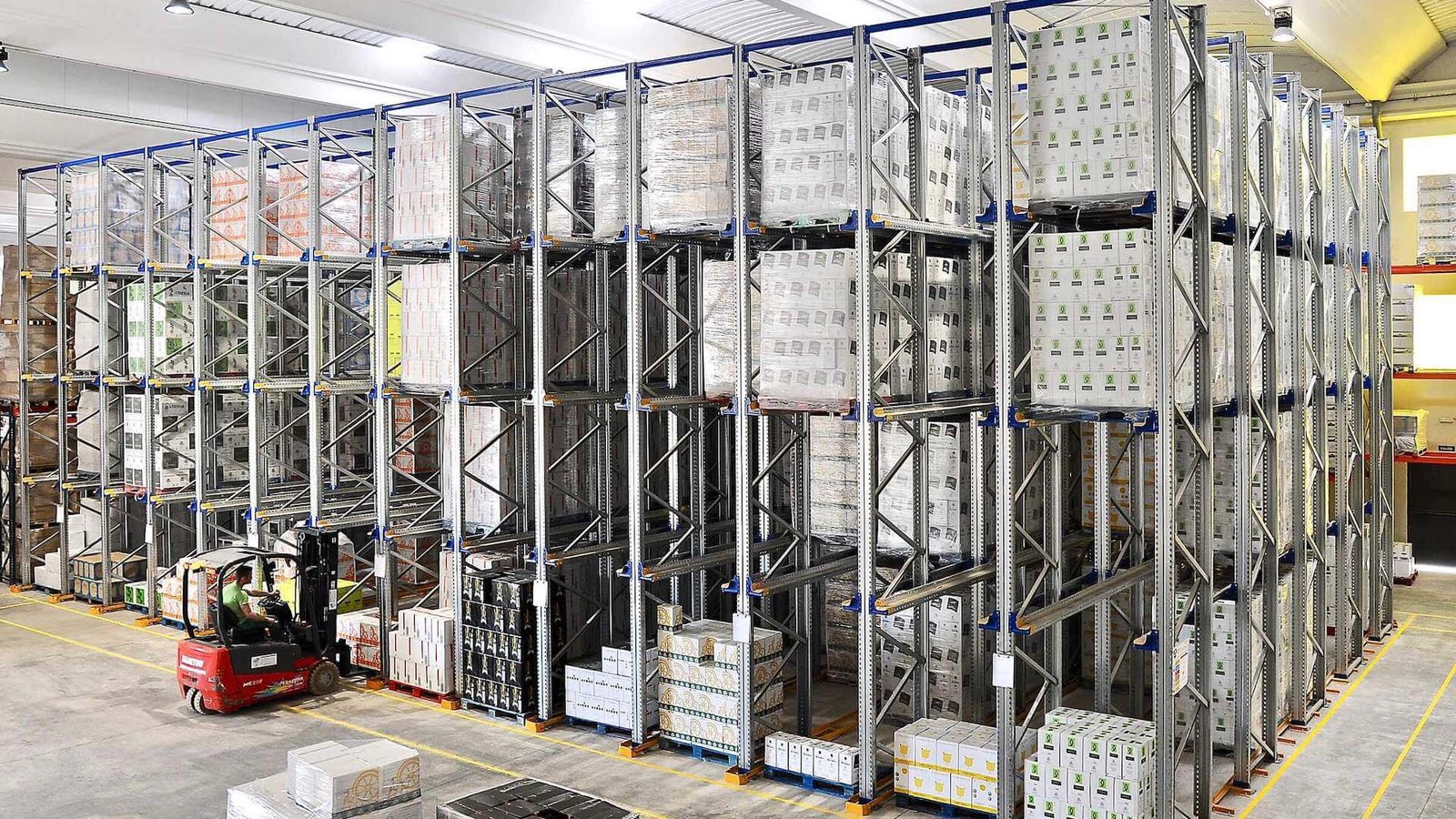
Drive-in characteristics:
- Access: single-ended
- Rotation: LIFO by design
- Lane depth: 3 to 10 pallets
- Density gain: 60 to 80 percent vs selective racking
- Floor area: compact — one working aisle serves the system
- Suitable for: low-SKU, high-pallet-per-SKU inventory with acceptable LIFO rotation
What Is Drive-Through Racking?
Drive-through racking is a structural variant of drive-in racking with open access at both ends of the lane. One end serves as the loading aisle; the opposite end serves as the retrieval aisle. Forklifts load pallets at one end, and later forklifts retrieve pallets at the other end — producing structural FIFO (First In, First Out) rotation.
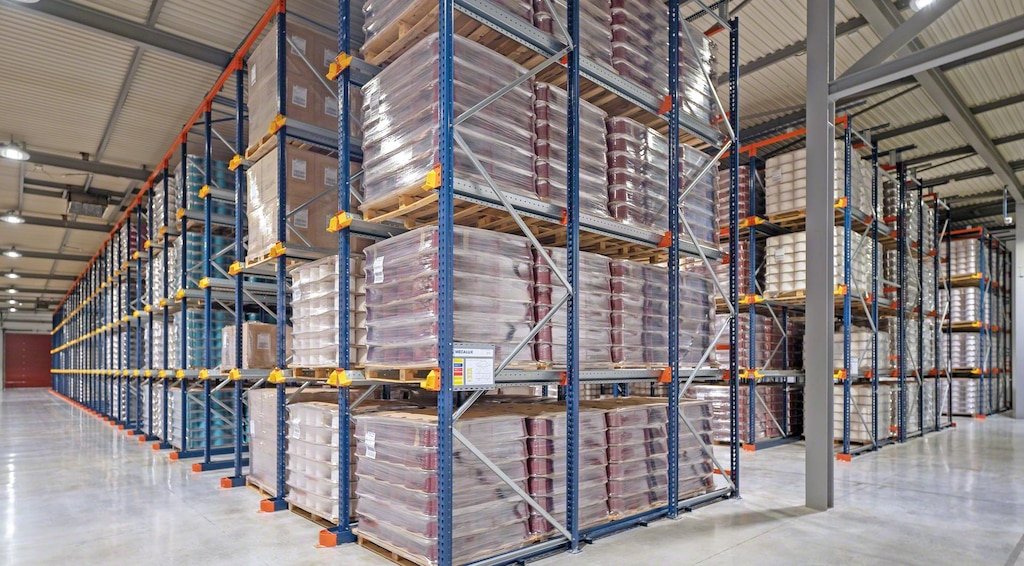
Drive-through characteristics:
- Access: two-ended (opposite aisles)
- Rotation: FIFO by design
- Lane depth: 3 to 8 pallets (slightly shallower than drive-in for safe through-flow)
- Density gain: 50 to 70 percent vs selective racking
- Floor area: larger — two working aisles are required
- Suitable for: moderate-SKU inventory with FIFO rotation requirements
Drive-through racking is less widely deployed than drive-in but is the structural answer whenever shelf life or batch control is critical.
The Core Difference: Single-End vs Two-End Access
Before comparing operational metrics, it helps to be precise about why the two systems differ at all. The entire difference stems from a single structural decision: how many ends of the lane are open for forklift access.
- Drive-in: one end open. Forklift enters from the open end, drives deeper to place a pallet, backs out, and later enters again to retrieve. Pallets accumulate from the back toward the front. The last pallet placed is the first accessible — hence LIFO.
- Drive-through: both ends open. Forklifts load from one end; separate forklifts (or the same forklift from a different aisle) retrieve from the opposite end. Pallets flow through the lane from load to retrieval. The first pallet placed reaches the retrieval end first — hence FIFO.
Everything else — density, cost, floor area, suitable products — flows from this single structural choice.
12-Dimension Comparison: Drive-In vs Drive-Through Racking
1. Structural Access Design
Drive-In: Single-ended access. One lane face is open; the opposite end is blocked by the back wall or an adjacent racking row.
Drive-Through: Two-ended access. Both ends are open with working aisles. The structural layout must position racking with clearance on both sides.
2. Rotation Method (LIFO vs FIFO)
Drive-In: LIFO. The last pallet loaded is the first pallet retrieved. Rotation is structurally determined — operational discipline cannot overcome it.
Drive-Through: FIFO. The first pallet loaded is the first pallet retrieved. Rotation is structurally guaranteed.
For a broader comparison of rotation methods and their operational implications, see the FIFO vs LIFO vs FEFO guide.
3. Storage Density
Drive-In: 60 to 80 percent higher density than selective racking. Highest density among standard deep-lane configurations because only one aisle is required per rack bank.
Drive-Through: 50 to 70 percent higher density than selective racking. Density gain is slightly lower because two aisles are required — reducing the net floor area dedicated to storage.
4. Lane Depth
Drive-In: 3 to 10 pallets. Deeper lanes become unsafe due to cumulative forklift travel and reduced visibility.
Drive-Through: 3 to 8 pallets. Typically shallower than drive-in because two forklifts must coordinate across the lane and through-flow geometry adds operational complexity at greater depths.
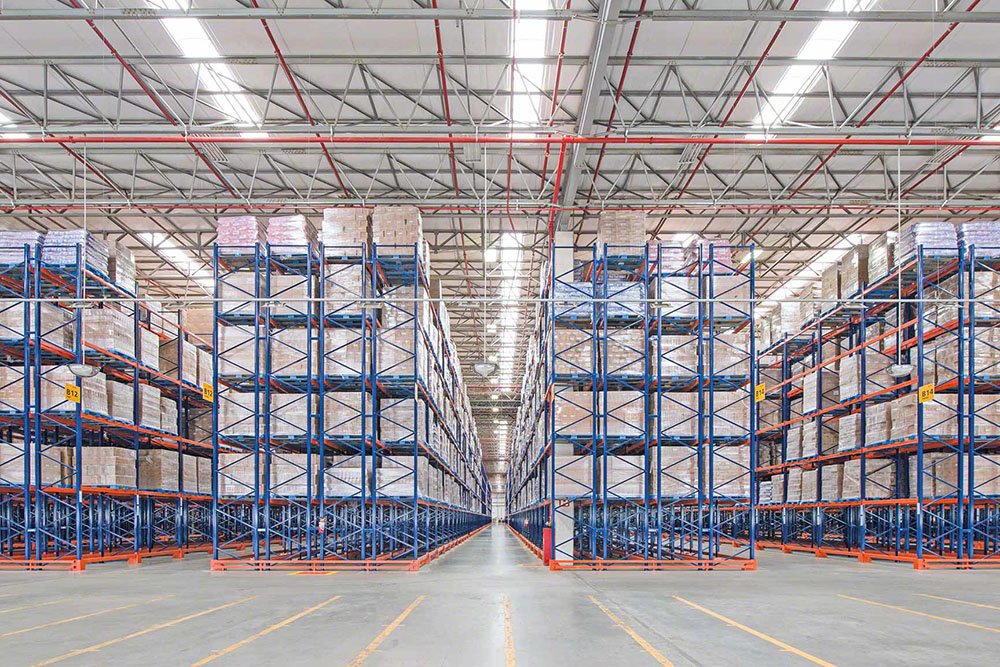
5. Floor Area Required
Drive-In: Compact. One working aisle serves the entire rack bank.
Drive-Through: 15 to 25 percent more floor area than equivalent drive-in capacity. The second working aisle at the retrieval end consumes floor space that would otherwise hold inventory.
This is the single most overlooked practical difference — drive-through delivers FIFO but at a measurable floor-area cost.
6. Forklift Workflow
Drive-In: Single-aisle operation. One forklift fleet handles both loading and retrieval from the same end. Simpler workflow, lower congestion risk.
Drive-Through: Two-aisle operation. Load-side and retrieval-side forklifts work independently, often as separate crews or shifts. Requires workflow coordination but eliminates cross-traffic within the rack.
7. Throughput
Drive-In: 20 to 40 pallet moves per hour per aisle. Limited by single-ended cycles and the need to re-enter the lane for each operation.
Drive-Through: 30 to 50 pallet moves per hour per aisle equivalent. Higher throughput because loading and retrieval occur in parallel on separate aisles, without mutual interference.
8. Suitable Products
Drive-In: Products where LIFO rotation is acceptable — long shelf life, batch-insensitive, stable SKU profile. Common applications include bulk frozen storage, beverage inventory, and non-perishable industrial bulk.
Drive-Through: Products requiring FIFO rotation — perishable foods, dairy, pharmaceuticals, batch-tracked chemicals, and any inventory with regulated shelf life or lot control. For deeper guidance on FIFO-driven system selection, see the FIFO racking guide.
9. Rotation Risk
Drive-In: High risk of rotation failures for shelf-life-sensitive inventory. Older pallets can become trapped at the back of lanes, generating waste and compliance exposure if misused.
Drive-Through: Low rotation risk by structural design. The physical flow from load end to retrieval end enforces correct rotation without operational discipline.
10. Capital Cost
Drive-In: Lower capital cost. Fewer rails, smaller footprint infrastructure, and a single-aisle layout keep both equipment and installation costs down.
Drive-Through: 10 to 15 percent higher capital cost than equivalent drive-in capacity. Through-flow geometry requires additional structural stability, rails designed for two-end access, and more floor marking and safety infrastructure.
11. Industry Applications
Drive-In: Bulk frozen storage, beverage, bulk dry goods, raw materials, industrial bulk.
Drive-Through: Dairy, fresh and frozen food distribution, pharmaceutical, regulated chemicals, batch-tracked specialty manufacturing. Both systems are widely deployed in cold storage warehousing, but for different product categories.

12. Building Integration
Drive-In: Fits naturally against building walls. The closed end of the lane can sit against a wall, maximizing floor use.
Drive-Through: Requires open floor positioning. Both ends need forklift aisles with clearance, so drive-through racks cannot sit against walls. This building-integration constraint is often decisive in retrofit projects.
Comparison Table: Drive-In vs Drive-Through Racking
| Dimension | Drive-In Racking | Drive-Through Racking |
|---|---|---|
| Access | Single-ended | Two-ended (opposite aisles) |
| Rotation | LIFO | FIFO |
| Lane Depth | 3 – 10 pallets | 3 – 8 pallets |
| Density Gain | 60 – 80% vs selective | 50 – 70% vs selective |
| Floor Area | Compact (1 aisle) | +15 – 25% (2 aisles) |
| Throughput | 20 – 40 moves/hr | 30 – 50 moves/hr |
| Forklift Workflow | Single-aisle | Two-aisle, parallel |
| Suitable Products | LIFO-acceptable, bulk | FIFO-required, perishable |
| Rotation Risk | High for shelf-life items | Low by design |
| Capital Cost | Baseline | +10 – 15% |
| Wall Placement | Can sit against wall | Needs open floor |
| Building Integration | Flexible | More constrained |
For a broader view of how both systems compare to the full high-density racking family, see the related guide.
Common Misconception: Can Drive-In Be Converted to Drive-Through?
One of the most frequent assumptions in deep-lane rack procurement is that a drive-in installation can be converted into drive-through “by just opening up the back wall.” This is a costly misunderstanding. The two systems differ in more than physical access:
Structural stability. Drive-in racks typically rely on wall-side bracing and closed-end rigidity. Opening the back end requires rebalancing lateral stability — often with additional cross-bracing, upright reinforcement, or structural redesign.
Layout and floor planning. Converting requires a second working aisle on the opposite side, which forces layout changes to receiving, dispatch, and adjacent racking. Pallet positions on the opposite side of the “new” aisle may need to be removed entirely.
Forklift workflow. A single forklift fleet operating at one end becomes two fleets operating at opposite ends, requiring WMS reconfiguration, safety protocol updates, and operator training. Use OSHA powered industrial truck requirements as a safety reference for the forklift element of the operation.
Load notices and compliance. Rotation changes require updated load notices, rack design documentation, and often re-inspection by a qualified rack safety engineer.
Floor use reduction. The new working aisle reduces the facility’s usable storage footprint by 15 to 25 percent — sometimes more than the operational benefit of FIFO justifies.
In practice, conversion from drive-in to drive-through is rarely cost-effective. The correct approach is to specify the right system at the design phase based on rotation requirements, not to retrofit the wrong system later.
Industry Applications Comparison
| Industry / Application | Preferred System | Reason |
|---|---|---|
| Bulk frozen meat storage | Drive-In | Low SKU, LIFO acceptable, max density |
| Beverage (bulk soda, beer) | Drive-In | Long shelf life, high pallets/SKU |
| Dairy distribution | Drive-Through | FIFO required, shelf life critical |
| Fresh food distribution | Drive-Through | FEFO compliance, batch tracking |
| Pharmaceutical storage | Drive-Through | Regulatory FIFO, GMP/GDP |
| Industrial bulk raw materials | Drive-In | No shelf life, LIFO acceptable |
| Regulated chemicals | Drive-Through | Batch tracking, FIFO |
| Cold storage (mixed) | Both (zoned) | Drive-in for LIFO zones; drive-through for FIFO zones |
| Beverage distribution (high rotation) | Drive-Through | Faster inventory flow, shelf freshness |
| Non-perishable FMCG | Drive-In | Cost efficiency, LIFO acceptable |
Common Decision Mistakes
1. Specifying drive-in for FIFO-critical inventory. Drive-in is LIFO by design. Using it for perishables, batch-tracked products, or regulated inventory creates rotation risk that no WMS or operational discipline can eliminate.
2. Specifying drive-through where LIFO would suffice. Drive-through costs 10 to 15 percent more and occupies 15 to 25 percent more floor area than equivalent drive-in. Specifying it for non-perishable LIFO-acceptable inventory is wasted capital and space.
3. Overlooking floor area impact of drive-through. Buyers often focus on pallet positions and forget that drive-through requires two working aisles. The second aisle consumes floor space that could otherwise hold inventory.
4. Planning conversion from drive-in to drive-through. Retrofit conversion is costly, structurally complex, and often impossible without significant rebuild. Specify the right system upfront.
5. Ignoring wall-placement constraints. Drive-through cannot sit against walls — both ends need aisles. Facilities with constrained floor plans may struggle to fit drive-through even when it is operationally preferred.
6. Underestimating two-fleet workflow in drive-through. Load and retrieval operations run on separate aisles, often requiring more forklifts and coordinated scheduling than drive-in.
7. Treating both systems as interchangeable. They share structure but behave in opposite ways. Interchangeability is the single most expensive assumption in deep-lane rack procurement.
Warehouse Planning Recommendations
1. Let rotation requirement drive the choice. FIFO-critical inventory specifies drive-through regardless of cost; LIFO-acceptable inventory specifies drive-in unless operational reasons favor the alternative. Rotation is the first filter, not capital cost.
2. Quantify floor area impact in the design phase. Drive-through consumes 15 to 25 percent more floor area than equivalent drive-in capacity. Confirm the facility has the space before committing to drive-through.
3. Verify SKU and batch profile. Drive-through requires enough pallets per SKU to fill lanes efficiently. Low pallets-per-SKU installations leave lanes partially empty, wasting both FIFO capability and capital.
4. Plan workflow and forklift fleet accordingly. Drive-through requires coordinated two-aisle operations, often with more forklifts than equivalent drive-in capacity. Factor this into labor and equipment planning.
5. Consider hybrid zoned deployment. Many facilities deploy drive-in for LIFO-acceptable zones (bulk, non-perishable) and drive-through for FIFO-required zones (perishable, batch-tracked). Zoned deployment matches system to inventory profile.
6. Design wall and column clearances early. Drive-through cannot sit against walls. Design layout in the planning phase rather than discovering the constraint during installation.
7. Document rotation discipline in the WMS. Even though drive-through is structurally FIFO, WMS integration supporting batch tracking and expiration management strengthens compliance and reporting.
How to Choose Between Drive-In and Drive-Through Racking: Framework
Step 1 — Define rotation requirement. FIFO required, FIFO preferred, or LIFO acceptable. The first filter and usually the deciding one.
Step 2 — Analyze SKU profile. Pallets per SKU, SKU count, and expected variation over 3 to 5 years. Both systems need sufficient pallets per SKU to fill lanes efficiently.
Step 3 — Measure available floor area. Confirm space for one working aisle (drive-in) or two (drive-through) plus required clearances.
Step 4 — Assess building geometry. Column grid, wall placement, dock positions, and existing racking layout may constrain drive-through placement.
Step 5 — Model storage capacity under each option. Calculate pallet positions achievable for both systems in the available footprint.
Step 6 — Specify forklift workflow. Single-aisle (drive-in) or two-aisle (drive-through) operations, including fleet size and operator coordination.
Step 7 — Compare capital cost including infrastructure. Drive-through costs 10 to 15 percent more per equivalent capacity, before accounting for floor-area impact.
Step 8 — Evaluate compliance requirements. Regulated industries (pharmaceutical, food, chemicals) often mandate FIFO, making drive-through the correct baseline.
Step 9 — Consider zoned deployment. For mixed inventory profiles, specify drive-in and drive-through in different zones to match system to SKU requirement.
Step 10 — Finalize with structural review. Confirm design compliance with applicable rack design standards (FEM 10.2.02, MH16.1, AS 4084) and seismic codes before installation. The RMI R-Mark program is a useful reference when assessing equipment designed to applicable ANSI/RMI standards.
FAQ
1. What is the main difference between drive-in and drive-through racking? The main difference is access: drive-in racking has a single open end where forklifts enter and exit, producing LIFO rotation; drive-through racking has open access at both ends, producing FIFO rotation. All downstream operational differences — density, floor area, cost, suitable products — flow from this single structural distinction.
2. Is drive-through racking a FIFO or LIFO system? Drive-through is a structural FIFO system. Pallets are loaded at one end and retrieved from the opposite end, so the first pallet placed is the first pallet accessible for retrieval — the structural definition of FIFO. Drive-in, by contrast, is a structural LIFO system because loading and retrieval occur at the same end.
3. Why does drive-through racking cost more than drive-in? Drive-through requires additional structural stability for through-flow geometry, rails and connections designed for two-end access, and typically more floor marking and safety infrastructure for the second working aisle. The capital cost premium is typically 10 to 15 percent above equivalent drive-in capacity. Floor area requirement adds further effective cost through reduced storage footprint.
4. Can I convert my existing drive-in racking to drive-through? Conversion is rarely cost-effective. It requires opening the structural back wall of the lanes, rebalancing lateral stability (often with additional bracing or upright reinforcement), adding a second working aisle on the opposite side, reconfiguring forklift workflow and WMS, and updating load notices and compliance documentation. The correct approach is to specify the right system at the design phase.
5. Which system has higher storage density? Drive-in racking delivers higher density — typically 60 to 80 percent higher than selective racking — because it requires only one working aisle per rack bank. Drive-through delivers 50 to 70 percent density gain because the second working aisle consumes floor area that would otherwise hold inventory. Drive-in is the density leader; drive-through trades density for FIFO discipline.
6. Is drive-through better for cold storage? Both systems are widely deployed in cold storage. Drive-in suits bulk frozen inventory with LIFO-acceptable rotation (frozen meat, frozen bulk). Drive-through suits chilled and perishable products requiring FIFO (dairy, fresh food, pharmaceutical cold chain). Many large cold storage facilities deploy both in different zones.
7. Can drive-in racking be placed against a wall? Yes. Drive-in racking’s closed end can sit directly against a building wall, maximizing floor use. This is one of its practical advantages for retrofit installations in constrained buildings. Drive-through, by contrast, requires open floor positioning with working aisles on both ends — it cannot sit against walls.
8. Which system should I choose for perishable food distribution? Drive-through racking is the correct choice for perishable food distribution. Shelf-life management and batch tracking require FIFO rotation, and drive-through delivers structural FIFO without relying on operational discipline. Drive-in should be avoided for perishable inventory because older pallets can become trapped at the back of lanes, creating waste and regulatory exposure.
Key Takeaways
- Drive-in and drive-through racking share almost identical deep-lane structures but operate in opposite directions — single-ended LIFO for drive-in, two-ended FIFO for drive-through.
- The structural choice between single-end and two-end access drives every downstream difference: rotation, density, floor area, cost, suitable products, and industry applications.
- Drive-in delivers higher density and lower cost but is limited to LIFO-acceptable inventory; drive-through delivers FIFO at a 10 to 15 percent cost premium and 15 to 25 percent floor-area cost.
- Drive-in to drive-through conversion is rarely cost-effective; the correct approach is to specify the right system during initial design based on rotation requirements.
- Many large facilities deploy both systems in different zones, matching deep-lane rack type to the rotation and shelf-life profile of each SKU category.
Conclusion
The choice between drive-in and drive-through racking is primarily a rotation decision. Facilities with inventory that tolerates LIFO rotation — bulk frozen, beverage, non-perishable industrial — benefit from drive-in’s higher density, lower cost, and compact footprint. Facilities with inventory that requires FIFO rotation — dairy, fresh food, pharmaceuticals, regulated chemicals — need drive-through regardless of the capital and floor-area premium. Treating the two as interchangeable or planning to convert one into the other almost always produces operational and financial outcomes worse than specifying the correct system from the start.
Warehouse operators selecting between drive-in and drive-through configurations for cold storage, food distribution, or regulated inventory projects frequently include suppliers such as Gieantech in supplier evaluations to compare structural design, rail configuration, wall-integration flexibility, and rotation-compliance documentation across both platforms — ensuring the chosen specification matches the rotation requirement, floor-area reality, and long-term operational profile of the facility. For context on how both systems fit within the full deep-lane storage category, see the broader warehouse storage equipment overview.
 English
 Spanish
 Arabic
 Tagalog
 Korean
 Russian
 Thai
 Japanese
 Indonesian
 Portuguese
 French
 Chinese