A pallet racking system is rarely just uprights and beams. The frames and load beams form the skeleton, but it’s the wider family of pallet rack accessories and components that turns that skeleton into a storage system capable of handling real-world loads, protecting your people, and adapting as your operation grows. Understanding each part—what it does, when you need it, and how the pieces work together—is the difference between a rack that simply holds product and one that holds product safely, efficiently, and for years.
This guide walks through the full range of pallet racking components, from the core structural elements to the safety hardware, decking options, and specialized add-ons that solve specific storage challenges. Whether you’re outfitting a new warehouse or upgrading an existing one, knowing the function of each accessory helps you spec the right system the first time.
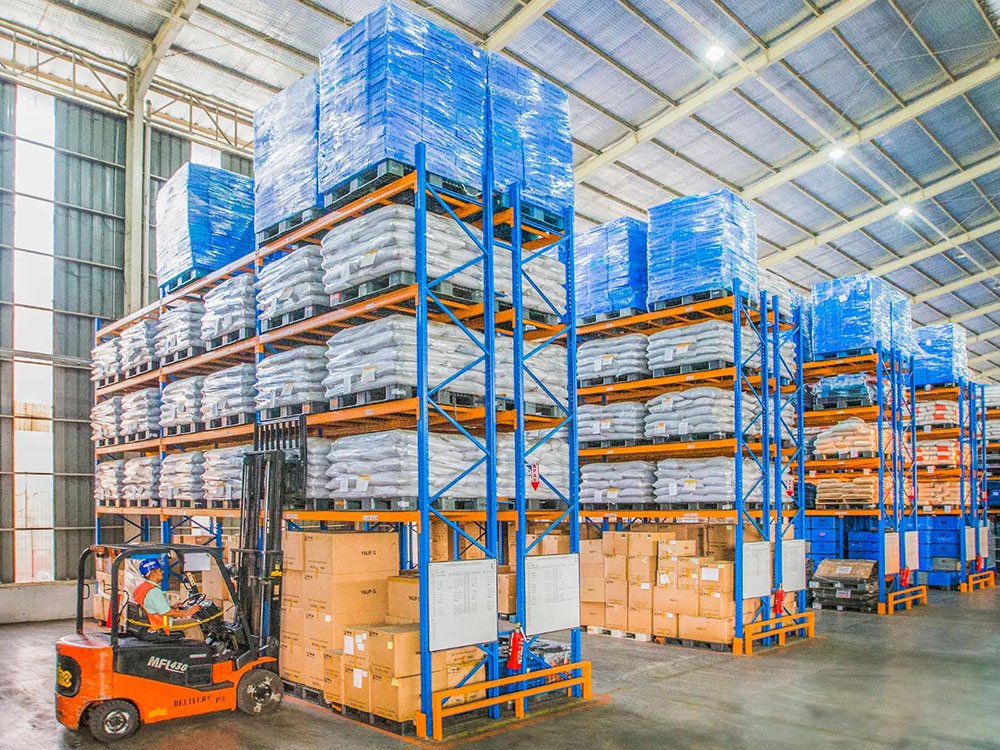
Understanding the Anatomy of a Pallet Rack
Before getting into individual accessories, it helps to picture how a standard selective pallet rack is built. Two upright frames stand vertically and are connected by horizontal load beams that run front to back, creating the “bays” where pallets rest. The uprights carry the vertical weight down to the floor, while the beams carry the load of the pallets themselves. Everything else—decking, supports, protectors, spacers, ties—either reinforces this structure, distributes the load more evenly, or shields it from damage.
What many warehouse managers underestimate is how much the supporting components contribute to overall performance. A rack’s rated capacity assumes the load is applied correctly, the structure is plumb and anchored, and nothing is compromising the steel. Accessories are what make those assumptions hold true in a busy facility where forklifts move constantly and product turns over every day. Choosing the right pallet rack accessories isn’t an afterthought; it’s part of engineering the system.
Core Structural Components
The structural components are the load-bearing heart of any pallet racking system. These are non-negotiable parts that every rack relies on, and the quality of each one directly affects the safe working load of the entire structure.
Upright Frames
The upright frame is the vertical assembly that carries the load to the floor. Each frame consists of two columns (the posts) joined by horizontal and diagonal braces. Upright frames come in a range of heights and depths, and their gauge—the thickness of the steel—determines how much weight a column can support. Heavier-duty operations call for thicker steel and reinforced columns, while lighter storage can use lighter frames.
The columns are punched with a repeating pattern of slots or holes along their length. This punching is what allows the load beams to be positioned at different heights, giving the system its adjustability. When you specify uprights, the punch pattern, column profile, and steel gauge all need to match the beams and the loads you intend to store.
Horizontal and Diagonal Braces
Inside each upright frame, horizontal braces and diagonal braces tie the two columns together. These braces resist the lateral and twisting forces that act on a loaded rack and keep the frame rigid. Without proper bracing, a tall upright would buckle or sway under load. The bracing pattern and spacing are engineered for the frame’s height and rated capacity, which is why you should never modify or remove braces in the field.
Load Beams
Load beams—sometimes called step beams or box beams—are the horizontal members that span between two upright frames and directly support the pallets. Beams connect to the upright columns through connectors at each end, which slot into the column punching. Step beams have a stepped profile along the top edge that supports wire decking or pallet supports, while box beams present a flat top face.
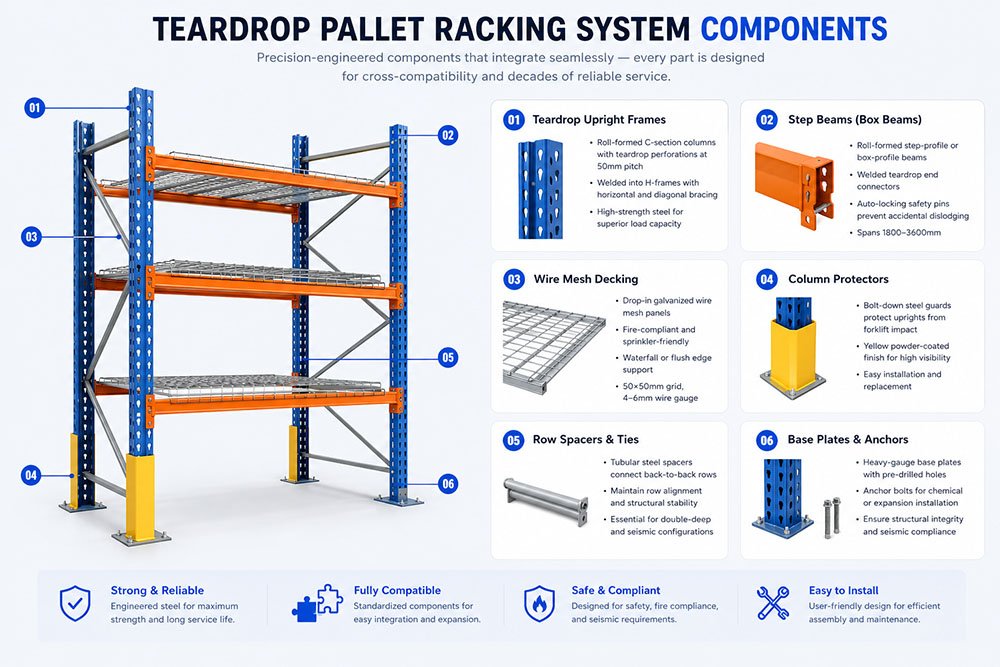
Beam capacity is rated as a pair and depends on the beam length, profile, and steel gauge. Longer beams carry less weight than shorter ones of the same profile, so the beam you choose must reflect both the pallet width and the total weight per level. The connectors and safety clips that lock the beams in place are just as important as the beams themselves—the clips prevent a beam from being knocked upward and dislodged by a forklift.
Footplates and Baseplates
At the bottom of each upright column sits a footplate (or baseplate), a flat steel plate welded or bolted to the column base. The footplate spreads the column’s load across a larger area of the floor and provides the surface through which the rack is anchored. A larger footplate distributes load over more concrete and reduces point pressure on the slab. In seismic regions or for taller racks, heavier-duty footplates are specified to handle the increased forces.
Floor Anchors
Anchors fix the footplates—and therefore the entire rack—to the concrete floor. Proper anchoring is one of the most important and most frequently overlooked aspects of rack safety. Anchors resist the uplift and shifting that occur during loading, unloading, and minor forklift contact, and they keep the structure plumb. The anchor type, diameter, and embedment depth depend on the slab thickness and the loads involved. Skipping anchors, or using too few, is a common cause of rack instability and collapse, so this small component carries outsized importance.
Decking and Load-Support Accessories
Pallet racks are designed to support standard pallets resting on the beams. But not every load is a full-size, undamaged pallet, and not every item should bridge an open gap between two beams. Decking and support accessories close that gap and create a continuous surface or additional support points, expanding what the rack can safely store.
Wire Mesh Decking
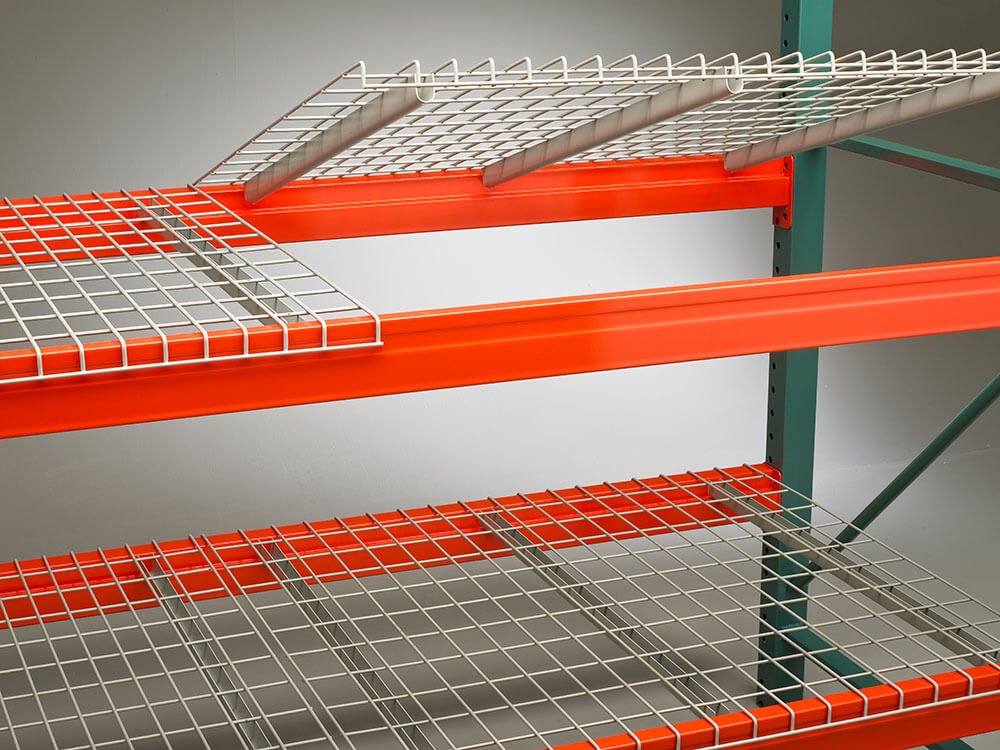
Wire mesh decking is one of the most popular pallet rack accessories, and for good reason. It’s a welded wire grid framed in steel that drops onto the beams to create a continuous, load-bearing shelf surface. Wire decking catches dropped items, prevents pallets from falling through gaps, allows light from overhead fixtures to pass to lower levels, and lets sprinkler water reach the products below—an important fire-code consideration in many facilities.
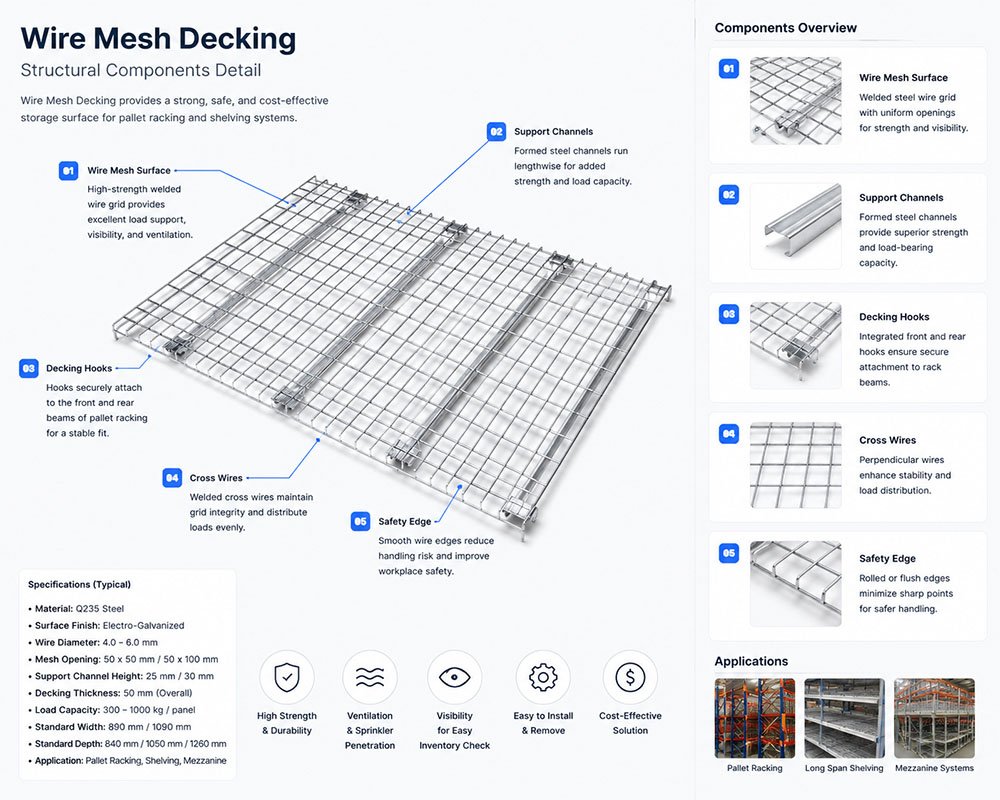
Wire decking comes in different mesh patterns, wire diameters, and support-channel configurations. The number and depth of the support channels welded underneath determine the deck’s capacity. For heavier loads or to meet fire codes, you choose a deck with more or deeper channels. Because it’s easy to install with no fasteners, wire decking is also one of the simplest ways to add safety and flexibility to an existing rack.
Pallet Supports and Bar Supports
Pallet supports are horizontal bars—usually a tube or formed steel section—that run front to back between the load beams, perpendicular to the beams themselves. They give the pallet additional support so its weight isn’t carried only by the two beam faces. This matters when pallets are oriented with their stringers running parallel to the beams, when pallets are in poor condition, or when loads are heavy and concentrated.
Pallet supports are an inexpensive way to increase the load rating and reliability of a level without committing to full decking. They simply rest in the step of the beam, making them quick to add or reposition.
Solid Steel and Particle Board Decking
For storing small items, totes, cartons, or loose product directly on the rack, a solid surface is often better than wire. Solid steel decking provides a flat, durable platform that’s easy to clean and resists punctures. Particle board or plywood decking offers a smooth, economical surface and is common where loads are light and fire-suppression codes allow it. Solid decking is the right call when small parts could fall through a wire grid or when a completely flat working surface is needed for picking.
Wood Decking
Timber decking remains a practical, low-cost option in many warehouses. Wood planks or panels rest on the beams or on support channels and create a solid shelf. While wood doesn’t allow sprinkler penetration the way wire decking does, it’s well suited to dry storage and lighter applications where cost matters and fire codes permit. The decking choice always comes back to the nature of the load, the local fire code, and the facility’s cleaning and durability requirements.
Safety Accessories for Pallet Racking
If structural components keep the rack standing under load, safety accessories keep it standing through the daily realities of warehouse traffic. Forklift impacts, overloading, and pallets pushed too far back are everyday hazards. A well-chosen set of rack safety accessories protects both the structure and the people working around it, and in many jurisdictions certain protections are required by code.
Column and Upright Protectors
The base of an upright column is the most vulnerable part of a pallet rack. It sits right at forklift height and takes the brunt of accidental contact during loading and travel. Column protectors—also called post protectors or upright guards—are steel or heavy-duty polymer guards that bolt or anchor to the floor in front of the column, or wrap around it, absorbing impact before it reaches the structural steel.
Even a minor strike to an unprotected column can dent or bend it, reducing its capacity far more than the small visible damage would suggest. Column protectors are a low-cost investment that prevents expensive repairs and dangerous weakening of the frame. They’re considered essential at the ends of aisles and anywhere forklifts maneuver close to the rack.
Row End Protectors and Guards
End-of-row guards protect the exposed ends of a run of racking, which face into aisles and cross-traffic lanes. These heavier steel barriers are anchored to the floor and run along the front face of the end frames, taking impacts that would otherwise knock an entire upright out of alignment. Because the end frames anchor a whole row, protecting them is critical—damage there can compromise an entire line of racking.
Guard Rails and Aisle Protection
In high-traffic areas, freestanding guard rails create a physical buffer between forklift lanes and racking, walkways, or equipment. These bolt-down steel rails absorb and redirect the energy of an impact, keeping vehicles away from the structure and protecting pedestrians. Guard rails are especially valuable at corners, near pedestrian doors, and around critical equipment where a collision would be costly.
Safety Bars and Pallet Stops
Safety bars, also called pallet support bars or load stops, sit in the beam step and provide extra support or act as a backstop. A pallet stop or back stop is positioned at the rear of a bay to prevent pallets from being pushed too far and falling off the back of the rack into an adjacent aisle or onto a person. This is particularly important in single-deep racking that backs onto a walkway or another row, where there’s no second beam to catch an overshot pallet.
Rack Netting and Backing
Where racking backs onto a pedestrian aisle, workstation, or public-facing area, rack safety netting or rigid back panels catch items that might fall from the rear of a bay. Netting is a flexible barrier stretched across the back of the racking, while solid back panels offer a more rigid containment surface. Both protect people working or walking behind the rack from falling product—a serious hazard in busy facilities and a requirement in many retail and high-traffic settings.
Load Signs and Capacity Plates
A capacity plate or load notice isn’t a physical guard, but it’s a vital safety accessory. It clearly states the maximum safe working load per beam level and per bay, based on the engineered design. Posting load signs keeps operators from overloading the rack—the single most common cause of structural failure. Many safety standards require that this information be displayed prominently, and keeping it visible and accurate is part of responsible rack management.
Alignment and Spacing Components
Some pallet racking components don’t bear loads or block forklifts; they keep the system geometrically correct. Proper alignment and spacing are essential for the rack to perform as engineered, and these small parts make a big difference in stability.
Row Spacers
In back-to-back racking, row spacers connect two rows at a fixed, consistent distance. They tie the rear columns of adjacent rows together, keeping the rows parallel and properly spaced and adding rigidity to the combined structure. Correct spacing leaves room for pallets to overhang at the rear without colliding, and the connection between rows helps both runs resist sway. Row spacers are a simple but important part of any double-row installation.
Wall Ties
Single rows of racking placed against a wall can be tied to the building structure with wall ties for additional lateral stability. A wall tie connects the rack’s rear columns to the wall, helping the single row resist tipping forces. This is useful for tall single-deep rows that don’t have a second row to brace against. As with all structural connections, wall ties should be engineered for the specific loads and building conditions rather than improvised on site.
Shims
Concrete floors are rarely perfectly level, and an out-of-plumb upright loses capacity quickly. Shims are thin steel plates placed under footplates to level the columns and bring the rack into plumb. Proper shimming ensures the load travels straight down each column as the engineering intends. Shims should be steel (not wood or other compressible material), sized to the footplate, and limited to the thickness the manufacturer allows—excessive shimming signals a floor problem that needs a different solution.
Specialized Accessories for Unique Storage Needs
Beyond the standard selective rack, a wide range of specialized components adapts pallet racking to specific products and workflows. These accessories let a single racking platform handle long items, round items, fast-moving cartons, and high-density storage.
Pull-Out and Sliding Shelves
Sliding or pull-out shelves bring stored items out toward the operator, improving access to product stored deep in a bay or up high. They’re useful for heavy items that are awkward to reach, for maintenance and tooling storage, and anywhere ergonomics and quick picking matter. The slide mechanism is rated for a specific load, so matching the shelf to the weight of what it carries is important.
Cantilever Arms
For long, bulky items like lumber, pipe, tubing, and sheet materials, cantilever arms replace the front-to-back beam structure with horizontal arms projecting from a central column. There are no front columns to obstruct loading, so long loads can be slid on without interference. Cantilever arms come in straight and inclined versions and in various lengths and capacities, making them the go-to solution for products that simply won’t sit neatly on a standard pallet beam.
Drum and Coil Cradles
Round and cylindrical items—drums, coils, reels, rolls—won’t sit safely on a flat deck. Cradles are V-shaped or curved supports that nest these items securely and keep them from rolling. Drum cradles and coil supports turn standard racking into safe storage for cylindrical goods, an essential accessory for manufacturers and distributors handling these load types.
Carton Flow and Pallet Flow Components
For high-density, first-in-first-out picking, flow components add gravity-fed lanes to a rack. Carton flow uses inclined roller or wheel tracks so cartons advance toward the pick face as front units are removed, while pallet flow uses heavy-duty roller lanes for full pallets. These dynamic accessories dramatically increase pick speed and storage density, and they integrate with standard upright frames, letting you blend selective and flow storage in the same system.
Push-Back Carts and Rails
Push-back systems use nested carts running on inclined rails to store pallets several deep on a last-in-first-out basis. As a forklift loads a pallet, it pushes the previous one back along the rails; removing the front pallet allows the others to roll forward. The carts and rails are the specialized components that make this high-density storage possible while still allowing access from a single aisle.
How to Select the Right Pallet Rack Accessories
With so many components available, the right selection always starts with the load and the workflow. A few core questions guide the process.
First, understand the loads. The weight, dimensions, and condition of your pallets and products determine beam capacity, whether you need pallet supports or decking, and which decking type is appropriate. Heavy or non-standard loads usually call for additional support components rather than relying on beams alone.
Second, map the traffic. Where forklifts maneuver close to racking, column protectors, end-of-row guards, and guard rails aren’t optional—they protect the structure and the people around it. The busier the aisle and the tighter the maneuvering, the more impact protection you should plan for.
Third, account for the environment and codes. Fire-suppression requirements often dictate wire decking over solid surfaces so sprinklers can reach lower levels. Seismic zones call for heavier footplates and anchoring. Pedestrian-adjacent racking needs back stops or netting. Local regulations and standards frequently specify these protections, so checking them early prevents costly retrofits.
Fourth, make sure everything is compatible. Beams, frames, connectors, and decking must match in punch pattern, profile, and capacity. Mixing components from incompatible systems is unsafe and undermines the engineered ratings. When in doubt, source matching components and confirm ratings with the manufacturer or a qualified rack engineer.
Finally, build in room to grow. Choosing adjustable, expandable components and standard profiles makes it far easier to reconfigure or extend the system later. A little foresight at the specification stage saves significant cost and disruption down the road.
Maintenance and Inspection of Rack Components
Accessories only keep working if the whole system is maintained. Regular inspection of pallet racking components is essential for ongoing safety. Walk the racks on a routine schedule and look for bent or dented columns, missing or loose beam safety clips, damaged braces, and any sign that a frame is out of plumb. Check that protectors and guards are still anchored, that decking sits properly without sagging, and that load signs remain accurate and visible.
Damage to structural components should be addressed promptly. A dented column may look minor but can lose a large share of its capacity, and a single compromised upright can endanger an entire row. Offload and isolate any damaged section until it’s repaired or replaced with the correct matching part. Keeping safety clips in place, anchors tight, and protectors intact is far cheaper than recovering from a collapse—and it keeps your team safe.
A simple maintenance routine pays off: train operators to report impacts immediately, schedule periodic professional inspections for larger or heavily used systems, and keep a small stock of replacement clips, anchors, and protectors on hand so minor issues get fixed before they become major ones.
Bringing the System Together
A pallet racking system performs best when every component is chosen with intent. The uprights, beams, footplates, and anchors carry the load. Decking and pallet supports make that load safe to store. Protectors, guards, back stops, and netting defend the structure and the people around it. Spacers, ties, and shims keep everything aligned and stable. And specialized accessories like cantilever arms, flow lanes, and cradles adapt the system to whatever you need to store.
None of these pallet rack accessories and components is an afterthought. Each one plays a defined role in turning a basic steel structure into a storage system that’s safe, durable, and tuned to your operation. Whether you’re building a new warehouse layout or strengthening an existing one, investing in the right components—and maintaining them well—delivers a system that protects your inventory, your equipment, and your team for the long haul.