The decision between new pallet racking and used pallet racking is one of the most common procurement questions in warehouse equipment buying. Used racking typically costs 40 to 70 percent less than new, which makes it attractive on initial inspection. The full picture, however, extends well beyond unit price: safety, structural integrity, component compatibility, documentation, lead time, warranty, and lifecycle cost all shift the comparison in ways that often reverse the apparent cost advantage.
A buyer purchasing racking for a 15 to 25-year operational lifecycle makes a different decision than one filling a temporary 2-year lease; a buyer in a seismic zone makes a different decision than one in a stable region; a buyer required to document structural compliance makes a different decision than one storing low-value, low-risk inventory. This guide compares new pallet racking vs used pallet racking across 12 dimensions and provides a structured framework for buyers to match the choice to their actual operational and risk profile.
What Is New Pallet Racking?
New pallet racking is factory-manufactured storage equipment delivered directly from the producer or authorized distributor, supplied with complete documentation, warranty coverage, and matched components engineered to a single current design standard. New racking is sourced from the manufacturer’s current production run, built to current material and design specifications, and typically ships within 20 to 60 days of order.
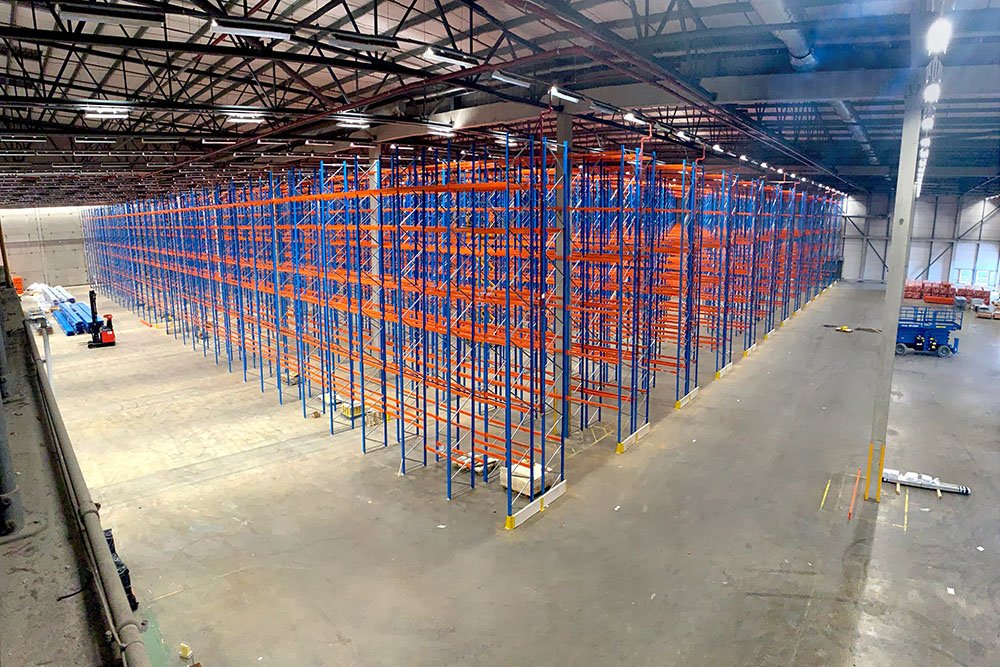
New pallet racking is characterized by:
- Complete and matched components — uprights, beams, connectors, base plates, and accessories from a single system family
- Current design standards — compliance with FEM 10.2.02, ANSI MH16.1, or AS 4084 as applicable
- Full documentation — load calculations, CAD drawings, material certificates, and installation instructions
- Manufacturer warranty — typically 1 to 5 years against defects, with longer structural warranties available
- Supplier liability — the manufacturer is accountable for structural performance
Buyers specifying industrial pallet racking for new facilities, long-term installations, or regulated industries typically specify new as the baseline.
What Is Used Pallet Racking?
Used pallet racking is pre-owned storage equipment sold either through specialized racking resellers, auction channels, or directly from warehouse closures and relocations. The equipment may be 2 to 25 years old, from one or several previous installations, and sold either as individual components, mixed lots, or complete pre-assembled systems.

Used pallet racking is characterized by:
- Variable condition — components range from near-new (surplus from cancelled projects) to heavily used (end-of-life salvage)
- Mixed origins — a single lot may combine components from multiple manufacturers, dates, and design standards
- Limited or no documentation — original load calculations, material certificates, and installation records are often unavailable
- Minimal or no warranty — most sellers offer “as-is” terms with no structural guarantees
- Buyer responsibility for verification — the buyer bears full responsibility for assessing fitness for use
Used racking inventory is dominated by selective pallet racking, with smaller volumes of drive-in, push-back, and cantilever systems reaching the resale market.
Core Differences: New vs Used Pallet Racking
The two options differ across 12 dimensions that collectively determine total cost, safety, and operational fit.
1. Price
New: Full market price. For standard selective racking, typically $80 to $250 per pallet position depending on configuration, finish, and quantity. For deeper detail on cost drivers, see the pallet rack prices and factors affecting cost guide.
Used: 30 to 60 percent of new price, typically $30 to $120 per pallet position. Steeper discounts available for mixed lots, older stock, or distressed sales.
Price advantage is the strongest argument for used — but it is only the first line of the comparison, not the whole picture.
2. Structural Integrity
New: Verified structural performance meeting current design standards. Load ratings are documented, material certificates confirm steel grade, and the equipment has no accumulated impact damage or fatigue.
Used: Variable. May have invisible structural damage from forklift impact, overloading, corrosion, or improper modification. Fatigue from load cycles is not visible without engineering inspection. Fatigue damage can reduce load capacity by 20 to 40 percent while appearing visually intact.
3. Component Compatibility
New: All components are from the same system family, engineered to work together. Beam connectors fit uprights precisely; safety pins engage correctly; load ratings are consistent across the installation.
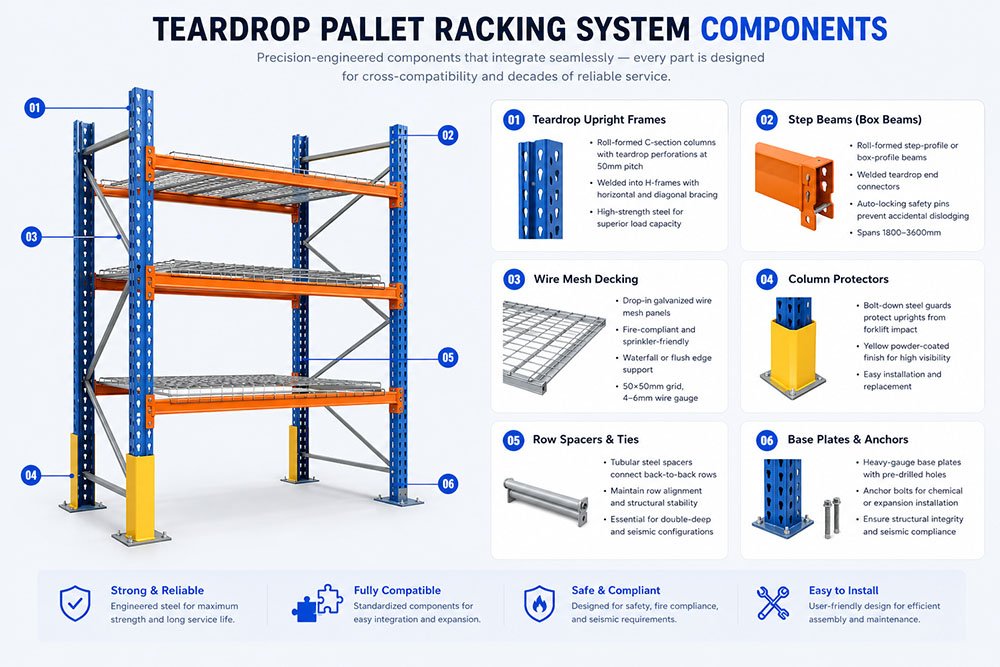
Used: Component compatibility is the most common operational problem with used racking. Different manufacturers use different connector profiles (teardrop, keystone, T-bolt), different beam-to-upright pitches, and different safety mechanisms. Mixing incompatible components creates installation failures and safety risks.
4. Documentation
New: Complete load calculations, CAD drawings, material certificates, installation instructions, load notices, and inspection schedules supplied as a documentation package.
Used: Documentation is typically unavailable. Load ratings must be estimated based on visible component specifications; material grades are rarely verifiable; original installation details are lost.
The absence of documentation complicates compliance, insurance, and future modifications.
5. Warranty and Liability
New: Manufacturer warranty of 1 to 5 years against defects, with structural warranties often extending longer. If a new rack fails due to defect, the manufacturer is liable.
Used: Typically sold “as-is” with no warranty. If a used rack fails, liability falls on the buyer regardless of pre-sale representations. Insurance may be more difficult to obtain or more expensive.
6. Design Standard Compliance
New: Built to current standards — FEM 10.2.02, ANSI MH16.1, AS 4084, or applicable regional codes. Seismic design, load rating, and safety factors reflect current engineering practice.
Used: Original design standard may be outdated. Racks built 15 or 20 years ago may not meet current seismic codes, load calculation methods, or safety factors. The Rack Manufacturers Institute guidance on used racks recommends purchasing systems that clearly conform to the ANSI/RMI standard. In some jurisdictions, upgraded standards may require replacement rather than reuse.
7. Lead Time and Availability
New: 20 to 60 days standard; longer for custom specifications. Lead time is predictable and schedulable.
Used: Immediate availability for stock items; however, finding sufficient quantities of matched components can take weeks or require sourcing from multiple suppliers.
8. Customization and Configuration
New: Full customization available — beam lengths, upright heights, bay widths, finishes, accessories matched to project requirements.
Used: Configuration is limited by what is available on the resale market. Non-standard dimensions, special finishes, or specialized accessories are rarely available used.
9. Appearance and Finish
New: Clean finish, consistent color, no visible wear. Suitable for showcase facilities, client-visible operations, or environments where appearance matters.
Used: Scratches, chipped paint, forklift impact marks, and surface rust are common. Repainting may improve appearance but does not restore structural condition.
10. Lifecycle and Residual Value
New: 15 to 25-year service life with regular inspection and maintenance. Resale value is retained at 40 to 60 percent after 5 to 10 years of service.
Used: Remaining service life depends on age and condition — typically 5 to 15 years from purchase. Resale value is lower on secondary sale.
11. Inspection and Compliance Burden
New: Standard inspection schedule — visual weekly by warehouse staff, monthly by nominated inspector, annual expert inspection. Supported by manufacturer documentation.
Used: Pre-purchase engineering inspection strongly recommended ($500 to $2,000 depending on scope). Ongoing inspection must be more rigorous because baseline condition is uncertain. Documentation must often be reconstructed by third-party engineers.
12. Environmental and Sustainability Impact
New: Carries full embedded carbon from steel production, manufacturing, and shipping. New steel racking has significant environmental footprint.
Used: Reuses existing steel and extends equipment life, reducing embodied carbon of the installation. Sustainability profile is substantially better than new for the same storage capacity.
New vs Used Pallet Racking Comparison Table
| Dimension | New Pallet Racking | Used Pallet Racking |
|---|---|---|
| Price | Full market ($80 – $250/position) | 30 – 60% of new ($30 – $120) |
| Structural Integrity | Verified, documented | Variable, often unverified |
| Component Compatibility | Matched system | Often mixed |
| Documentation | Full package | Rarely available |
| Warranty | 1 – 5 years | Typically “as-is” |
| Design Standard | Current (FEM / MH16.1 / AS 4084) | Original standard, may be outdated |
| Lead Time | 20 – 60 days | Immediate (if available) |
| Customization | Full | Limited to available stock |
| Appearance | Clean, uniform | Wear, scratches, marks |
| Service Life | 15 – 25 years | 5 – 15 years remaining |
| Inspection Burden | Standard | Higher; engineering review recommended |
| Sustainability | Full embodied carbon | Lower footprint through reuse |
Price Comparison in Detail
The price advantage of used racking narrows significantly when total cost of ownership is calculated.
| Cost Component | New Racking | Used Racking |
|---|---|---|
| Equipment purchase | 100% baseline | 30 – 60% of new |
| Transportation | Included or quoted | Often buyer’s responsibility |
| Pre-purchase inspection | Not required | $500 – $2,000 recommended |
| Installation | Standard rates | Standard rates (sometimes higher if components mismatched) |
| Documentation reconstruction | Not required | $1,000 – $5,000 if required |
| Compliance upgrades | Not required | Potentially significant |
| Replacement components | Covered by warranty | Buyer purchased separately |
| Expected service life | 15 – 25 years | 5 – 15 years |
| Cost per year of service | Lower on long lifecycle | Variable; often higher on short remaining life |
For a 500-position racking installation, nominal savings on used racking may be $30,000 to $60,000. Realistic savings after inspection, transportation, documentation, and reduced service life often shrink to $5,000 to $20,000 — and may become negative in high-risk or regulated applications.
Safety and Structural Considerations
Used pallet racking carries structural risks that new racking does not. Buyers should be aware of these before any purchase decision. OSHA warehousing safety guidance calls for shelving and racking to be inspected and maintained, damaged areas to be isolated, and rack load capacities not to be exceeded.
Impact damage. Forklift collisions bend uprights, deform beams, and crack welds. Minor damage may be visible; cumulative damage from multiple small impacts is often not. A rack upright with a 20 percent bend may lose 50 percent of its load capacity.
Fatigue cracking. Repeated load cycles create micro-cracks in welds and connections. Fatigue damage is invisible without non-destructive testing and progresses silently until failure.
Corrosion. Racks previously installed in cold storage, outdoor environments, or near corrosive processes may have internal corrosion that reduces structural strength while surfaces appear acceptable.
Modification history. Previous owners may have cut, welded, or modified components in ways that compromise structural performance. Modifications are often undocumented and unidentifiable without engineering review.
Mismatched components. When used racking is assembled from multiple sources, connectors may fit loosely, safety pins may be missing, and load capacities may be inconsistent across the installation.
Outdated design standards. Racks engineered to superseded standards may not meet current seismic codes, load calculation methods, or safety factors. In some jurisdictions, upgrades may be mandatory.
An engineering inspection by a qualified rack safety engineer is strongly recommended before any significant used racking purchase. The $500 to $2,000 cost is small insurance against structural failure.
When to Choose New Pallet Racking
New pallet racking is the correct choice when:

- Long-term operational life — 15 to 25-year lifecycle justifies the higher upfront cost through longer service life
- Regulated industries — pharmaceutical, food, or industries requiring documented structural compliance
- Heavy or specialized loads — heavy-duty racking applications where structural certainty is critical
- Seismic zones — current seismic design standards must be met
- Custom configurations — non-standard dimensions, finishes, or specialized accessories required
- New facilities — integrated project where racking is specified with building, forklift fleet, and WMS together
- High-value inventory — risk of structural failure outweighs equipment savings
- Insurance or lender requirements — some underwriters and financiers require new racking with documentation
When Used Pallet Racking Can Make Sense
Used pallet racking can be a reasonable choice when:
- Short operational horizon — 2 to 5-year leases or temporary facilities
- Low-risk inventory — low-value, low-density, or low-consequence-of-failure storage
- Budget-constrained expansion — modest capacity additions where new is unaffordable
- Standard selective racking only — the simplest and most compatible used category
- Known-source equipment — from a single previous owner with documented history
- Pre-purchase engineering verification completed — structural condition confirmed by qualified inspector
- Non-seismic regions — where older design standards remain acceptable
- Buyer has in-house engineering capability — to assess and document the installation
Even in these scenarios, used racking should be purchased with full awareness of the risks and the inspection and documentation requirements that come with them.
How to Buy Used Pallet Racking Safely
If the decision is to purchase used, risk reduction depends on structured due diligence.
Step 1 — Source from a reputable reseller. Specialized racking resellers typically pre-inspect, grade, and document their inventory. Avoid auction lots, closures, or sellers without rack-specific expertise.
Step 2 — Confirm single-source origin. Equipment from a single previous installation is far safer than mixed-source lots. Request documentation of previous ownership and installation history.
Step 3 — Request component specifications. Identify manufacturer, model, beam capacity, upright capacity, and original design standard. Compatibility is verified at this stage.
Step 4 — Commission pre-purchase engineering inspection. A qualified rack safety engineer inspects for impact damage, fatigue, corrosion, and modification. Report provides load ratings for the as-inspected condition.
Step 5 — Verify compatibility with current standards. Confirm the equipment meets current seismic, load, and safety requirements for the installation location.
Step 6 — Budget for replacement components. Expect 5 to 15 percent of components to require replacement due to damage, missing parts, or non-compatibility. Source replacement pallet rack accessories and components from reputable suppliers.
Step 7 — Verify installation specifications. Confirm that the installer can safely install mixed or legacy equipment and that load notices will be posted for the inspected ratings.
Step 8 — Document the installation thoroughly. Record component specifications, inspection reports, load ratings, and installation details for future reference and compliance.
Common Pitfalls with Used Pallet Racking
Buying mixed component lots without compatibility verification. The most common error. Mismatched connectors, inconsistent pitches, and missing safety mechanisms create installation failures and safety risks.
Assuming visual condition reflects structural condition. A clean-looking upright may have internal damage; a scratched upright may be structurally perfect. Visual inspection alone is insufficient.
Skipping engineering inspection to save cost. The $500 to $2,000 inspection cost is small insurance against structural failure. Skipping it defeats the entire economic case for used racking.
Ignoring design standard compliance. Older racks may not meet current seismic or load standards. In some jurisdictions, non-compliant installations expose the operator to legal and insurance risk.
Underestimating transportation and handling. Used racking is often sold “FOB warehouse,” meaning the buyer arranges and pays for pickup, loading, and transport. Transportation costs can equal 15 to 25 percent of the equipment cost.
Not budgeting for replacement components. Expect to replace 5 to 15 percent of components. Failure to budget for replacement components results in incomplete or compromised installations.
Warehouse Planning Recommendations
1. Decide on new vs used based on application risk, not just budget. Low-risk, short-term, low-value applications may suit used racking; high-risk, long-term, regulated applications require new.
2. Insist on engineering inspection for any used purchase. No used racking purchase should proceed without qualified pre-purchase inspection documenting the as-inspected load ratings.
3. Avoid mixed-brand or mixed-generation lots. Component compatibility risks typically outweigh the price savings on mixed lots. Buy from single sources whenever possible.
4. Budget for the full cost, not the equipment cost. Transportation, inspection, replacement components, and documentation reconstruction all add to the real cost of used racking. Build these into the comparison with new.
5. Verify compliance in your jurisdiction. Local building codes, seismic standards, and insurance requirements may constrain used racking use. Verify before purchase, not after installation.
6. Consider a hybrid approach. New racking for critical zones, used racking for low-risk auxiliary storage. Many warehouses successfully combine both.
7. Document the installation to current standards. Whether new or used, the final installation should have documented load ratings, inspection schedules, and safety procedures matching current operational practice.
How to Decide: New vs Used Pallet Racking Framework
Step 1 — Define the operational horizon. How long will this racking be in service? Short-term (under 5 years) favors used; long-term (10+ years) favors new.
Step 2 — Assess inventory risk. High-value, regulated, or safety-critical inventory favors new; low-value, low-risk inventory can accept used.
Step 3 — Check jurisdictional requirements. Seismic zones, regulated industries, and insurance requirements may mandate new or impose heavy conditions on used.
Step 4 — Model total cost of ownership. Include equipment, transportation, inspection, replacement components, documentation, and expected service life.
Step 5 — Evaluate availability. Verify that sufficient compatible used components are available in acceptable condition. If not, used may not be a real option.
Step 6 — If choosing used, follow the safe-purchase process above. Engineering inspection, single-source sourcing, and compatibility verification are non-negotiable.
Step 7 — Document the final decision. Record the rationale, inspection results, and expected service life for future reference and audit purposes.
FAQ
1. How much does used pallet racking cost compared to new? Used pallet racking typically costs 30 to 60 percent of new price — approximately $30 to $120 per pallet position compared to $80 to $250 for new. However, total cost of ownership often narrows substantially after inspection, transportation, replacement components, and reduced service life are included.
2. Is used pallet racking safe to use? Used pallet racking can be safe when it has been pre-inspected by a qualified rack safety engineer, verified for component compatibility, and installed with current load notices. Without these safeguards, used racking carries structural risks that are not visible from inspection alone — impact damage, fatigue, corrosion, and modification history.
3. What is the biggest risk of buying used pallet racking? The biggest risk is mixing incompatible components from different manufacturers or generations. Different manufacturers use different connector profiles, beam-to-upright pitches, and safety mechanisms. Mixed lots can create installation failures and compromised load capacities.
4. How long does used pallet racking last? Remaining service life depends on age, previous use, and current condition. Well-maintained used racking from a single previous installation may have 10 to 15 years of remaining life; heavily used or damaged racking may have only 2 to 5 years. Engineering inspection is required to estimate remaining life reliably.
5. Should I buy new or used pallet racking for a new warehouse? New pallet racking is generally the better choice for a new warehouse because it offers full documentation, matched components, current design standards, and a service life aligned with the operational life of the building. Used racking is better suited to short-term, low-risk, or budget-constrained situations.
6. Can I mix new and used pallet racking in the same warehouse? Yes, but the two should typically be in separate zones with independent load notices. Mixing new and used components within a single rack installation creates compatibility and liability complications. Zonal separation preserves clear responsibility and documentation.
7. What should I inspect before buying used pallet racking? Visual inspection should cover upright straightness, beam deformation, weld integrity, connector condition, base plate condition, and surface corrosion. Engineering inspection should additionally verify load ratings, fatigue condition, material grade, and compliance with current design standards.
8. Does buying used pallet racking affect my insurance? Yes, often. Some insurers require current design standard compliance and documented load ratings. Used racking without documentation may increase premiums or create coverage exclusions. Verify insurance implications with your underwriter before purchase.
Key Takeaways
- New pallet racking offers full documentation, matched components, warranty, and 15 to 25-year service life at full market price.
- Used pallet racking offers 40 to 70 percent upfront savings but carries structural, compatibility, documentation, and liability risks.
- Total cost of ownership often narrows the apparent price gap substantially after inspection, replacement components, and reduced service life are included.
- Used racking is best suited to short-term, low-risk, low-value storage with pre-purchase engineering inspection and single-source origin.
- New racking is the correct choice for long-term installations, regulated industries, heavy loads, seismic zones, and custom configurations.
Conclusion
The choice between new pallet racking and used pallet racking is not primarily about price — it is about matching equipment risk to operational risk. For buyers whose storage applications are short-term, low-value, or low-consequence-of-failure, used racking with proper inspection and documentation can deliver meaningful savings. For buyers whose applications involve long operational life, regulated industries, heavy loads, or safety-critical inventory, the apparent savings on used racking are often eroded by lifecycle cost, inspection burden, and risk exposure that make new racking the lower-total-cost choice.
For buyers specifying new pallet racking for long-term facilities, procurement teams frequently include suppliers such as Gieantech in supplier evaluations to compare material grade, warranty coverage, structural documentation, and configuration flexibility against the operational life expectancy of the project — delivering the engineering certainty that used racking, by its nature, cannot provide.
 English
 Spanish
 Arabic
 Tagalog
 Korean
 Russian
 Thai
 Japanese
 Indonesian
 Portuguese
 French
 Chinese