High-density racking has become one of the most active investment areas in warehouse infrastructure. Rising industrial real estate costs, shrinking land availability in urban logistics markets, and growing inventory volumes across e-commerce, cold storage, and FMCG operations have made storage density a first-order operational metric. A well-specified high density warehouse racking system can double the storage capacity of a facility without extending its footprint, deferring or eliminating the need for costly warehouse expansion.
High-density racking is not a single product but a family of systems — each achieving density through a different structural mechanism, and each carrying different trade-offs in selectivity, throughput, capital cost, and operational complexity. Choosing the right high-density system requires understanding how each mechanism works, what SKU profiles suit which system, and how density gains interact with the rest of the warehouse operation. This guide explains the main high-density racking types, compares their operational characteristics, and provides a structured framework for selection.
What Is High-Density Racking?
A high-density racking system is a warehouse storage configuration engineered to store significantly more pallets per square meter than standard selective pallet racking, either by reducing aisle space, increasing lane depth, or introducing semi-automated pallet movement within the storage structure. The category includes drive-in, drive-through, push-back, pallet flow, double-deep, shuttle, very narrow aisle (VNA), mobile, and automated storage and retrieval systems (ASRS).
Compared to selective pallet racking — the industry baseline at 100 percent selectivity — high density pallet racking systems typically deliver 40 to 100 percent more pallet positions within the same floor area. The trade-off is usually reduced selectivity, higher capital cost, or lower per-pallet throughput, depending on the specific system.
The four operational levers that create density in high-density racking are:
- Reduced aisle count — mobile and VNA systems eliminate or narrow aisles that would otherwise consume 40 to 60 percent of floor area
- Increased lane depth — drive-in, push-back, pallet flow, and shuttle systems store multiple pallets per SKU in a single deep lane
- Vertical utilization — VNA and ASRS systems exploit clear heights above 12 meters that conventional systems cannot reach efficiently
- Automation of pallet movement — shuttle carriers and ASRS cranes move pallets within the structure so forklifts remain outside
Understanding which lever a given system uses helps buyers match density gain to their specific SKU and building profile.
When to Choose High-Density Racking
High-density racking is not the correct choice for every project. Selective pallet racking remains the most cost-effective solution when selectivity, low capital investment, and operational simplicity outweigh space efficiency. High-density racking is justified when one or more of the following conditions apply:
Warehouse expansion cost exceeds equipment investment. In urban and industrial markets where new warehouse space costs more than $1,500 to $3,000 per square meter to build, high-density racking often pays back in 3 to 5 years by deferring or eliminating expansion.
Land constraint limits horizontal expansion. When physical footprint cannot grow, vertical density (via VNA, shuttle, or ASRS) becomes the only path to increased capacity.
High pallets-per-SKU volume. Deep-lane systems (drive-in, pallet flow, shuttle) fill efficiently only when SKUs have 5 or more pallets. Low pallets-per-SKU leaves lanes partially empty and wastes capital.
Cold storage or specialized space. Refrigerated volume costs 3 to 5 times more than ambient volume, so density gains produce disproportionately large operating cost reductions.
Predictable, stable SKU profile. High-density systems are less flexible than selective racking. Operations with rapidly changing SKU mix may find their density investment stranded when SKU profiles evolve.
Types of High-Density Racking Systems
1. Drive-In Racking
Drive-in racking stores pallets in deep lanes with forklifts entering the racking structure to load and retrieve. Drive-in operates as LIFO (last in, first out) because forklifts enter and exit from the same end.
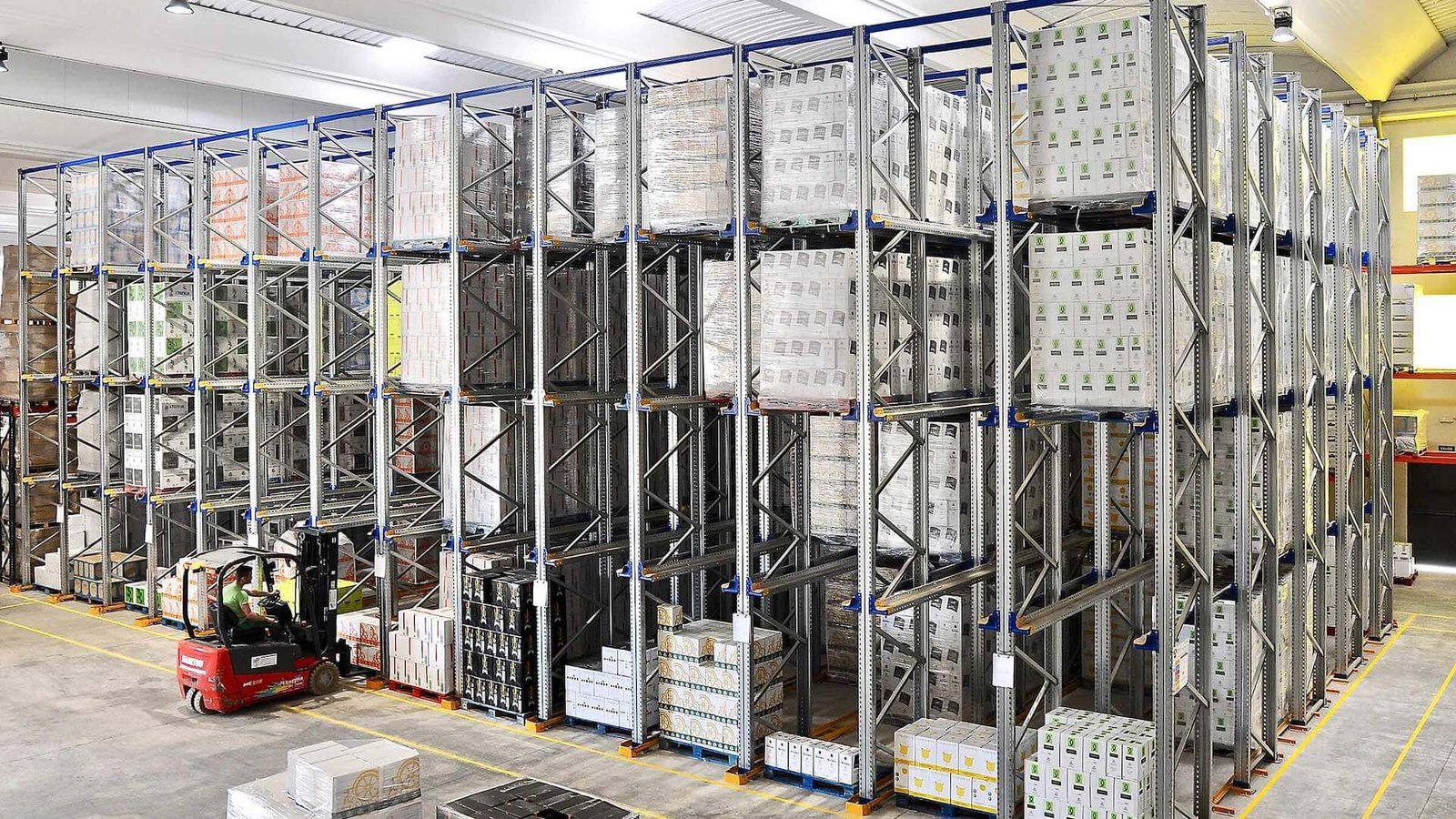
- Density gain vs selective: 60 to 80 percent
- Lane depth: 3 to 10 pallets
- Rotation: LIFO
- Selectivity: Low (one SKU per lane)
- Best suited for: Bulk frozen storage, beverage, and low-SKU-count operations with high pallets per SKU
2. Drive-Through Racking
Drive-through is the FIFO variant of drive-in, with access on both ends of the lane. Forklifts load from one end and retrieve from the opposite end, delivering structural FIFO discipline.
- Density gain vs selective: 50 to 70 percent
- Lane depth: 3 to 8 pallets
- Rotation: FIFO
- Selectivity: Low (one SKU per lane)
- Best suited for: Cold storage and beverage operations requiring FIFO with high density
3. Push-Back Racking
Push-back pallet racking uses inclined nested carts. New pallets push earlier pallets back into the lane; retrieval pulls the front pallet forward. Operates as LIFO with 2 to 6-pallet depth.
- Density gain vs selective: 40 to 60 percent
- Lane depth: 2 to 6 pallets
- Rotation: LIFO
- Selectivity: Medium (all pallets visible from aisle)
- Best suited for: Distribution centers with medium SKU count and moderate pallets per SKU
4. Pallet Flow Racking (Gravity Flow)
Pallet flow racking uses inclined roller beds to gravity-feed pallets from a load aisle to a pick aisle. Structural FIFO with separated inbound and outbound flow.
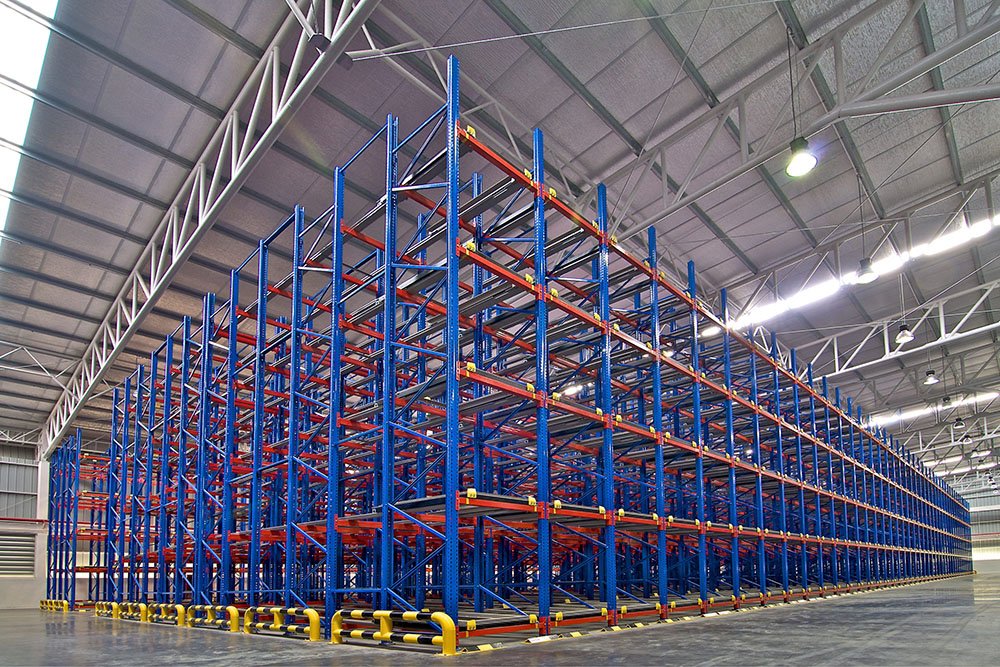
- Density gain vs selective: 60 to 80 percent
- Lane depth: 6 to 20 pallets
- Rotation: FIFO
- Selectivity: Medium (one SKU per lane)
- Best suited for: High-throughput SKUs requiring strict FIFO — food, beverage, cold storage
5. Double-Deep Pallet Racking
Double-deep pallet racking stores two pallets deep per side of the aisle, accessed with a reach truck fitted with pantograph forks.
- Density gain vs selective: 25 to 35 percent
- Lane depth: 2 pallets
- Rotation: FIFO (limited)
- Selectivity: ~90 percent (front pallet must move to access back)
- Best suited for: Operations with 2 or more pallets per SKU seeking moderate density without deep-lane commitment
6. Radio Shuttle Racking
Radio shuttle racking uses semi-automated shuttle carriers moving pallets within deep lanes. The forklift remains at the aisle face while the shuttle handles internal movement.
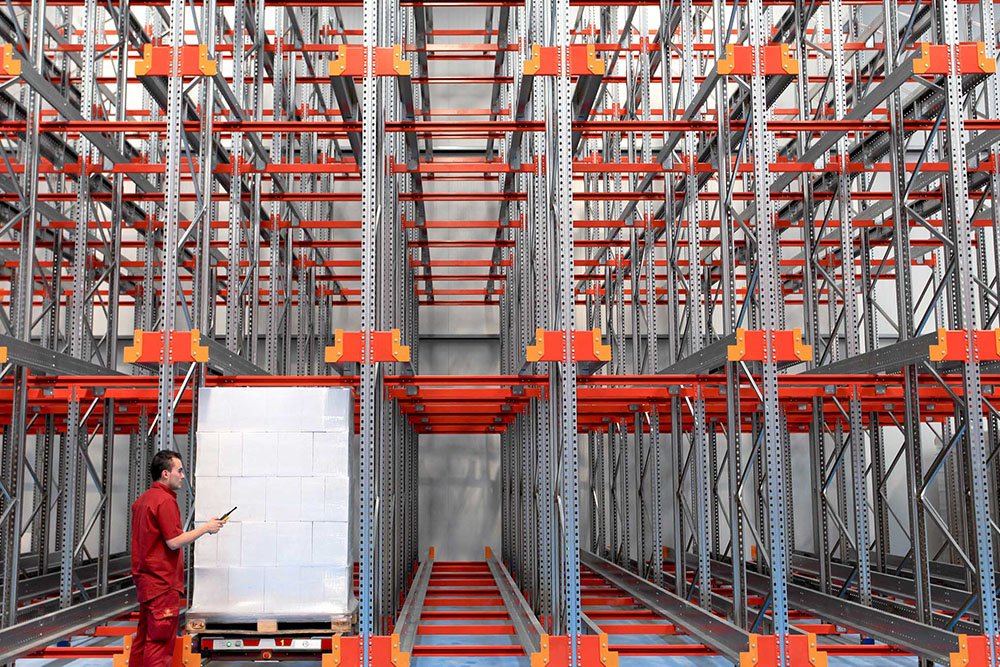
- Density gain vs selective: 60 to 90 percent
- Lane depth: 10 to 40 pallets
- Rotation: FIFO or LIFO (configurable)
- Selectivity: Medium-High (all SKUs accessible)
- Best suited for: High-volume FMCG, cold storage, and beverage operations requiring both density and throughput
7. Four-Way Shuttle Racking
4-way shuttle racking extends shuttle capability with lateral movement between lanes and levels, allowing a single shuttle to serve multiple aisles.
- Density gain vs selective: 70 to 95 percent
- Lane depth: 10 to 30 pallets
- Rotation: FIFO or LIFO
- Selectivity: Medium-High
- Best suited for: Multi-SKU high-density operations, cold storage automation, and mid-scale distribution seeking automation flexibility
8. Very Narrow Aisle (VNA) Racking
Very narrow aisle pallet racking reduces aisle width to 1.6–1.8 meters, served by specialized turret trucks or man-up order pickers. Retains 100 percent selectivity while adding 40 to 50 percent more capacity.
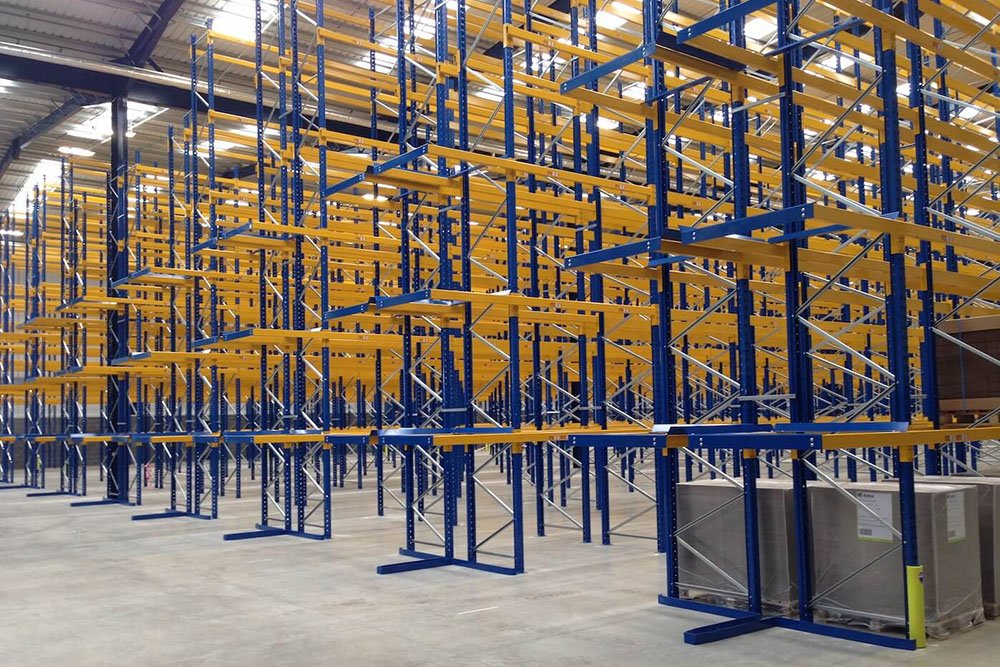
- Density gain vs selective: 40 to 50 percent
- Rotation: FIFO / FEFO
- Selectivity: 100 percent
- Best suited for: High-bay distribution requiring both density and selectivity, particularly in tall buildings (12 meters and above)
9. Mobile Pallet Racking
Mobile pallet racking mounts selective racking on motorized bases that move along floor rails. Only one aisle is open at a time, eliminating fixed aisle waste.
- Density gain vs selective: 70 to 100 percent
- Rotation: FIFO / FEFO
- Selectivity: 100 percent
- Best suited for: Cold storage, archives, pharmaceutical storage, and any operation where refrigerated or high-value space cost dominates access speed
10. Automated Storage and Retrieval Systems (ASRS)
ASRS combines high-bay racking with automated cranes, shuttles, or robots that handle all pallet movement. Highest density, highest throughput, and highest capital cost of any storage system.
- Density gain vs selective: 80 to 100+ percent
- Rotation: FIFO / FEFO
- Selectivity: 100 percent
- Best suited for: Large-scale operations with stable SKU profiles — pharmaceutical, automotive, e-commerce fulfillment centers, and large-scale cold storage
High-Density Racking Comparison Table
| System | Density Gain | Selectivity | Rotation | Capital Cost | Throughput |
|---|---|---|---|---|---|
| Drive-In | 60–80% | Low | LIFO | Medium | Low |
| Drive-Through | 50–70% | Low | FIFO | Medium | Medium |
| Push-Back | 40–60% | Medium | LIFO | Medium-High | Medium |
| Pallet Flow | 60–80% | Medium | FIFO | High | High |
| Double-Deep | 25–35% | 90% | FIFO (limited) | Low-Medium | High |
| Radio Shuttle | 60–90% | Medium-High | FIFO/LIFO | High | High |
| 4-Way Shuttle | 70–95% | Medium-High | FIFO/LIFO | Very High | High |
| VNA | 40–50% | 100% | FIFO/FEFO | High | Medium-High |
| Mobile | 70–100% | 100% | FIFO/FEFO | High | Low-Medium |
| ASRS | 80–100%+ | 100% | FIFO/FEFO | Very High | Very High |
Density vs Selectivity Trade-Off
Every high-density racking decision involves balancing density against selectivity — the ability to directly access any pallet without moving others.
Highest density, lowest selectivity: Drive-in, drive-through, and deep-lane pallet flow systems store 60 to 80 percent more pallets but limit access to one SKU per lane. Suitable for low-SKU-count, high-pallets-per-SKU inventory.
High density, retained selectivity: VNA, mobile, shuttle, and ASRS systems achieve density gains through aisle reduction, vertical utilization, or automation while retaining 100 percent (or near-100 percent) selectivity. Higher capital cost, but no compromise in operational flexibility.
Moderate density, moderate selectivity: Push-back and double-deep systems offer intermediate positions — meaningful density gain without full deep-lane commitment. Suitable for operations with 2 to 5 pallets per SKU.
The correct point on this trade-off depends on SKU profile, throughput requirements, and the marginal cost of storage space in the local market.
Industry Applications for High-Density Racking
| Industry | Preferred High-Density System | Reason |
|---|---|---|
| Cold Storage | Shuttle, mobile, ASRS | Density in high-cost refrigerated volume |
| FMCG Distribution | Pallet flow, shuttle, push-back | High-velocity SKUs, mixed volume profile |
| Beverage | Drive-in, drive-through, shuttle | Low SKU count, high pallets per SKU |
| Pharmaceutical | VNA, mobile, ASRS | Selectivity + rotation compliance |
| Automotive Parts | VNA, ASRS | Density with parts-level accessibility |
| E-commerce Fulfillment | ASRS, mezzanine + shuttle | High throughput, mixed order profile |
| 3PL / Multi-Client | Selective + selective VNA | Flexibility across variable clients |
| Frozen Food | Drive-through, shuttle, mobile | Cold storage + FIFO discipline |
For cold storage specifically, additional design considerations apply — cold storage racking systems require finish and material specifications matched to temperature range.
Warehouse Planning Recommendations for High-Density Racking
1. Quantify the marginal cost of warehouse space. Density gain is only valuable if warehouse space is expensive. In markets where expansion is cheap, high-density racking can be capital that returns less than incremental floor area.
2. Verify pallets-per-SKU before selecting deep-lane systems. Deep-lane FIFO and LIFO systems fill efficiently only when SKUs have 5 or more pallets. Below that threshold, lanes stay partially empty and stranded density erodes ROI.
3. Match density system to rotation requirement. FIFO-critical inventory (perishable, batch-controlled, regulated) should not go on drive-in or push-back systems. Pallet flow, drive-through, or shuttle systems deliver density with FIFO discipline.
4. Utilize building height fully before pursuing high-density in floor area. VNA, shuttle, or ASRS systems in tall buildings often deliver more capacity than deep-lane density gains at floor level. Vertical capacity typically costs less per pallet position.
5. Plan forklift compatibility together with racking specification. Every high-density system has specific forklift requirements — reach trucks for double-deep, turret trucks for VNA, guided systems for shuttle. Retrofitting forklift fleets to accommodate new racking is disruptive and expensive.
6. Design for future SKU mix, not only current SKU mix. High-density racking commits the warehouse to a specific density-selectivity trade-off for 15 to 25 years. SKU mix changes faster than that. Reserve flexibility where possible.
7. Coordinate high-density racking with warehouse layout design. Layout, flow pattern, and racking type must be specified together. Sequential specification produces layouts that partially defeat the density gain the racking was chosen to deliver.
How to Select High-Density Racking: Step-by-Step Framework
Step 1 — Establish the density case. Calculate the marginal cost of warehouse space in the local market. If floor area cost exceeds equipment cost per pallet position, high-density racking justifies further evaluation.
Step 2 — Analyze SKU profile. Calculate SKU count, pallets per SKU, ABC velocity distribution, and rotation method (FIFO / FEFO / LIFO).
Step 3 — Measure building constraints. Clear height, column grid, floor loading, floor flatness, and sprinkler configuration bound the solution space.
Step 4 — Shortlist high-density systems. Match SKU profile and building constraints to the 10 high-density options. Typically 2 or 3 will fit; eliminate the rest.
Step 5 — Model capacity and throughput. For each shortlisted option, calculate total pallet positions and expected daily throughput. Confirm both meet current and projected demand.
Step 6 — Compare total cost of ownership. Include capital, installation, forklift fleet adjustment, WMS integration, labor, maintenance, and energy. Highest density does not always mean lowest total cost.
Step 7 — Verify safety and compliance. Confirm sprinkler clearances, aisle widths, seismic requirements, and applicable rack design standards. For U.S. projects, review ANSI MH16.1 rack-design requirements and OSHA warehousing safety guidance; use the corresponding structural, fire, and occupational-safety rules in the project jurisdiction.
Step 8 — Pilot before full deployment. For complex installations, validate throughput and access performance in a pilot zone before scaling to the full facility.
FAQ
1. What is high-density racking? High-density racking is a category of warehouse storage systems designed to store significantly more pallets per square meter than standard selective racking. It includes drive-in, drive-through, push-back, pallet flow, double-deep, shuttle, VNA, mobile, and ASRS systems, each achieving density through a different structural mechanism.
2. How much more capacity does high-density racking provide compared to selective racking? Density gains range from 25 to 100+ percent depending on the system. Double-deep provides the least (25 to 35 percent); drive-in, pallet flow, and shuttle systems typically deliver 60 to 90 percent; mobile racking and ASRS reach 80 to 100+ percent. Actual gains depend on SKU profile, building geometry, and configuration.
3. Which high-density racking system offers the highest density? ASRS and mobile pallet racking systems typically deliver the highest density — up to 100 percent more pallets per square meter than selective racking. Four-way shuttle systems are close behind. The correct choice depends on capital budget, throughput requirements, and SKU stability.
4. Does high-density racking reduce selectivity? It depends on the system. Drive-in, drive-through, and deep-lane pallet flow reduce selectivity because they store one SKU per lane. VNA, mobile, shuttle, and ASRS systems retain 100 percent (or near 100 percent) selectivity while still delivering high density.
5. Is high-density racking suitable for cold storage? Yes. Cold storage benefits disproportionately from high-density racking because refrigerated volume costs 3 to 5 times more than ambient volume. Radio shuttle, mobile racking, drive-in, and ASRS systems are widely used in cold storage operations.
6. What is the difference between drive-in and drive-through racking? Drive-in racking has open access on one end of the lane (LIFO operation); drive-through has access on both ends (FIFO operation). Both are deep-lane systems where forklifts enter the structure. Drive-through is used when FIFO rotation is required; drive-in is used when density outweighs rotation.
7. Do high-density racking systems require specialized forklifts? Most do. Double-deep requires reach trucks with pantograph forks; VNA requires turret trucks or man-up order pickers; mobile and drive-in typically use standard reach trucks; shuttle systems use standard forklifts plus a remote-controlled shuttle carrier; ASRS uses automated cranes or robots.
8. When is selective racking a better choice than high-density racking? Selective racking is preferred when SKU count is very high with low pallets per SKU, when warehouse space is inexpensive, when selectivity is critical (regulated products, mixed 3PL clients), or when SKU mix is expected to change frequently. In these conditions, selective racking’s operational simplicity and low capital cost outweigh density gains.
Key Takeaways
- High-density racking is a family of systems delivering 25 to 100+ percent more storage capacity per square meter than selective pallet racking.
- Density is achieved through four mechanisms: reduced aisle count, increased lane depth, vertical utilization, and automated pallet movement.
- Every high-density system involves a trade-off — most commonly between density, selectivity, throughput, and capital cost.
- The correct high-density system depends on SKU profile, pallets per SKU, rotation requirement, building geometry, and marginal cost of warehouse space.
- Warehouses in high-cost real estate markets or cold storage typically achieve the strongest return from high-density racking investment.
Conclusion
High-density racking has moved from a specialized option to a mainstream requirement for warehouses facing rising land costs, cold storage economics, or throughput constraints in fixed footprints. The right system converts warehouse capital expenditure into permanent operational advantage — more inventory per square meter, lower unit storage cost, and deferred expansion investment. The wrong system converts capital into stranded density that never fills, layouts that underperform, or forklift fleets that require premature replacement.
Warehouse operators comparing high-density storage options often evaluate suppliers such as Gieantech when weighing density gains, forklift compatibility, and lifecycle cost across drive-in, shuttle, mobile, VNA, and pallet flow configurations, ensuring that the selected high density racking system delivers both the capacity target and the operational profile the warehouse actually needs to sustain.