Mold storage is one of the most financially significant and operationally sensitive storage categories in any manufacturing facility. A single injection mold or stamping die can represent $50,000 to $500,000 in tooling investment, weigh 500 kg to 8,000 kg or more per unit, and sit at the center of production throughput — a mold that cannot be retrieved quickly stops the production line it serves. The cost of a mold rack is small relative to the value of what it stores, but the design of that rack directly affects die-change time, tool damage rates, workplace safety, and shop-floor productivity.
Selecting the right mold storage rack is not simply a matter of load capacity. The rack must match mold weight, retrieval frequency, available handling equipment (forklift, overhead crane, or both), production workflow, and die-change targets. Choosing a selective pallet rack when a full-open drawer rack is needed can double die-change time; specifying H-steel racks for lightweight molds wastes capital. This guide explains the four main types of mold storage racks, their operational characteristics, and provides a structured framework to match the correct specification to real manufacturing requirements.
What Is a Mold Storage Rack?
A mold storage rack is a specialized industrial storage system engineered to safely store, protect, and provide efficient retrieval access to injection molds, stamping dies, forging tools, and other heavy manufacturing tooling. Unlike standard pallet racking, mold storage racks are purpose-built for the unique characteristics of molds: extreme point loads concentrated on small footprints, retrieval cycles tied directly to production changeovers, and the need for crane or forklift access matched to the facility’s existing material handling fleet.
Mold storage racks differ from standard warehouse racking in five fundamental ways:
- Reinforced structural design — handles concentrated point loads of 500 to 8,000+ kg per position
- Specialized retrieval mechanisms — drawer slides, pallet mounting, or crane-lift access engineered for mold geometry
- Faster die-change support — rack design directly affects changeover time
- Mold-specific protection — surface treatments, mold cradles, or dividers prevent tooling damage
- Integration with handling equipment — matched to crane, forklift, or combined access patterns
Choosing the correct type of mold storage rack is the primary decision; everything else — slotting, protection, and workflow integration — follows from that choice.
Why Mold Storage Deserves Specialized Racking
General-purpose pallet racking rarely serves mold storage well. The reasons are structural, operational, and economic.
Weight concentration. A single mold may weigh 2,000 kg concentrated on a 400 × 600 mm footprint — a point-load intensity that standard pallet racking is not designed to carry.
Retrieval frequency and timing. Molds are retrieved not for inventory purposes but for production changeovers. A delayed mold retrieval delays the entire production line. Rack design must support fast, predictable retrieval under production pressure.
Handling equipment compatibility. Molds are moved by forklift, overhead crane, or both — and the rack must match. Overhead cranes cannot lift from the back of a shelf; forklifts cannot access the top of a tall deep-lane rack.
Protection of tooling value. A dropped or impacted mold can cost tens of thousands of dollars to repair. Mold rack design must prevent damage during storage and retrieval.
Workplace safety. Mold handling injuries are among the most severe in manufacturing. Proper rack design reduces manual effort, improves ergonomics, and lowers accident rates.
For a deeper view of operational workflows around mold storage, see the mold storage solutions guide.
The Four Main Types of Mold Storage Racks
Four mold storage rack configurations cover the full spectrum of mold weight, retrieval frequency, and handling-equipment access. Each is engineered for a specific operational profile.
1. Standard Mold Rack (Half-Open Drawer)
The standard mold rack is the entry-level configuration — drawer-out mold storage with bearing slides allowing the drawer to pull partially out of the rack for mold access. Designed for small to mid-size molds typically retrieved by overhead crane or chain hoist.

Key specifications:
- Load capacity: up to 1,000 kg per drawer
- Drawer extension: ~70 to 80 percent (partial-extension bearing slides)
- Access method: overhead crane or chain hoist from above the extended drawer
- Typical die-change impact: reduces changeover from ~45 minutes to under 20 minutes
- Capital cost: lowest of the four categories
Best suited for: Injection molding shops handling small to mid-size molds, operations with moderate die-change frequency, and facilities seeking entry-level mold storage upgrade from pallet or floor storage.
2. Full-Open Mold Rack (100% Extension)
Full-open mold racks use heavy-duty full-extension drawer slides that pull the drawer 100 percent clear of the upright structure. This allows the overhead crane to lift directly from above with zero obstruction — the single highest-impact design feature for die-change speed.

Key specifications:
- Load capacity: 1,000 to 3,000 kg per drawer
- Drawer extension: 100 percent (full-extension slides)
- Access method: overhead crane lifting directly from above
- Typical die-change impact: minimizes changeover time, often cuts crane-cycle time by 30 to 50 percent vs partial-extension
- Capital cost: moderate; the volume-seller configuration across injection, stamping, and die-casting shops
Best suited for: High-volume manufacturing operations where die-change speed directly affects throughput, injection and stamping shops with mid-weight molds, and facilities with overhead crane infrastructure that benefit from unobstructed vertical access.
3. Selective Pallet Rack for Molds (Pallet-Mount)
Selective pallet racking adapted for mold storage uses reinforced steel cradles or bolted-down carriers to safely hold molds on pallet positions. Each mold sits on its own pallet or carrier that can be moved by forklift to any accessible position. Compare applicable pallet racking types when choosing a layout; forklift movements should also follow OSHA powered industrial truck requirements.
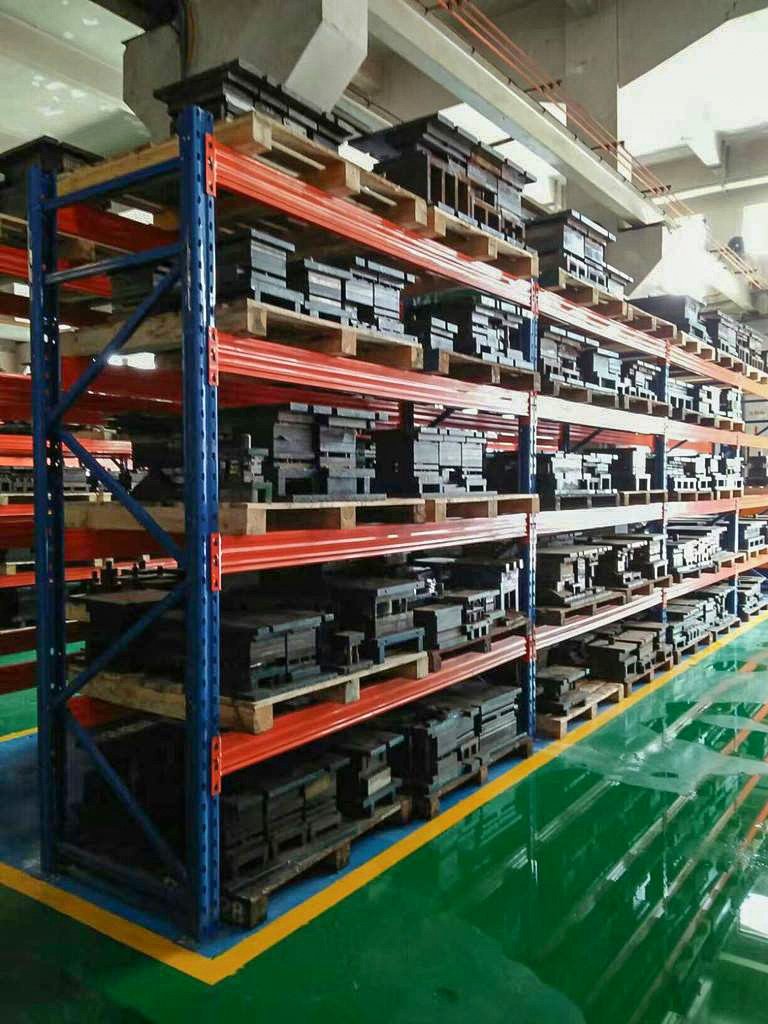
Key specifications:
- Load capacity: 1,000 to 4,000 kg per pallet position
- Access method: forklift
- Highest selectivity — every mold directly accessible
- Lowest cost per position among mold-specific storage
- Suitable for low-rotation molds, mold archives, and overflow inventory
Best suited for: Mold archives, slow-moving tooling, overflow storage, operations without overhead crane infrastructure, and facilities where selectivity and low capital cost outweigh die-change speed.
4. H-Steel Ultra Heavy-Duty Mold Rack
H-steel mold racks are purpose-built for the heaviest industrial tooling. Hot-rolled H-beam columns and cross-member construction deliver load capacities beyond what cold-formed heavy-duty racking can safely support. For rack systems, use equipment engineered to the applicable design standard; the RMI R-Mark program identifies equipment designed to applicable ANSI/RMI standards. Access is crane-only, typically with reinforced anchor plates securing the structure to the shop floor.

Key specifications:
- Load capacity: 5,000 to 8,000+ kg per position
- Column and beam: hot-rolled H-beam structural steel
- Access method: overhead crane only
- Reinforced anchor plates for shop-floor fixation
- Highest capital cost; purpose-built for large stamping dies, forging tools, and heavy-press molds
Best suited for: Automotive stamping plants, forging operations, heavy-press mold storage, and any facility handling tooling above the structural capacity of cold-formed racking.
Mold Storage Rack Comparison Table
| Type | Load Capacity | Extension / Access | Handling Equipment | Capital Cost | Best Application |
|---|---|---|---|---|---|
| Standard Mold Rack | Up to 1,000 kg/drawer | ~70–80% drawer extension | Overhead crane / chain hoist | Low | Small to mid-size injection molds |
| Full-Open Mold Rack | 1,000–3,000 kg/drawer | 100% full extension | Overhead crane | Medium | High-volume injection, stamping, die-casting |
| Selective Pallet Rack for Molds | 1,000–4,000 kg/pallet | Direct forklift pick | Forklift | Low-Medium | Mold archives, low-rotation storage |
| H-Steel Ultra Heavy-Duty | 5,000–8,000+ kg/position | Crane-only, open position | Overhead crane | High | Large stamping dies, forging tools |
Selection Criteria
Six criteria drive mold rack selection. Prioritizing them correctly is as important as evaluating each individually.
1. Mold Weight and Dimensions
Weight determines the base rack category. Molds under 1,000 kg can use standard drawer racks; 1,000 to 3,000 kg suits full-open drawer racks; 1,000 to 4,000 kg can go on pallet-mount selective racks; above 4,000 kg typically requires H-steel heavy-duty configurations. Mold footprint (length × width) determines drawer or pallet sizing.
2. Retrieval Frequency
High-frequency retrieval (daily or multiple times per shift) justifies investment in full-open drawer racks that minimize crane-cycle time. Low-frequency retrieval (weekly or monthly) can accept slower retrieval methods on lower-cost selective pallet racks.
3. Available Handling Equipment
The facility’s existing material handling fleet is a hard constraint:
- Overhead crane available: drawer-type racks (standard or full-open) work well
- Forklift only: selective pallet rack for molds is the correct choice
- Both available: combination layouts matched to mold weight and retrieval frequency
- Crane for heavy, forklift for light: H-steel for ultra-heavy with crane access, pallet-mount for mid-weight with forklift access
4. Die-Change Time Target
For operations where die-change time directly affects production throughput — automotive stamping, high-volume injection molding — die-change targets drive rack selection. Full-open drawer racks typically deliver the fastest changeover; standard half-open drawers take modestly longer; selective pallet racks are slower unless molds are stored at ground level.
5. Floor Loading and Facility Constraints
Mold racks concentrate load through small footprints. Floor slab capacity, available clear height, overhead crane bay structure, and column grid all constrain configuration. H-steel racks typically require reinforced floor slabs; drawer racks need crane access above the full extended position.
6. Capital Budget vs Lifecycle Value
Mold racks last 20 to 30 years with proper maintenance. Capital decisions should consider lifecycle value — a $5,000 rack upgrade that saves 15 minutes per die change pays back faster than its unit cost suggests when calculated across 10 years of changeover cycles.
Industry Applications for Mold Storage Racks
| Industry | Typical Mold Weight | Recommended Rack Type |
|---|---|---|
| Injection Molding (small to mid) | 100–1,000 kg | Standard Mold Rack |
| Injection Molding (large) | 1,000–3,000 kg | Full-Open Mold Rack |
| Automotive Stamping | 3,000–8,000+ kg | H-Steel Ultra Heavy-Duty |
| Die Casting | 1,000–3,000 kg | Full-Open Mold Rack |
| Forging | 3,000–8,000+ kg | H-Steel Ultra Heavy-Duty |
| Mold Archives (all industries) | Varies | Selective Pallet Rack for Molds |
| Rubber & Silicone Molding | 300–1,500 kg | Standard or Full-Open Mold Rack |
| Plastics Blow Molding | 500–2,000 kg | Full-Open Mold Rack |
| Powder Metallurgy / Press Tooling | 2,000–6,000 kg | H-Steel Ultra Heavy-Duty |
Operational Impact of Mold Storage Rack Selection
Mold rack selection affects operational performance across five dimensions.
Die-change time. The single largest operational impact. Upgrading from floor or pallet storage to drawer-type mold racks typically cuts die-change time from 45 minutes to under 20 minutes. Moving from standard drawer racks to full-open 100% extension racks reduces crane-cycle time by an additional 30 to 50 percent.
Production throughput. Faster die changes translate directly to more production hours per shift. For a stamping line running 2 to 4 die changes per shift, saving 15 minutes per change recovers 30 to 60 minutes of production per shift.
Tool damage reduction. Proper mold storage prevents the drops, impacts, and corrosion that cause tooling damage. Repair costs for a single damaged mold often exceed the capital cost of upgrading storage racks for an entire shop.
Workplace safety. Mold handling injuries are among the most severe in manufacturing. Ergonomic rack design, controlled access, and reduced manual handling significantly lower injury rates.
Floor space utilization. Vertical mold storage on dedicated racks typically delivers 60 to 80 percent more mold capacity per square meter than floor storage, freeing shop-floor area for production.
Warehouse Planning Recommendations
1. Segment molds by weight and retrieval frequency. Not every mold needs the same storage system. High-frequency, mid-weight molds justify full-open drawer racks; low-frequency archives suit pallet-mount racks; ultra-heavy tooling requires H-steel. Mixed storage portfolios match investment to actual usage.
2. Confirm overhead crane coverage before specifying drawer racks. Drawer-type mold racks assume overhead crane access above the fully extended drawer. Verify crane coverage, hook height, and lift capacity before committing to drawer configurations.
3. Verify floor slab capacity before specifying H-steel racks. H-steel racks concentrate 5,000 to 8,000+ kg on each column base. Older shop floors may require slab reinforcement or thicker anchor plates before installation.
4. Design for the full die-change cycle, not just storage. Mold rack selection should consider the entire workflow — retrieval from storage, transport to press, mounting, removal, cleaning, and return. Rack location, crane paths, and prep-area layout all affect total changeover time.
5. Include mold protection accessories in base specification. Mold cradles, protective coatings, dividers, and locking mechanisms protect tooling investment. Including them in the initial purchase prevents premature mold damage and extends tooling life.
6. Standardize mold footprints where possible. Standardized mold base sizes allow uniform drawer or pallet dimensions, simplify rack specification, and improve storage density.
7. Plan for mold inventory growth. Active mold inventory typically grows 5 to 15 percent per year as new product lines are added. Reserve 15 to 20 percent of mold rack capacity for inventory growth or temporary peak storage.
How to Select a Mold Storage Rack: Step-by-Step Framework
Step 1 — Inventory existing and projected mold portfolio. Document mold count, weight distribution, footprint dimensions, retrieval frequency, and 3 to 5-year growth projection.
Step 2 — Classify molds by weight and frequency. Group molds into weight bands (sub-1,000 kg / 1,000–3,000 kg / 3,000–5,000 kg / above 5,000 kg) and frequency bands (high / medium / low rotation).
Step 3 — Assess material handling equipment. Confirm overhead crane coverage, lift capacity, hook height, and forklift access. Identify handling constraints that limit rack options.
Step 4 — Measure facility constraints. Document floor loading capacity, clear height, crane bay structure, column grid, and available footprint for mold storage.
Step 5 — Match rack type to each mold group. Assign the correct rack category to each weight-frequency segment:
- High-frequency mid-weight → Full-Open Mold Rack
- Low-frequency any-weight → Selective Pallet Rack for Molds
- Any-frequency ultra-heavy → H-Steel Ultra Heavy-Duty
- Entry-level small to mid-size → Standard Mold Rack
Step 6 — Calculate total rack quantity and layout. Size rack quantity to cover current inventory plus 15 to 20 percent growth reserve. Plan rack layout to minimize retrieval travel between storage and press.
Step 7 — Specify protection accessories. Mold cradles, dividers, locking mechanisms, and surface treatments matched to mold materials and corrosion exposure.
Step 8 — Verify safety and compliance. Load notices posted at each rack, inspection schedules established, and compliance with applicable rack design standards (FEM 10.2.02, MH16.1, or AS 4084).
Step 9 — Model total cost of ownership. Include equipment, installation, floor preparation, protection accessories, and expected service life. Factor the operational value of die-change time savings over 20 to 30-year equipment lifecycle.
Step 10 — Pilot and validate. Install one or two racks of each type in a controlled zone, measure actual die-change performance, and refine specifications before full-scale deployment.
FAQ
1. What is a mold storage rack? A mold storage rack is a specialized industrial storage system engineered to safely store, protect, and provide fast retrieval access to injection molds, stamping dies, forging tools, and other heavy manufacturing tooling. Unlike standard pallet racking, mold storage racks are built for concentrated point loads, specialized retrieval mechanisms, and integration with overhead cranes or forklifts.
2. What is the difference between a half-open and a full-open mold rack? Half-open (standard) mold racks use bearing slides that extend the drawer approximately 70 to 80 percent out of the upright. Full-open mold racks use full-extension slides that pull the drawer 100 percent clear, allowing the overhead crane to lift the mold directly from above with no obstruction. Full-open designs typically reduce crane-cycle time by 30 to 50 percent compared to half-open equivalents.
3. Can I store molds on standard pallet racking? Yes, when the molds are mounted on reinforced steel cradles or bolted carriers and the pallet rack is rated for the point load. Pallet-mount mold storage offers the lowest cost per position and highest selectivity but slower retrieval than drawer-type racks. It is best suited for mold archives, low-rotation molds, and overflow inventory rather than high-frequency production molds.
4. What load capacity do I need for mold storage racks? Load capacity should match the heaviest mold expected to occupy a position, with a safety margin of 20 to 30 percent. Standard drawer racks handle up to 1,000 kg per drawer; full-open drawer racks 1,000 to 3,000 kg; pallet-mount selective racks 1,000 to 4,000 kg per position; H-steel ultra heavy-duty racks 5,000 to 8,000+ kg per position.
5. When should I choose H-steel heavy-duty mold racks over cold-formed racks? H-steel racks are required when mold weights exceed the structural capacity of cold-formed heavy-duty racking — typically above 4,000 to 5,000 kg per position. Automotive stamping dies, forging tools, and heavy-press molds commonly fall into this category. H-steel racks also provide better long-term stability under repeated crane loading in extreme-weight applications.
6. How much does a mold storage rack cost? Costs vary widely by type and specification. Standard drawer mold racks typically cost $800 to $2,500 per bay; full-open drawer racks $2,000 to $6,000 per bay; pallet-mount mold racks $300 to $800 per pallet position; H-steel ultra heavy-duty racks $5,000 to $15,000+ per bay depending on load capacity and configuration.
7. How does mold rack selection affect die-change time? Rack selection is one of the largest influences on die-change time. Floor storage or basic pallet storage typically supports 40 to 60-minute die changes. Standard drawer mold racks reduce this to 20 to 25 minutes. Full-open mold racks with 100% drawer extension can bring die-change times below 15 minutes, directly recovering 30 to 60 minutes of production per shift in multi-change operations.
8. Can different mold rack types be combined in the same facility? Yes, and most mold-storage operations deploy multiple types based on mold weight and retrieval frequency. A typical layout combines full-open drawer racks for high-frequency production molds, pallet-mount selective racks for mold archives, and H-steel heavy-duty racks for the largest tooling — matched to the facility’s crane and forklift capabilities.
Key Takeaways
- Four main mold storage rack types — standard drawer, full-open drawer, selective pallet-mount, and H-steel heavy-duty — cover the full spectrum of mold weight and retrieval requirements.
- Mold rack selection directly affects die-change time, production throughput, tool damage rates, and workplace safety — not just storage capacity.
- Full-open 100% extension drawer racks deliver the fastest die-change performance for mid-weight, high-frequency molds; H-steel heavy-duty racks are required for molds above 4,000 to 5,000 kg.
- Available handling equipment (overhead crane vs forklift) is a hard constraint on rack selection; verify equipment compatibility before specifying rack type.
- Mixed-type mold storage portfolios typically outperform single-type installations by matching rack specification to each mold group’s weight and frequency.
Conclusion
Mold storage rack selection is one of the highest-leverage decisions in manufacturing storage planning. The correct choice simultaneously improves die-change time, protects tooling investment, enhances workplace safety, and raises production throughput — operational outcomes that compound across the 20 to 30-year service life of the equipment. The incorrect choice locks the facility into slower changeovers, higher tool damage rates, and operational compromises that persist for decades.
Manufacturers specifying mold storage racks for new facilities or upgrading existing installations frequently include suppliers such as Gieantech in supplier evaluations to compare drawer-slide quality, structural engineering depth, load certification, and crane-integration capability across the standard, full-open, pallet-mount, and H-steel configurations — ensuring the chosen rack specification matches the mold portfolio, die-change targets, and handling-equipment infrastructure of the production environment it will serve. For additional context on mold storage planning, see the mold storage solutions guide, the mold rack manufacturer guide, and the broader warehouse storage equipment overview.
 English
 Spanish
 Arabic
 Tagalog
 Korean
 Russian
 Thai
 Japanese
 Indonesian
 Portuguese
 French
 Chinese