Warehouse storage equipment is one of the largest single capital decisions in any warehouse project. The equipment selected determines storage density, picking productivity, accessibility, building height utilization, and total cost of ownership for the next 15 to 25 years. A correctly specified system can lift storage capacity by 40 to 80 percent within the same footprint; an incorrectly specified system locks the operation into inefficient flow and recurring labor costs.
Choosing warehouse storage equipment is therefore not a product question but a warehouse planning question. Each equipment type carries trade-offs between selectivity, density, throughput, and capital cost — and the right choice depends on SKU profile, inventory turnover, building dimensions, and long-term growth plans. This guide explains the main categories of warehouse storage equipment, compares their operational performance, and provides a structured framework for selection.
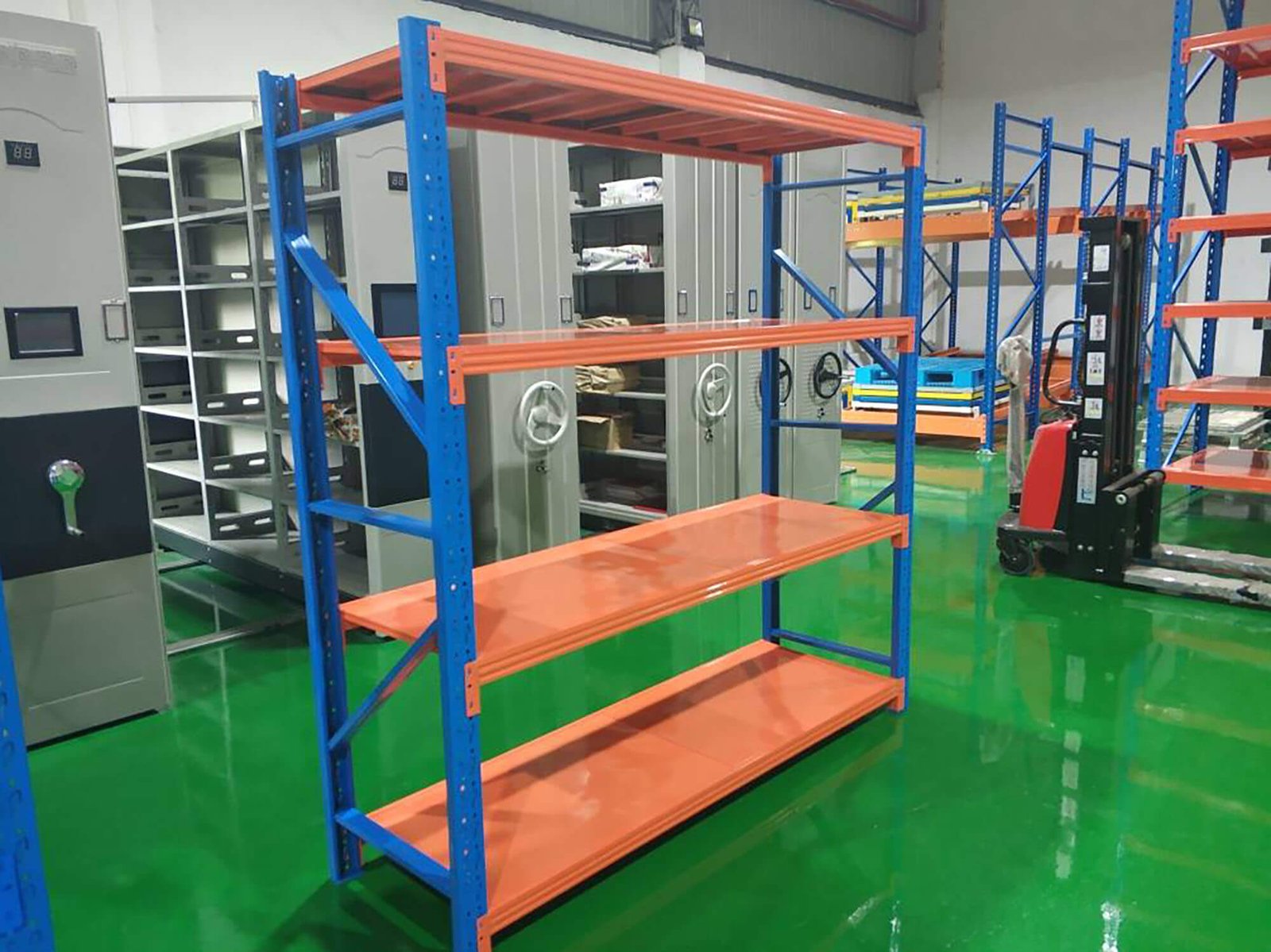
What Is Warehouse Storage Equipment?
Warehouse storage equipment is the structural system used to hold, organize, and provide access to inventory within a warehouse facility. It includes pallet racking, shelving, mezzanine structures, cantilever systems, and automated storage solutions that together define how products are stored and retrieved.
The selection of warehouse storage equipment determines four critical operational parameters:
- Storage density — how many pallets or cartons can be held per square meter
- Selectivity — how directly each SKU can be accessed without moving other inventory
- Throughput capacity — how many pick or putaway transactions the system supports per hour
- Flexibility — how easily the system adapts to changes in SKU mix, pallet dimensions, or volume
These parameters together influence storage capacity, labor productivity, and operating costs across the entire facility.
Main Categories of Warehouse Storage Equipment
1. Selective Pallet Racking
Selective pallet racking is the most widely used warehouse storage system globally. Each pallet position is directly accessible by a forklift from the aisle, providing 100 percent selectivity.
Operational characteristics:
- Direct access to every pallet
- Compatible with FIFO and FEFO rotation
- Adjustable beam heights for changing pallet sizes
- Lowest capital cost per pallet position
- Lowest storage density among pallet systems
Best suited for: Operations with high SKU count, low pallets-per-SKU ratios, and a need for direct accessibility — including FMCG, e-commerce fulfillment, and general distribution.
2. Drive-In and Drive-Through Racking
Drive-in racking stores pallets in deep lanes, with forklifts entering the racking structure to deposit or retrieve loads. Drive-through racking allows entry from both sides.
Operational characteristics:
- High storage density (up to 70 percent more than selective racking)
- LIFO operation for drive-in; FIFO possible with drive-through
- Limited selectivity — typically one SKU per lane
- Slower individual pallet retrieval
- Suitable for low-SKU, high-volume products
Best suited for: Cold storage, beverage warehouses, and operations with large quantities of identical pallets per SKU.
3. Push-Back Racking
Push-back racking uses inclined rails and nested carts. New pallets push earlier pallets back into the lane; retrieval pulls the front pallet, allowing the next pallet to slide forward.
Operational characteristics:
- LIFO rotation with 2 to 6 pallet depth
- Higher density than selective racking
- Faster than drive-in (no forklift entry required)
- All pallets visible from the aisle
- Higher capital cost than drive-in
Best suited for: Distribution centers with medium SKU count and 3 to 5 pallets per SKU where moderate density and faster handling are required.
4. Pallet Flow Racking (Gravity Flow)
Pallet flow racking uses inclined roller or wheel beds. Pallets loaded at one end gravity-feed to the picking end, providing automatic FIFO rotation.
Operational characteristics:
- Automatic FIFO sequencing
- High density with lane depth up to 20 pallets
- Separate load and pick aisles reduce congestion
- Ideal for high-throughput SKUs
- Requires precise pallet quality and flow speed controllers
Best suited for: Food and beverage operations, perishable goods, and any high-throughput environment requiring strict FIFO discipline.
5. Cantilever Racking
Cantilever racking uses horizontal arms extending from vertical columns, providing open-fronted storage for long, bulky, or irregular loads.
Operational characteristics:
- Designed for non-palletized long items
- Open front allows unobstructed loading
- Single-sided or double-sided configurations
- Adjustable arm heights
- Lower density than pallet racking but optimized for non-standard loads
Best suited for: Steel bars, timber, pipes, tubing, furniture components, and other long-format products.
6. Mezzanine Floors
Mezzanine floors are intermediate structural levels built within an existing warehouse to multiply usable floor area, typically by two or three times.
Operational characteristics:
- Adds floor area without expanding building footprint
- Supports shelving, picking modules, packing stations, or offices
- Integrated with conveyors, lifts, or chutes
- Typically used in conjunction with light or medium-duty shelving
- Capacity depends on floor loading and building height
Best suited for: E-commerce fulfillment centers, pick-and-pack operations, spare parts warehouses, and any operation where building height exceeds storage requirement.
7. Shuttle Racking (Radio Shuttle / Pallet Shuttle)
Shuttle racking uses a semi-automated carrier (the shuttle) that moves pallets along deep lanes under remote control. The forklift only loads and retrieves at the aisle face.
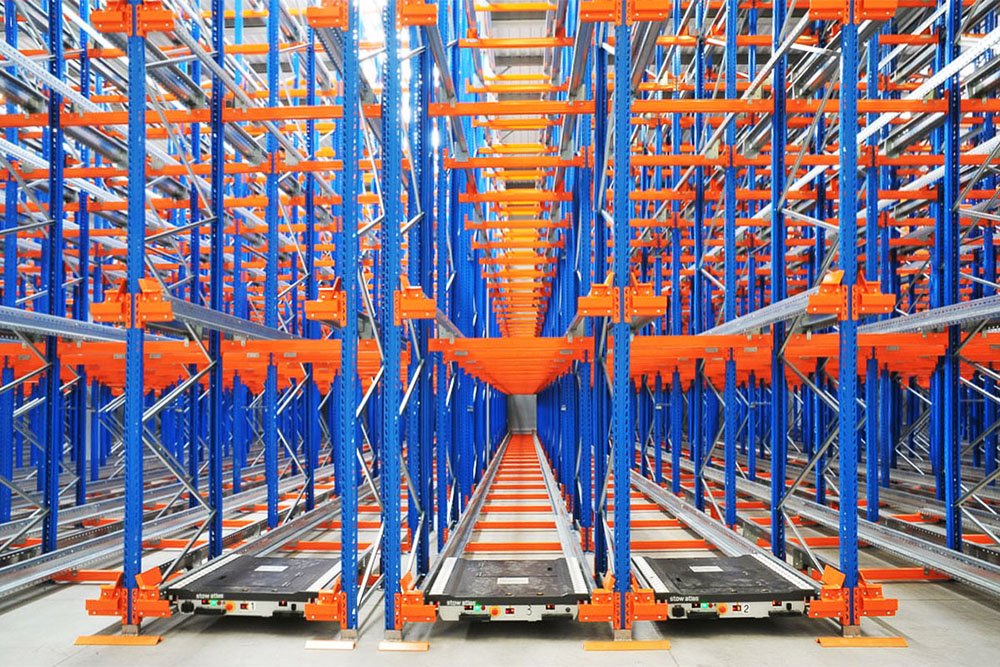
Operational characteristics:
- High density with lane depth of 10 to 40 pallets
- Supports FIFO or LIFO operation
- Reduces forklift travel inside the racking
- Improves safety by eliminating forklift entry into deep lanes
- Higher capital cost; significant productivity gains in high-volume operations
Best suited for: Cold storage, beverage distribution, FMCG, and any high-density operation with consistent SKU profiles.
8. Mobile Racking
Mobile racking mounts selective pallet racking on motorized bases that move along floor rails. Only one aisle is open at a time, eliminating wasted aisle space.
Operational characteristics:
- Up to 80 percent more storage capacity than fixed selective racking
- 100 percent selectivity maintained
- Slower access (aisle must open before retrieval)
- Higher capital and maintenance cost
- Suitable for low-throughput, high-value, or temperature-controlled storage
Best suited for: Cold storage, archives, pharmaceutical storage, and high-value goods where space cost outweighs access speed.
9. Very Narrow Aisle (VNA) Systems
VNA systems use specialized forklifts operating in aisles as narrow as 1.6 to 1.8 meters, combined with high-bay selective racking.
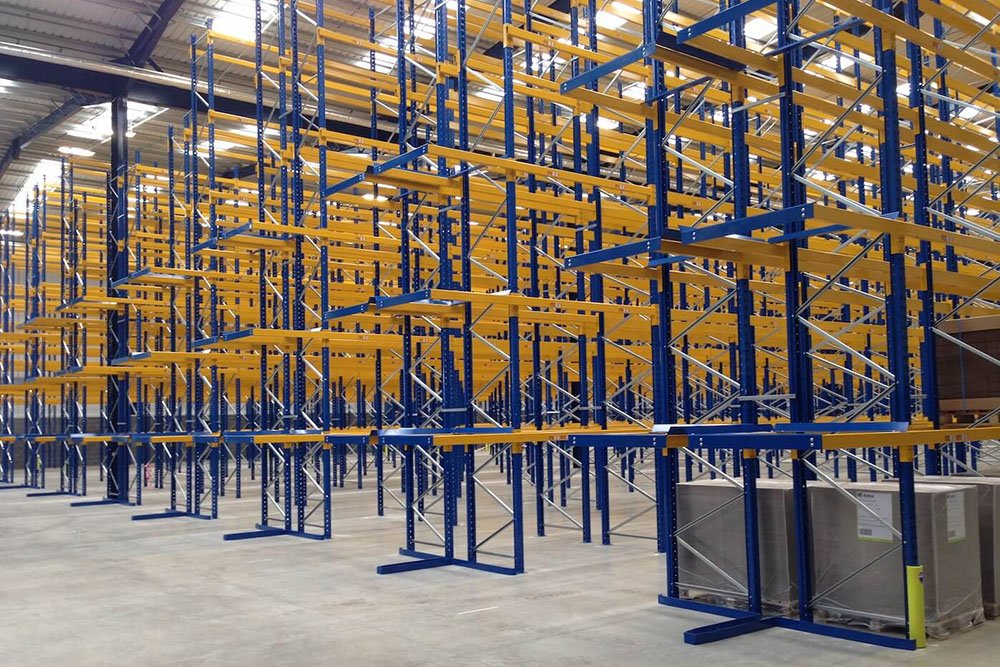
Operational characteristics:
- 40 to 50 percent more storage capacity than wide-aisle racking
- Maintains 100 percent selectivity
- Requires guided forklifts (wire, rail, or laser guidance)
- Demands flat, level floors and precise installation
- Best deployed in high buildings (12 meters and above)
Best suited for: High-bay distribution centers and operations needing both density and selectivity.
10. Automated Storage and Retrieval Systems (ASRS)
ASRS combines high-bay racking with automated cranes, shuttles, or robots that handle storage and retrieval without forklift operators.
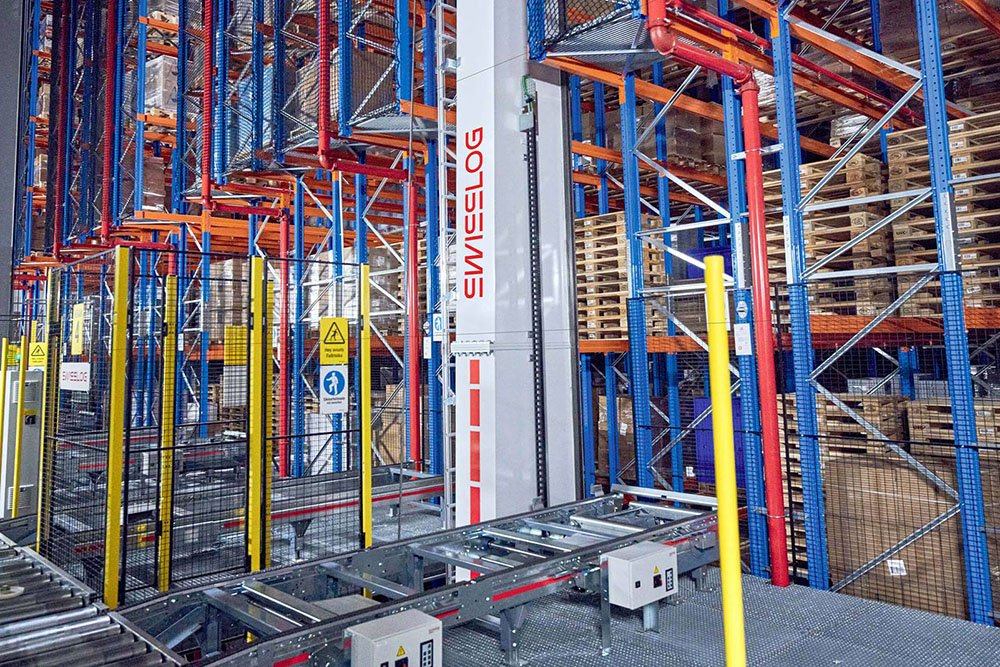
Operational characteristics:
- Highest storage density and throughput
- 24/7 operation with minimal labor
- Integrates directly with WMS and ERP
- High capital cost and long payback period
- Limited flexibility once installed
Best suited for: High-volume, stable-SKU operations such as pharmaceutical distribution, automotive parts, and large e-commerce fulfillment centers.
11. Long-Span Shelving and Carton Flow Racking
Long-span shelving stores hand-loaded cartons or totes, typically for picking operations. Carton flow racking adds gravity rollers for automatic carton replenishment to the pick face.
Operational characteristics:
- Optimized for piece-pick and case-pick operations
- Ergonomic pick faces reduce labor strain
- Compatible with mezzanines and pick modules
- Supports FIFO at the carton level
Best suited for: E-commerce fulfillment, parts distribution, and any operation with high-volume small-item picking.
Warehouse Storage Equipment Comparison Table
| Equipment | Storage Density | Selectivity | Rotation | Capital Cost | Throughput |
|---|---|---|---|---|---|
| Selective Pallet Racking | Low | 100% | FIFO / FEFO | Low | High |
| Drive-In Racking | High | Low | LIFO | Moderate | Low |
| Push-Back Racking | Medium-High | Medium | LIFO | Medium-High | Medium |
| Pallet Flow Racking | High | Medium | FIFO | High | High |
| Cantilever Racking | Low-Medium | High | Varies | Moderate | Medium |
| Mezzanine Floor | N/A (adds area) | N/A | N/A | Moderate | Varies |
| Shuttle Racking | Very High | Medium-High | FIFO / LIFO | High | High |
| Mobile Racking | Very High | 100% | FIFO / FEFO | High | Low-Medium |
| VNA Systems | High | 100% | FIFO / FEFO | High | High |
| ASRS | Very High | 100% | FIFO / FEFO | Very High | Very High |
| Carton Flow Racking | Medium | High | FIFO | Medium | Very High |
Equipment Selection by Industry Application
| Industry | Recommended Equipment |
|---|---|
| FMCG Distribution | Selective racking, push-back, pallet flow |
| Cold Storage | Shuttle racking, mobile racking, drive-in |
| E-commerce Fulfillment | Mezzanine + shelving, carton flow, ASRS |
| Pharmaceutical | Selective racking, mobile racking, ASRS |
| Automotive Parts | Cantilever, selective racking, mezzanine |
| Beverage | Pallet flow, drive-in, shuttle racking |
| 3PL / Multi-client | Selective racking, VNA, mezzanine |
| Heavy Industrial | Cantilever, heavy-duty selective racking |
| Retail Distribution | Selective racking, push-back, carton flow |
Operational Impact of Warehouse Storage Equipment
The equipment selection directly affects several operational KPIs:
Storage capacity — Moving from selective racking to shuttle or mobile systems can increase pallet positions per square meter by 60 to 100 percent, often deferring or eliminating the need for expansion.
Labor productivity — Pallet flow and shuttle systems can reduce forklift travel by 30 to 50 percent, directly improving pallets-handled-per-hour metrics.
Building height utilization — VNA and ASRS exploit clear heights above 12 meters that are otherwise unusable with conventional wide-aisle racking, converting vertical space into capacity.
Order accuracy — Carton flow and ASRS systems improve pick accuracy through guided picking, structured presentation, and reduced manual search time.
Operating costs — Mobile racking and ASRS reduce square-meter cost in space-constrained operations; selective racking minimizes capital expenditure in space-abundant operations. The lowest-total-cost solution depends on local real estate cost relative to equipment cost.
Warehouse Planning Recommendations
To select warehouse storage equipment that supports long-term performance, apply the following planning recommendations:
1. Analyze the SKU profile first Calculate pallets per SKU, pick frequency, and ABC classification. High pallets-per-SKU ratios favor deep-lane systems; high SKU counts with low pallets-per-SKU favor selective systems.
2. Map inventory turnover to density requirements Slow-moving inventory tolerates lower selectivity in exchange for higher density. Fast-moving inventory requires accessibility to sustain throughput.
3. Use building height fully Storage capacity per square meter scales with usable height. Buildings with 10 meters or more of clear height should be evaluated for VNA, shuttle, or ASRS systems before considering expansion.
4. Match equipment to rotation method FEFO and strict FIFO operations should avoid LIFO-only systems such as drive-in racking. Hybrid layouts can combine selective racking for regulated SKUs with deep-lane systems for bulk goods.
5. Plan for future SKU and volume changes Storage equipment lasts 15 to 25 years; SKU mix often changes within 3 to 5 years. Reserve flexibility through modular racking, accessible beam adjustment, and undefined-use zones.
6. Integrate equipment with material handling and WMS Forklift type, aisle width, floor flatness, and WMS slotting logic must be specified together with the racking system. Mismatched specifications create execution failure post-installation.
7. Verify safety and compliance standards Storage equipment should comply with relevant standards such as FEM 10.2.02 (European racking design), ANSI MH16.1 (US selective racking), and applicable seismic codes. Load notices and routine inspections protect operational continuity.
How to Select Warehouse Storage Equipment: Step-by-Step Framework
Step 1 — Define the operational profile Document SKU count, pallets per SKU, daily throughput, order profile, and inventory turnover. This profile drives every subsequent decision.
Step 2 — Determine selectivity and density requirements Decide whether the operation prioritizes direct access (selective) or maximum capacity (deep-lane). Most operations land between these extremes and require hybrid solutions.
Step 3 — Evaluate building constraints Measure clear height, column spacing, floor loading, and door positions. Building geometry constrains equipment options and often dictates final layout.
Step 4 — Shortlist suitable equipment types Match the operational profile to the equipment categories above. Typically two or three options will fit; eliminate clearly unsuitable systems early.
Step 5 — Model storage capacity and throughput Calculate pallet positions and expected daily transactions for each shortlisted option. Verify the model meets both current demand and projected growth.
Step 6 — Compare total cost of ownership Include capital cost, installation, forklift fleet adjustment, labor, maintenance, and energy. Lowest capital cost rarely equals lowest total cost.
Step 7 — Validate with simulation and pilot For complex installations, use warehouse simulation software or pilot zones to validate flow, throughput, and ergonomics before full deployment.
FAQ
1. What is the most common type of warehouse storage equipment? Selective pallet racking is the most widely used worldwide. It offers 100 percent selectivity, the lowest capital cost per pallet position, and compatibility with virtually all forklift types and rotation methods.
2. How does warehouse storage equipment affect storage capacity? Equipment selection can change storage capacity within the same building footprint by 40 to 100 percent. Moving from wide-aisle selective racking to VNA, shuttle, or mobile racking systems typically delivers the largest gains.
3. What is the difference between drive-in racking and shuttle racking? Both store pallets in deep lanes for higher density. Drive-in racking requires forklifts to enter the lane, which slows operations and limits selectivity. Shuttle racking uses a remote-controlled carrier inside the lane, so the forklift remains in the aisle, increasing safety and throughput.
4. When should an operation consider ASRS? ASRS is justified when throughput requirements exceed manual capacity, when labor cost or availability is a constraint, or when storage density requirements cannot be met by conventional equipment. SKU stability and capital availability are prerequisites.
5. Can different storage equipment types be combined in one warehouse? Yes, and most modern warehouses do. A typical layout may combine selective racking for high-SKU bulk storage, shuttle or pallet flow racking for high-volume SKUs, mezzanine and carton flow for piece picking, and cantilever racking for long items.
6. What building height is required to justify high-bay equipment? VNA systems typically require 12 meters or more of clear height to deliver meaningful capacity gains. Shuttle and ASRS systems can justify even higher buildings (up to 30 meters or more), where vertical capacity replaces horizontal expansion.
7. How long does warehouse storage equipment last? Properly installed and maintained storage equipment typically lasts 15 to 25 years. Service life depends on load cycles, forklift impact frequency, environmental conditions, and adherence to inspection and maintenance schedules.
8. What safety standards apply to warehouse storage equipment? Common standards include FEM 10.2.02 (Europe), ANSI MH16.1 and RMI specifications (US), and applicable national seismic and load codes. Operators should display load notices, conduct periodic rack inspections, and address damage promptly to maintain safety and compliance.
Key Takeaways
- Warehouse storage equipment selection determines storage capacity, throughput, selectivity, and total operating cost.
- Selective pallet racking remains the default for high-SKU operations; deep-lane systems deliver density where SKU profile allows.
- Building height utilization, achieved through VNA, shuttle, or ASRS, often delivers more capacity than horizontal expansion.
- Hybrid layouts combining multiple equipment types fit most modern warehouse operations.
- Equipment selection should be driven by SKU profile, throughput, and building constraints, not by product preference.
Conclusion
Warehouse storage equipment is a long-term operational asset, not a one-time purchase. The system installed today defines how the warehouse will perform for the next two decades, including how much inventory it can hold, how quickly it can be moved, and how readily it can adapt to changes in SKU mix and demand. A structured selection process — built around SKU analysis, building constraints, and total cost of ownership — produces materially better outcomes than catalog-driven choices.
Operations seeking to balance density, throughput, and flexibility typically require a combination of equipment types matched to specific zones and SKU categories rather than a single uniform system. Companies such as Gieantech represent the type of warehouse storage solution provider commonly evaluated by warehouse operators seeking to align racking design, building utilization, and operational throughput with long-term capacity planning.
 English
  Spanish
  Arabic
  Tagalog
  Korean
  Russian
  Thai
Thai  Japanese
  Indonesian
  Portuguese
  French
  Chinese