No two warehouses store inventory the same way, and no single style of racking is right for every operation. The pallet you store, how fast it turns over, how many SKUs you carry, and how much floor space you can afford all push you toward different solutions. That’s why understanding the main pallet rack types is one of the most valuable things a warehouse manager, operations planner, or facility designer can do before committing to a storage system.
Each type of pallet racking strikes its own balance between two competing priorities: selectivity (how easily you can reach any individual pallet) and storage density (how many pallets you can pack into a given footprint). Some racks let you touch every pallet directly but use more aisle space; others pack pallets tightly but limit access. The art of warehouse design lies in matching the right rack type to the way your product actually moves. This guide walks through the major pallet racking systems, how each one works, where it shines, and what trade-offs to weigh before you choose.
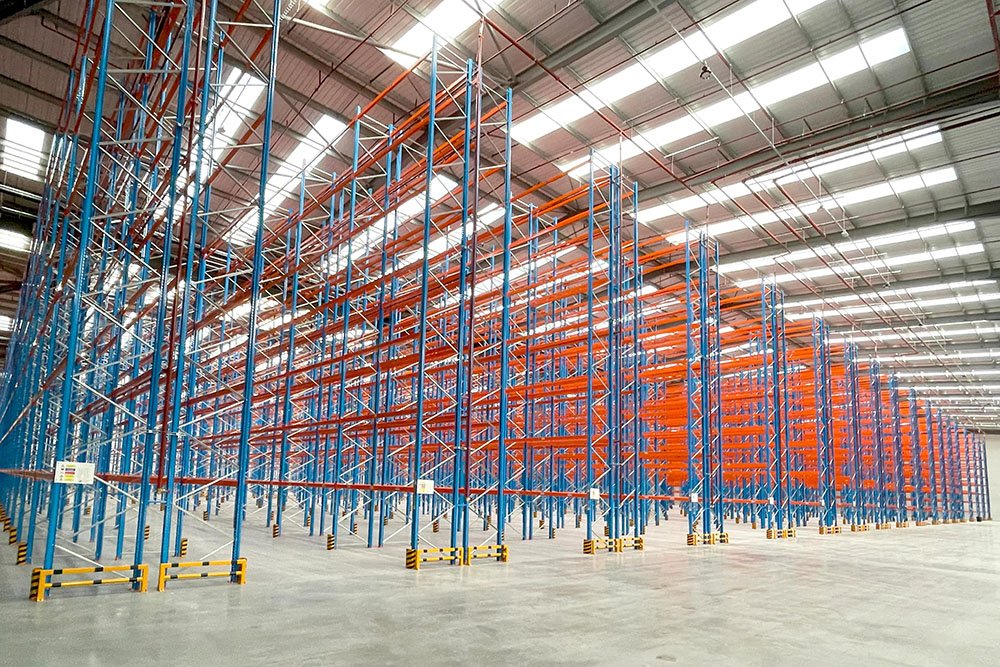
Why the Right Rack Type Matters
Choosing a pallet racking system isn’t just about buying steel to hold product. The decision shapes how much you can store, how quickly your team can pick and replenish, how many forklifts and operators you need, and even how safe your operation is. A rack type that fits your workflow can dramatically increase capacity and throughput; the wrong one creates bottlenecks, wastes space, and frustrates everyone who works around it.
The cost equation matters too. High-density systems pack more pallets into the same building, which can defer or eliminate the need for a costly expansion. But density usually comes at the price of selectivity and added complexity, so the savings only materialize if your inventory profile actually suits that style of storage. Getting the rack type right the first time pays off for years; getting it wrong is expensive to undo once the system is installed and loaded.
The Key Factors That Determine the Best Fit
Before looking at specific systems, it helps to understand the variables that point you toward one type over another. These factors come up again and again throughout this guide.
The first is stock rotation. Some operations need first-in, first-out (FIFO) handling, where the oldest stock is always picked first—essential for perishable goods, dated products, and anything with a shelf life. Others can work with last-in, first-out (LIFO), where the most recently stored pallet is the first one out. The rotation requirement alone rules certain rack types in or out.
The second is the relationship between SKU count and pallet quantity. If you carry many different products but only a few pallets of each, you need high selectivity so every SKU stays reachable. If you carry few products but many pallets of each, you can afford to store them deep and dense because you rarely need to reach a buried pallet of a different item.
The third is throughput—how many pallets move in and out per hour. High-throughput operations favor systems that allow fast, direct access, while slower-moving bulk storage can tolerate the extra handling that high-density systems sometimes require.
Finally, there’s the physical environment: ceiling height, floor quality, building shape, the forklifts you operate, and any temperature or fire-code constraints. With these factors in mind, the differences between rack types become much easier to evaluate.
Selective Pallet Racking
Selective pallet racking is the most common and most widely recognized of all the pallet rack types, and for most warehouses it’s the default starting point. In a selective system, single rows of racking are arranged with aisles between them, and a forklift accesses pallets directly from the aisle. Every pallet sits on a load beam and is reachable without moving any other pallet, which gives this system its defining quality: 100% selectivity.
That direct access is exactly why selective racking is so popular. It handles a high number of SKUs gracefully, supports any rotation method including strict FIFO, and works with standard forklifts that most facilities already own. It’s also the most economical system per rack and the easiest to install, modify, and expand. For operations with many different products and moderate volumes of each, selective racking is hard to beat.
The trade-off is space efficiency. Because every row needs an aisle beside it, a large share of the floor is given over to aisles rather than storage. In facilities where space is tight or expensive, that can become a limiting factor, which is what drives many operations to consider denser alternatives.
Single-Deep Selective Racking
The standard form of selective racking is single-deep, meaning pallets are stored one deep on each side of an aisle. This is the simplest configuration: maximum accessibility, lowest cost, and the easiest to reconfigure as your needs change. Single-deep selective racking suits the broadest range of operations and is the benchmark against which other systems are compared.
Double-Deep Selective Racking
Double-deep racking stores pallets two deep, with one pallet positioned behind another. This roughly halves the number of aisles needed compared to single-deep, increasing storage density while keeping much of the selective layout’s familiarity. The catch is that reaching the rear pallet requires a forklift fitted with a reach mechanism (or a pantograph reach truck) to extend past the front position. Selectivity drops because you can’t reach a back pallet until the front one is removed, so double-deep works best when you store at least two pallets of the same SKU together. It’s a sensible middle ground for operations that want more density without moving all the way to a fully high-density system.
Drive-In and Drive-Through Racking
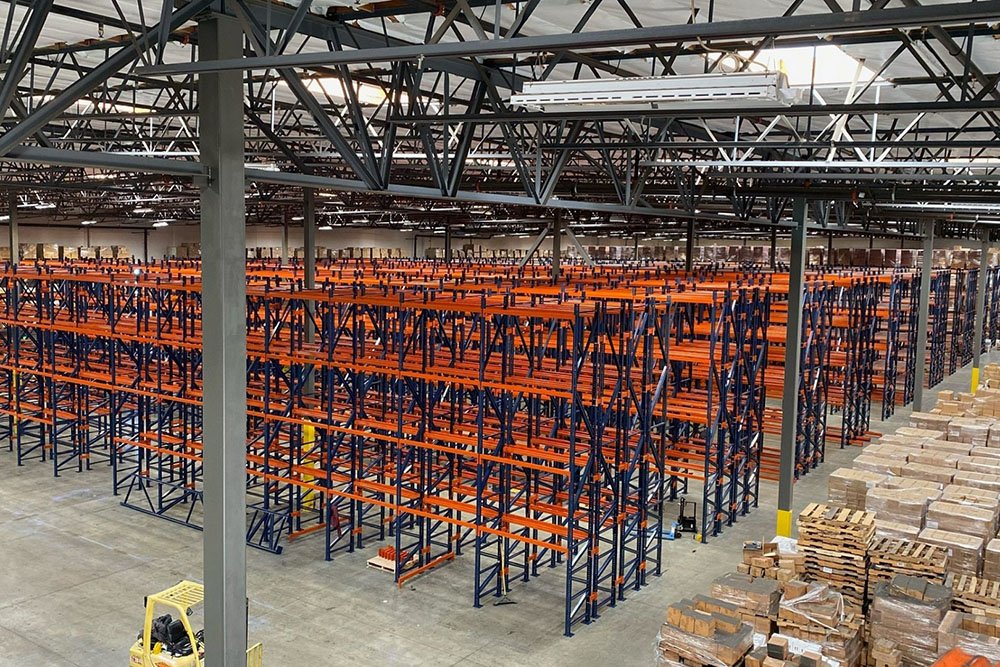
When storage density is the top priority and you handle large quantities of relatively few products, drive-in and drive-through racking offer some of the highest space utilization of any system. Instead of individual aisles between every row, these systems create deep storage lanes that a forklift drives directly into.
Drive-In Racking
In a drive-in system, racking is built in continuous blocks with lanes several pallets deep. Pallets rest on horizontal support rails that run along both sides of each lane, and the forklift drives inside the lane to deposit or retrieve pallets, stacking them several deep and several high. Because there’s only one entry point per lane, drive-in racking operates on a LIFO basis—the last pallet placed in a lane is the first one retrieved.
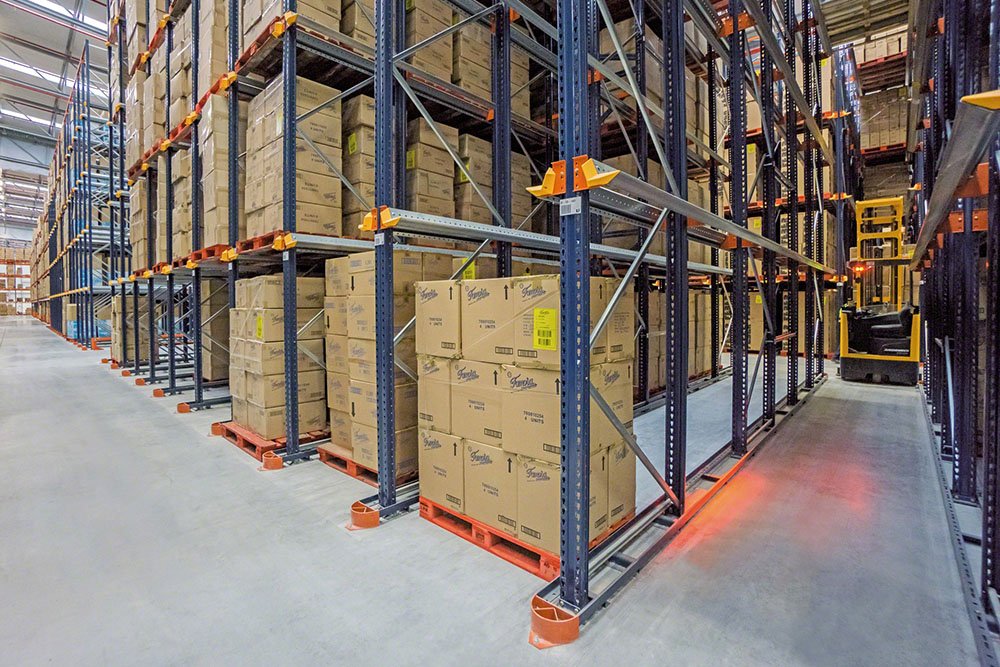
This makes drive-in racking ideal for high-density storage of uniform products with low rotation sensitivity: cold storage, seasonal inventory, and bulk goods where you have many identical pallets and don’t need to reach a specific one. The density is excellent because aisles are minimized. The trade-offs are reduced selectivity, slower handling inside the lanes, and a need for careful forklift operation, since the truck maneuvers within the structure itself.
Drive-Through Racking
Drive-through racking is built the same way but is open at both ends, allowing a forklift to enter from one side and exit from the other. With access from both ends, it can support FIFO rotation: load from the back and pick from the front. This makes drive-through a good option for higher-density storage of products that still need orderly rotation. The trade-off compared to drive-in is that you lose the wall-backed support of a closed block, and you give up some lane configurations, but the FIFO capability is worth it for the right inventory.
Push-Back Racking
Push-back racking is a high-density LIFO system that stores pallets several deep without requiring the forklift to drive into the structure. Each lane contains a series of nested carts riding on inclined rails. When a forklift loads a pallet, it pushes the pallet—and the cart beneath it—back and up the incline, making room for the next pallet at the front. When the front pallet is removed, gravity rolls the remaining pallets forward to the pick face.
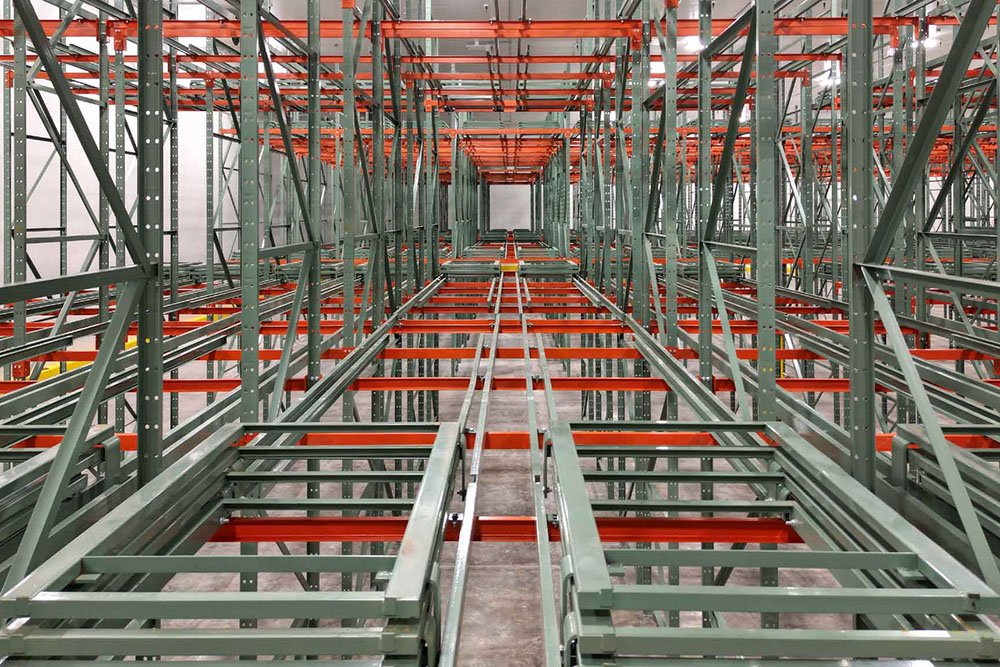
The big advantage of push-back is that it combines strong density with relatively quick access from a single aisle, because the operator never has to enter a lane. It typically stores two to five pallets deep, offering far better space utilization than selective racking while keeping handling faster than drive-in. Push-back suits operations with multiple pallets per SKU and a moderate number of SKUs, where LIFO rotation is acceptable. The cart-and-rail mechanism adds cost and a maintenance consideration, but for many distribution centers the density-versus-access balance is excellent.
Pallet Flow Racking
Pallet flow racking—also called gravity flow or dynamic racking—is the high-density answer for operations that need strict FIFO rotation. Each deep lane is fitted with inclined roller or wheel tracks. Pallets are loaded at the high end and roll gently under gravity toward the low end, where they’re picked. As a front pallet is removed, the next one advances automatically to the pick face.
This separation of loading and picking into opposite ends of the lane delivers both excellent density and clean FIFO flow, which is why pallet flow is a favorite in food and beverage, pharmaceutical, and other date-sensitive operations. It also reduces forklift travel because loading and picking happen in dedicated areas. The system relies on speed controllers and braking rollers to keep heavy pallets moving safely down the incline, so it’s a more engineered—and more expensive—solution than static racking. For high-volume FIFO storage of many identical pallets, though, the throughput and density gains are substantial.
Carton Flow Racking
Closely related to pallet flow, carton flow racking applies the same gravity principle to individual cartons and cases rather than full pallets. Inclined wheel or roller tracks let cartons advance toward the picker as front units are removed, supporting fast, ergonomic FIFO order picking. While it isn’t a pallet storage system in the strict sense, carton flow often integrates into the lower, pick-facing levels of a pallet racking structure, with bulk pallet storage above and fast-moving case picking below. This blend lets a single system serve both replenishment and high-velocity picking, which is why carton flow frequently appears alongside the major pallet rack types in warehouse design.
Cantilever Racking
Cantilever racking is the specialist among pallet rack types, designed for long, bulky, or awkwardly shaped loads that don’t sit neatly on standard pallet beams. Instead of front-to-back beams between two upright frames, cantilever racking uses a central column with horizontal arms projecting outward, leaving the front completely open. With no front columns to get in the way, long items can be loaded and unloaded freely.
This makes cantilever the go-to system for lumber, piping, tubing, steel bar, sheet materials, furniture, and similar products. The arms come in straight and inclined versions and in single- or double-sided configurations, and they’re rated for specific loads so the system can be tuned to heavy or light materials. While it isn’t suited to standard palletized goods, cantilever racking solves a storage problem that no beam-based system can, and it’s indispensable for building-supply, manufacturing, and distribution operations that handle long loads.
Mobile Pallet Racking
Mobile racking takes selective racking and mounts the rows on powered mobile bases that travel on floor-embedded rails. Because the rows can move, the system needs only one or two open aisles at a time rather than an aisle beside every row. When an operator needs to reach a particular row, the bases shift to open an aisle exactly where it’s needed, then close again afterward.
The result is a dramatic gain in density—often the storage of selective racking with a fraction of the aisle space—while preserving full selectivity, since every pallet remains directly accessible once its aisle is open. Mobile racking is especially valuable where floor space is extremely expensive, such as cold storage and urban facilities, because the energy and capital invested in the moving system is repaid by the space saved. The trade-offs are higher upfront cost, the need for level rails and a controlled floor, and slightly slower access while aisles open and close. For the right high-value space, though, mobile racking is one of the most efficient ways to combine density with selectivity.
Pallet Shuttle Systems
Pallet shuttle racking is a semi-automated high-density solution that addresses the handling slowness of traditional drive-in lanes. Instead of a forklift entering the lane, a battery-powered shuttle carts the pallets in and out along rails inside each deep storage channel. The forklift simply places a pallet at the lane entrance and the shuttle ferries it to the back; to retrieve, the shuttle brings the pallet forward to the lane mouth.
Because the operator never drives into the structure, pallet shuttle systems are faster and safer than drive-in racking while achieving comparable or better density. They can be configured for either FIFO or LIFO operation depending on how the lanes are arranged, making them flexible for a range of inventory profiles. The shuttle is moved between lanes by the forklift as needed, so one shuttle can serve many channels. This system bridges the gap between fully manual high-density racking and full automation, and it’s increasingly popular for cold storage and high-volume distribution where both density and throughput matter.
Narrow Aisle and Very Narrow Aisle Racking
Narrow aisle (NA) and very narrow aisle (VNA) racking are, strictly speaking, configurations of selective racking rather than entirely separate structures—but they’re distinct enough in practice to treat as their own approach. The idea is simple: by shrinking the aisle width, you fit more rows into the same floor and recover space that conventional selective layouts give up to wide aisles.
The catch is that narrow aisles require specialized handling equipment. VNA systems use guided turret trucks or order pickers that can operate in aisles far narrower than a standard forklift needs, often guided by floor wire or rails for precision. This preserves the full selectivity of single-deep racking while substantially increasing density. The trade-offs are the cost of the specialized trucks, the need for very flat floors and precise installation, and the fact that movement within the aisles can be slower. For operations with many SKUs that need full access but can’t afford the floor space of wide aisles, VNA is an elegant solution.
Balancing Density Against Accessibility
Step back from the individual systems and a clear pattern emerges. Every pallet rack type lands somewhere on a spectrum between maximum accessibility and maximum density. Selective racking sits at the accessibility end: every pallet reachable, but more floor given to aisles. Drive-in, push-back, and pallet flow sit toward the density end: many pallets packed tightly, but access is constrained by lane depth and rotation rules. Mobile racking, narrow aisle, and pallet shuttle systems use mechanization to push closer to the best of both worlds, at the cost of higher investment and complexity.
There’s no universally “best” rack type—only the best fit for a given inventory profile. An operation with thousands of SKUs and a few pallets each belongs at the selective end. An operation with a handful of products and thousands of identical pallets belongs at the density end. Most real warehouses fall somewhere in between, and many use a combination of systems: selective racking for the long tail of SKUs, high-density flow or push-back for fast-moving bulk lines, and cantilever for the odd long loads. Mixing rack types within one facility is normal and often the smartest approach.
How to Choose the Right Pallet Racking System
Bringing it all together, the selection process follows a logical path. Start with your stock rotation requirement: if you need strict FIFO, that points toward selective, drive-through, or pallet flow systems, while LIFO-tolerant inventory opens up drive-in and push-back. Next, weigh your SKU-to-pallet ratio: many SKUs with few pallets each demand selectivity, while few SKUs with many pallets each reward density.
Then factor in throughput and handling speed, since high-velocity operations need quick, direct access and may justify mechanized systems. Consider your building—ceiling height, floor flatness, and shape—and the forklifts you operate or are willing to invest in, since several high-density and narrow-aisle systems require specialized trucks. Finally, account for any special loads, like long materials that call for cantilever racking, or temperature-controlled environments where space is so costly that mobile or shuttle systems pay for themselves.
It’s worth running the numbers on both capacity and cost for the two or three rack types that fit your profile, including the cost of any specialized handling equipment. The cheapest racking per bay isn’t always the cheapest system once aisles, trucks, and labor are included. And because needs change, favor systems that can be expanded or reconfigured where possible, so today’s decision doesn’t lock you out of tomorrow’s growth.
Combining Rack Types in a Single Facility
In practice, very few large warehouses rely on a single pallet rack type, and recognizing this is one of the most useful insights in storage design. Inventory rarely behaves uniformly: most operations have a small group of fast-moving products that account for the bulk of order volume, alongside a long tail of slower SKUs that each move only occasionally. Forcing all of that inventory into one racking style means optimizing for one part of it and compromising on the rest.
A more effective approach segments the inventory and assigns each segment the rack type that suits it. The fast-moving bulk lines might go into pallet flow or push-back racking, where density and rotation are handled efficiently and forklift travel is minimized. The broad tail of slower SKUs stays in selective racking, where full accessibility keeps every item within reach without penalty. Long or oddly shaped materials live on cantilever racking off to one side, and any high-value, space-constrained zone—such as a freezer—might justify mobile or pallet shuttle systems. The result is a hybrid layout that plays to each system’s strengths.
Designing a combined facility does add complexity. The aisles, forklift types, and workflows for different zones have to coexist, and the building has to be planned so that each area connects logically to receiving, picking, and shipping. But the payoff is a warehouse that genuinely fits the shape of its inventory rather than averaging across it. When you evaluate rack types, then, it’s worth thinking not only about which single system is best, but about how two or three of them might work together to serve different parts of your operation.
Conclusion
The range of pallet rack types reflects the genuine diversity of how products are stored and moved. Selective racking offers unmatched accessibility and simplicity; double-deep, drive-in, drive-through, push-back, and pallet flow systems trade some access for dramatic gains in density; cantilever handles the long and awkward loads no beam system can; and mobile, narrow-aisle, and pallet shuttle systems use mechanization to bend the usual rules. Each one earns its place by solving a particular storage problem better than the alternatives.
The right choice always comes back to your own operation—your rotation needs, your inventory mix, your throughput, and your space. Understanding how each pallet racking system works, and where it sits on the spectrum between density and accessibility, puts you in a position to design a warehouse that stores more, runs faster, and adapts as your business grows. Take the time to match the system to the way your product actually moves, and the racking will repay that effort every single day it’s in service.