Heavy-duty racking and light-duty racking sit at opposite ends of the warehouse storage spectrum. The two systems differ not only in load capacity but in access method, structural design, material specification, application scenario, installation requirements, and total cost of ownership. Choosing between them — or deciding to combine both in a single facility — is one of the most common questions in warehouse equipment procurement.
The instinctive assumption that heavy-duty and light-duty racking are just “the same equipment at different weight ratings” leads to poor procurement decisions in both directions: buyers over-specify light-duty operations with heavy-duty racking they don’t need, or under-specify heavy-duty operations with light-duty racking that fails under load. This guide compares the two systems across 12 dimensions — load, access, structure, materials, application, price, installation, safety, and lifecycle — so buyers can match specification to actual operational requirements.
What Is Heavy-Duty Racking?
Heavy-duty racking is a warehouse storage system engineered to hold palletized loads of 500 to 5,000 kilograms or more per beam level, accessed exclusively by forklifts or other mechanical handling equipment. It is the foundation of industrial storage in distribution centers, manufacturing plants, third-party logistics facilities, and any operation moving inventory by the pallet rather than by hand.
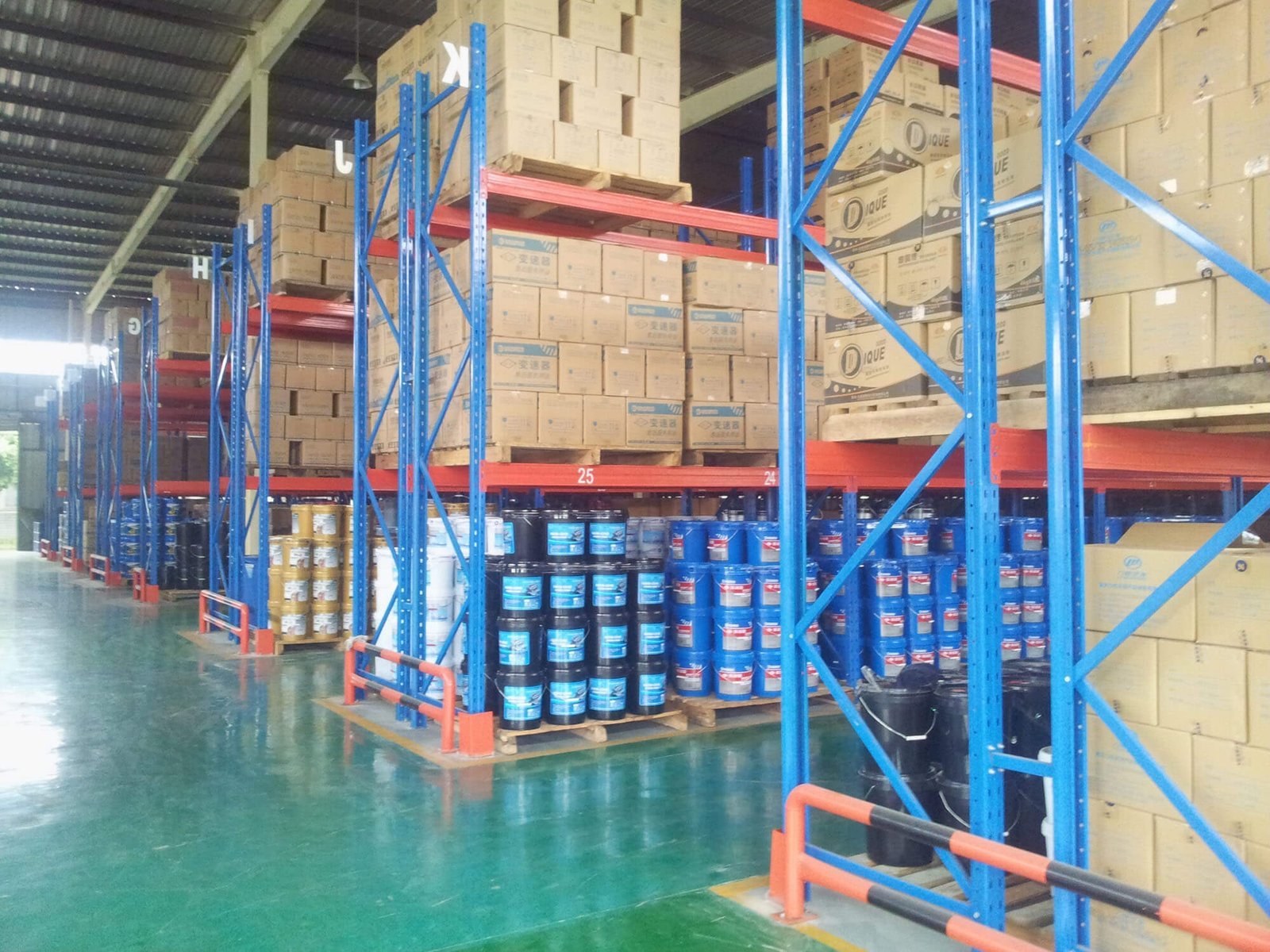
Heavy-duty racking is characterized by:
- Heavy steel structural sections — cold-rolled uprights of 1.5 to 3.0 mm gauge, box or step beams engineered for palletized loads
- Forklift-based access — every load is placed and retrieved by counterbalance, reach, or narrow-aisle forklift
- Bolted or welded assembly — professional installation with load calculations and anchoring
- Building integration — floor anchoring, sprinkler coordination, and clear-height utilization up to 30 meters or more
The category includes 選擇性托盤式儲存架, drive-in, push-back, pallet flow, shuttle, cantilever, and VNA systems — all of which store palletized inventory and require mechanical handling.
What Is Light-Duty Racking?
Light-duty racking is a warehouse or commercial storage system engineered for hand-loaded items typically weighing 50 to 300 kilograms per level, accessed manually rather than by forklift. It is used for cartons, small parts, retail merchandise, spare parts, tools, files, and any inventory picked and replaced by hand.
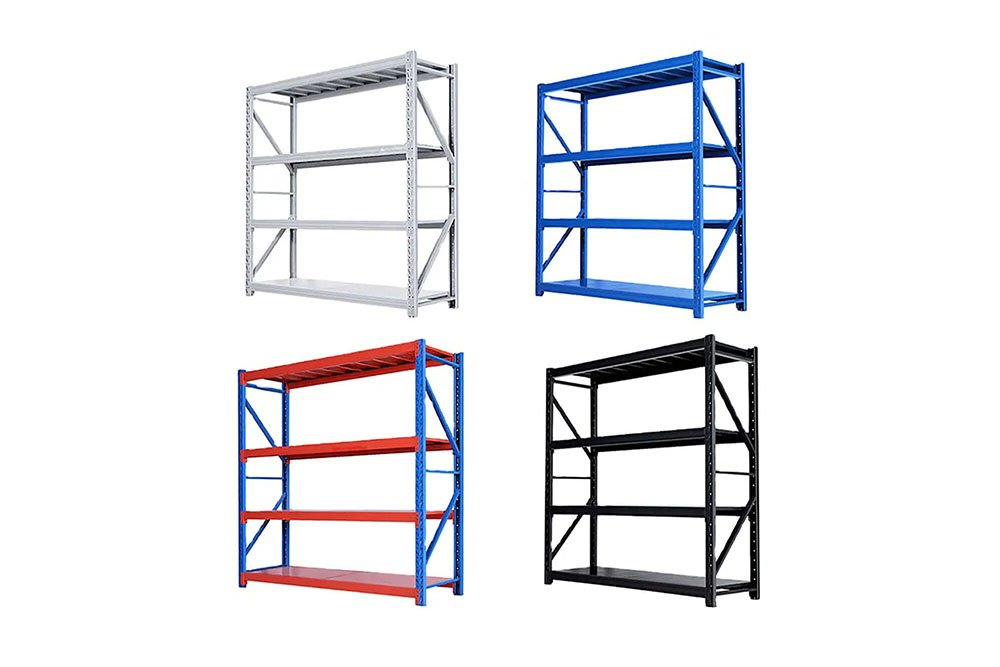
Light-duty racking is characterized by:
- Lighter structural sections — thinner cold-rolled steel columns, angle-iron frames, or wire mesh construction
- Manual access — operators load and pick by hand, from floor level or via a step ladder
- Boltless or slotted assembly — often installed without tools or with minimal fasteners
- Standalone or freestanding — usually placed on the floor without anchoring, though anchored to walls in taller configurations
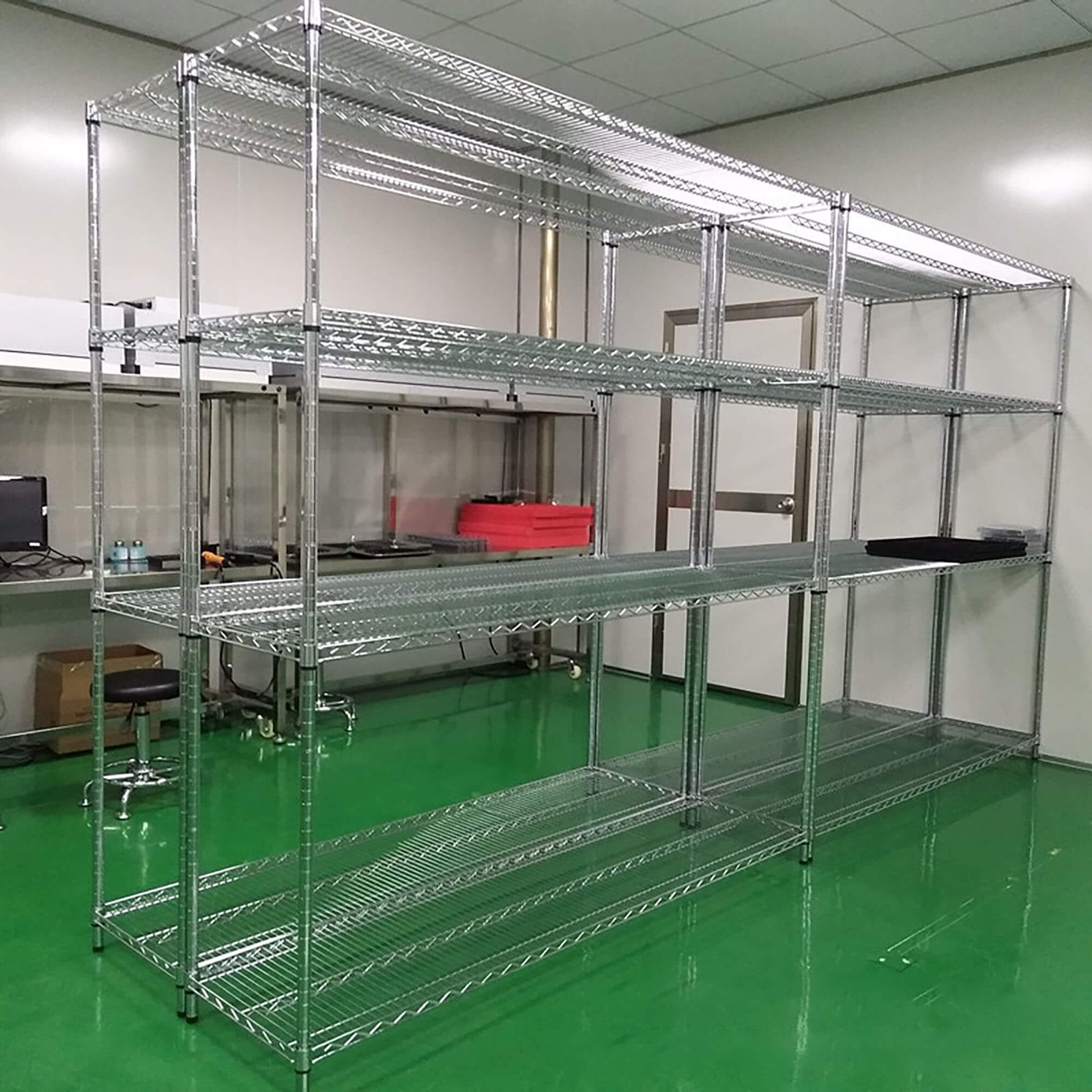
The category includes boltless racks, slotted angle racks, chrome wire shelving, stainless steel shelves, and general shelving units used in stockrooms, retail backrooms, and archive storage.
Core Differences: Heavy-Duty vs Light-Duty Racking
The two systems differ across 12 significant dimensions. Understanding each helps buyers match specification to actual application.
1. Load Capacity
Heavy-duty: 500 to 5,000+ kilograms per beam level, with typical selective racking rated at 1,500 to 3,500 kg UDL (uniformly distributed load) per beam pair.
Light-duty: 50 to 300 kilograms per shelf level, with wire shelving typically rated at 150 to 250 kg per shelf and boltless racks at 200 to 300 kg.
The load capacity gap reflects fundamentally different design intent — one system carries pallets, the other carries cartons and small items.
2. Access Method
Heavy-duty: Exclusively forklift or mechanical handling. Load heights of 3 to 30+ meters and load weights of hundreds to thousands of kilograms make manual handling impossible and unsafe.
Light-duty: Manual access only, either from floor level, from a small step, or occasionally with a rolling ladder for taller shelving. Forklifts do not enter light-duty racking zones and are not compatible with the shelf-based design.
This access method difference drives many downstream design decisions: aisle width, floor loading, safety clearances, and layout all follow from whether the racking is served by forklift or by hand.
3. Structural Design
Heavy-duty: Uprights consist of two cold-rolled columns connected by horizontal and diagonal bracing (Z, K, or D-bracing patterns), transferring load through base plates anchored to the concrete floor. Load beams span between uprights with multi-tab hook-in or bolted end connectors.
Light-duty: Columns are lighter cold-rolled sections or slotted angle iron. Shelves span between columns and provide the load-bearing surface directly, without separate load beams. Cross-bracing is minimal or absent in short configurations.
4. Materials and Construction
Heavy-duty: Q235B or Q345B structural steel, with column thicknesses of 1.5 to 3.0 mm. Beam profiles include box beam (closed rectangular), step beam (with a step for decking), and structural I-beam (for extreme loads). Welded and bolted joints throughout.
Light-duty: Cold-rolled steel of 0.6 to 1.5 mm gauge. Wire shelving uses steel wire welded into rigid grids. Boltless racks use interlocking clip connections; slotted angle racks use bolted connections through pre-punched holes.
5. Height and Size
Heavy-duty: Standard heights from 3 to 12 meters; high-bay configurations extend to 30 meters or more. Bay widths of 2.4 to 3.6 meters accommodate two or three pallets per level.
Light-duty: Typical heights of 1.8 to 3.0 meters — sized for manual reach without ladders. Bay widths of 0.9 to 1.8 meters match manual pick zones and standard carton dimensions.
6. Assembly and Installation
Heavy-duty: Professional installation required. Includes floor anchoring, load calculations, safety clearance verification, and load-notice posting. Installation crews use lifting equipment, alignment tools, and structural engineering documentation.
Light-duty: Self-assembly or minimal-tool assembly common. Boltless racks assemble by hand without any tools; slotted angle racks require basic hand tools. Floor anchoring is rare except for tall configurations. Wall anchoring may be used in retail environments.
7. Coating and Finish
Heavy-duty: Standard powder coating for ambient environments. Hot-dip galvanized available for cold storage, outdoor, or corrosive environments. Custom coatings for pharmaceutical or food-grade applications.
Light-duty: Powder coating is standard. Chrome plating for wire shelving; stainless steel for food, pharmaceutical, or clean-room applications. Coating durability is less critical because impact loads are minimal.
8. Application Environments
Heavy-duty: Distribution centers, manufacturing warehouses, third-party logistics facilities, cold storage, automotive parts warehouses, industrial storage, bulk retail backrooms.
Light-duty: Retail stockrooms, spare parts storage, office file storage, e-commerce piece-pick zones, kitchen and pharmacy shelving, workshop and garage storage, small warehouse operations.
9. Price
Heavy-duty: $80 to $250 per pallet position for standard selective racking, rising to $400 to $2,000+ for shuttle, VNA, mobile, or ASRS systems. Installation typically adds 15 to 25 percent. See the pallet rack prices and cost factors guide for detailed cost drivers.
Light-duty: $30 to $150 per bay for standard shelving units. Boltless racks and wire shelving are at the lower end; stainless steel shelving at the upper. Installation cost minimal or zero.
10. Installation Time and Cost
Heavy-duty: 30 to 60 days from order to installation for standard configurations; 60 to 120 days for custom projects. Professional installation crew required. Building preparation (floor flatness, sprinkler modification) may add lead time.
Light-duty: 7 to 21 days from order to delivery. Assembly by warehouse staff within hours or days. No specialized installation required.
11. Safety and Compliance
Heavy-duty: Governed by design standards including FEM 10.2.02 (Europe), ANSI MH16.1 and RMI requirements (North America), and AS 4084 (Australia/Asia). Load notices, periodic inspection schedules, and damage repair procedures are mandatory. Seismic and fire code compliance is part of the design.
Light-duty: Fewer formal standards apply, though load ratings should still be verified and observed. Fire code compliance is typically simpler because load values and heights are lower. Manual handling ergonomics is the primary safety consideration; the NIOSH ergonomic guidelines for manual material handling provide an authoritative reference for designing hand-loaded work.
12. Lifecycle and Maintenance
Heavy-duty: 15 to 25-year service life with regular inspection and maintenance. Forklift impact is the primary damage source; column protectors and rack guards extend service life. Damaged components should be repaired or replaced promptly.
Light-duty: 5 to 10-year typical service life. Damage sources include overloading, corrosion, and physical wear. Replacement is straightforward and often cost-effective versus repair.
Comparison Table: Heavy-Duty vs Light-Duty Racking
| Dimension | Heavy-Duty Racking | Light-Duty Racking |
|---|---|---|
| Load Capacity | 500 – 5,000+ kg per level | 50 – 300 kg per level |
| Access Method | Forklift / mechanical | Manual / hand-loaded |
| Steel Grade | Q235B / Q345B, 1.5 – 3.0 mm | Cold-rolled, 0.6 – 1.5 mm |
| Typical Height | 3 – 30+ meters | 1.8 – 3.0 meters |
| Bay Width | 2.4 – 3.6 m (2–3 pallets) | 0.9 – 1.8 m (cartons) |
| Assembly | Professional install, anchored | Boltless / DIY, freestanding |
| Coating | Powder / hot-dip galvanized | Powder / chrome / stainless |
| Applications | Distribution, industrial, cold storage | Retail, office, piece-pick |
| Price per unit | $80 – $2,000+ per pallet position | $30 – $150 per bay |
| Lead Time | 30 – 120 days | 7 – 21 days |
| Standards | FEM 10.2.02, MH16.1, AS 4084 | Manufacturer specification |
| Service Life | 15 – 25 years | 5 – 10 years |
| Building Requirements | Reinforced floor, height, sprinklers | Standard floor |
| Customization | Highly customizable | Standard sizes primarily |
Application Scenarios
When to Choose Heavy-Duty Racking
- Palletized inventory with unit loads of 300 kg or more per pallet
- High-volume operations where forklift-based handling delivers throughput
- Vertical storage requiring heights of 4 meters or more
- Distribution centers, manufacturing warehouses, cold storage, 3PL operations
- Long-term facilities where 15 to 25-year service life justifies capital investment
- Regulated industries requiring documented structural compliance
When to Choose Light-Duty Racking
- Carton or piece-level inventory with unit loads under 50 kg
- Manual picking operations for e-commerce, retail, spare parts, or office use
- Short-height storage where operators can reach items without mechanical assistance
- Retail stockrooms, workshops, archives, kitchen storage, pharmacies
- Temporary or evolving spaces where flexibility and low capital cost outweigh long-term durability
- Small-scale operations without forklift infrastructure
When to Combine Both in One Facility
Most modern warehouses run both systems concurrently:
- Pallet zones use heavy-duty racking for bulk storage and full-pallet operations
- Pick modules integrate light-duty shelving with mezzanine floors for piece-picking
- Backroom or auxiliary storage uses light-duty racking for supplies, tools, spare parts, and archives
The two systems complement rather than compete — each serves the inventory profile it was designed for.
Medium-Duty Racking as Middle Ground
Between the two extremes sits medium-duty racking, designed for loads of 300 to 800 kg per level. Medium-duty systems bridge the gap between hand-loaded shelving and forklift-served pallet racking, and are typically used for:
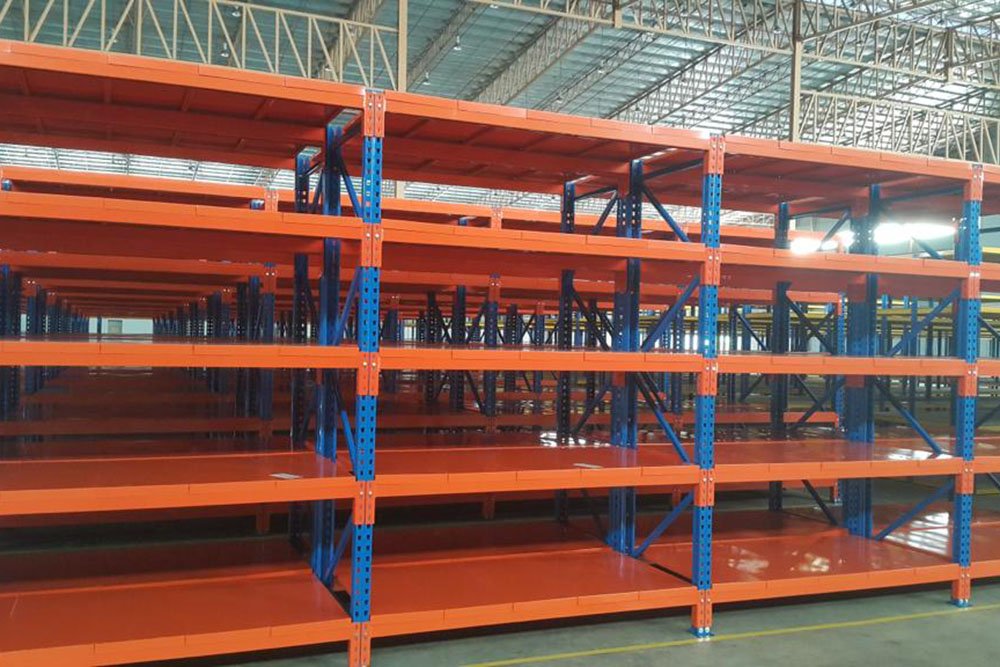
- Semi-heavy hand-loaded items (large cartons, small equipment)
- Mezzanine floor storage where full pallet capacity is not required
- Long-span shelving for automotive parts, workshop tools, or bulk retail
- Applications where pallet jacks or manual pallet trucks are used instead of forklifts
Medium-duty racking is often overlooked but frequently the correct choice when neither light-duty nor heavy-duty fits the operational profile.
Price Comparison in Detail
Cost differences between heavy-duty and light-duty racking extend beyond unit price into total cost of ownership.
| Cost Component | Heavy-Duty | Light-Duty |
|---|---|---|
| Equipment (per bay) | $200 – $600 | $30 – $150 |
| Installation | Professional, 15 – 25% of equipment | Included in bay cost |
| Building preparation | Floor slab, sprinklers, forklift access | Minimal |
| Forklift infrastructure | Required (fleet + charging + maintenance) | Not required |
| Inspection and compliance | Annual expert inspection | Visual only |
| Maintenance / repair | Column protectors, replacement parts | Replacement of damaged units |
| Service life | 15 – 25 years | 5 – 10 years |
For a 500-square-meter storage area, heavy-duty racking with associated forklift fleet may cost 5 to 10 times more than an equivalent light-duty installation. The comparison is only meaningful, however, when both systems could serve the same inventory — which is rarely the case.
Warehouse Planning Recommendations
1. Match racking type to inventory unit load, not to available budget. Under-specifying heavy-duty operations with light-duty racking creates safety risk and premature failure. Over-specifying light-duty operations with heavy-duty racking wastes capital and adds unnecessary complexity.
2. Consider access method as the primary design determinant. Whether inventory is picked by hand or by forklift shapes every downstream decision — aisle width, floor loading, safety clearances, building height utilization. Access method matters more than load capacity in most decision paths.
3. Design pick modules with light-duty racking on mezzanines. Piece-pick and case-pick zones typically use light-duty racking integrated with mezzanines rather than heavy-duty pallet racking. This maximizes pick face density and reduces operator travel.
4. Reserve heavy-duty zones for genuine pallet inventory. Storing cartons on heavy-duty racking wastes 60 to 80 percent of the capital investment. Segment the warehouse so heavy-duty racking serves pallet volumes and light-duty racking serves piece volumes.
5. Evaluate medium-duty as a middle-ground option. For operations with mid-weight items and pallet-jack handling, medium-duty racking often outperforms both alternatives on cost and fit.
6. Plan safety and compliance appropriate to system. Heavy-duty racking requires inspection procedures, damage protocols, and load-notice documentation. Light-duty racking should still be inspected periodically for corrosion, overloading, and stability but at lower formal rigor.
7. Consider total cost of ownership, including infrastructure. Heavy-duty racking is not just the racks themselves — it includes forklift fleet, floor preparation, sprinkler modification, and inspection. Total cost may exceed equipment cost by 2 to 3 times.
How to Choose Between Heavy-Duty and Light-Duty Racking: Framework
Step 1 — Classify inventory unit load. Determine whether items are palletized (500 kg+) or hand-loaded (under 300 kg per unit). Anything in between merits medium-duty evaluation.
Step 2 — Determine access method. Forklift access mandates heavy-duty; manual access mandates light-duty. Mixed operations require both, in segmented zones.
Step 3 — Analyze storage volume and height. High-volume, high-bay storage justifies heavy-duty investment. Low-volume, low-height storage suits light-duty.
Step 4 — Verify building capability. Heavy-duty racking requires reinforced floors, clear height, and sprinkler compatibility. Light-duty racking works in standard buildings without modification.
Step 5 — Map application zones. Segment the warehouse into pallet zones (heavy-duty), pick modules (light-duty on mezzanines), and auxiliary storage (light-duty). Design each zone to its inventory profile.
Step 6 — Model total cost of ownership. Include equipment, installation, forklift infrastructure, compliance, maintenance, and replacement over 15 to 25 years.
Step 7 — Confirm safety and compliance. Verify heavy-duty racking meets FEM, MH16.1, or AS 4084 standards. Verify light-duty load ratings match intended use.
FAQ
1. What is the main difference between heavy-duty racking and light-duty racking? Load capacity is the visible difference, but access method is the more fundamental distinction. Heavy-duty racking is designed for forklift access and palletized loads of 500 kg or more per level; light-duty racking is designed for manual access and hand-loaded items of 50 to 300 kg per level. This access method difference drives structural design, materials, height, and layout.
2. Can heavy-duty racking be used for light-duty applications? Physically yes, but economically no. Using heavy-duty racking for cartons or small items wastes 60 to 80 percent of the capital investment and adds unnecessary building infrastructure. It also occupies floor space inefficiently because heavy-duty bay widths are optimized for pallets, not cartons.
3. Can light-duty racking be used for heavy loads? No, and doing so creates serious safety risk. Light-duty racking is engineered for specific load ratings; exceeding those ratings causes structural failure, potentially injuring operators and damaging inventory. Always verify load capacity against actual item weights.
4. What is the price difference between heavy-duty and light-duty racking? Heavy-duty racking costs 3 to 20 times more than equivalent light-duty racking depending on system type. Selective heavy-duty racking may cost $200 to $600 per bay; a light-duty shelving unit of similar footprint costs $30 to $150. Total facility cost differential is larger when forklift infrastructure and building preparation are included.
5. Do I need a forklift for heavy-duty racking? Yes. Heavy-duty racking is designed exclusively for forklift or mechanical access. Load heights and weights make manual handling impossible and unsafe. The forklift specification (counterbalance, reach, VNA turret) must be matched to the racking type before installation.
6. What is medium-duty racking, and when should I choose it? Medium-duty racking handles loads of 300 to 800 kg per level, bridging the gap between light-duty shelving and heavy-duty pallet racking. It suits operations with mid-weight hand-loaded items, mezzanine floor storage, and applications using pallet jacks rather than forklifts.
7. How long does each system last? Heavy-duty racking typically lasts 15 to 25 years with regular inspection and damage repair. Light-duty racking typically lasts 5 to 10 years, limited by lighter construction and less rigorous maintenance schedules. Actual service life depends on load cycles, environment, and impact damage.
8. Can I install light-duty racking myself? Yes. Boltless racks, wire shelving, and slotted angle racks are designed for self-assembly and require only basic tools or no tools at all. Heavy-duty racking, by contrast, requires professional installation with load calculations, floor anchoring, and safety verification.
Key Takeaways
- Heavy-duty and light-duty racking differ across 12 dimensions — load capacity, access method, structural design, materials, height, assembly, coating, application, price, installation, safety standards, and lifecycle.
- Access method (forklift versus manual) is the most fundamental distinction and shapes every other design decision.
- Heavy-duty racking is engineered for palletized inventory, forklift access, and 15 to 25-year service life; light-duty racking is engineered for hand-loaded items, manual access, and 5 to 10-year service life.
- Most modern warehouses run both systems concurrently — heavy-duty for pallet storage, light-duty on mezzanines and in pick modules for piece picking.
- Medium-duty racking bridges the two extremes and is often the correct choice for mid-weight, hand-loaded applications.
Conclusion
The choice between heavy-duty racking and light-duty racking is rarely binary. Most warehouses need both, deployed in the zones and applications each was engineered to serve. Under-specifying heavy operations with light-duty racking creates safety risk; over-specifying light operations with heavy-duty racking wastes capital. The correct approach is to segment inventory by unit load and access method, then match racking specification to each segment.
Buyers matching racking specifications to warehouse operational profiles frequently review suppliers such as Gieantech when comparing heavy-duty pallet configurations against light-duty shelving options across the same facility layout, ensuring both systems are specified to correct load ratings, dimensional standards, and lifecycle requirements without over-investing in either category.
 English
  Spanish
  Arabic
  Tagalog
  Korean
  Russian
  Thai
Thai  Japanese
  Indonesian
  Portuguese
  French
  Chinese